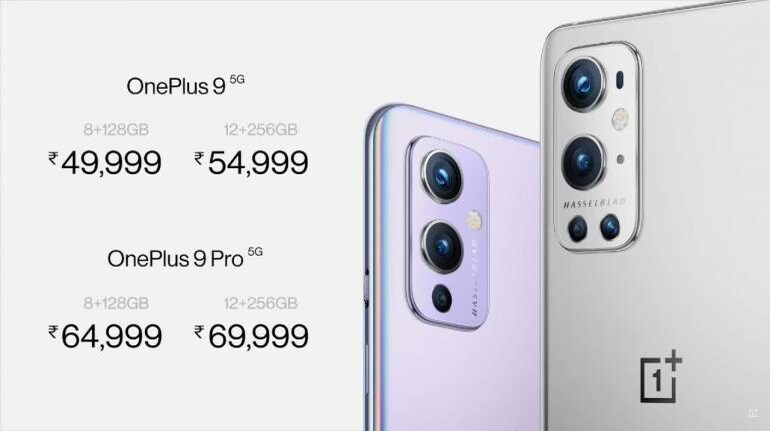
As OnePlus has grown as a company, its product lines have evolved with it and to think…that OnePlus started with just one product. The main draw for people of course, is the yearly upgrade to the main OnePlus series, the 9 and the 9 Pro. The popular smartphones have managed to maintain a good balance between price and features.
Like with every year, OnePlus 9 features several new improvements and refinements but how does it compare against the last big line-up?
| OnePlus 8 | OnePlus 8 Pro | OnePlus 9 | OnePlus 9 Pro | |
| Operating System | Oxygen OS 11 (Android 11) | Oxygen OS 11 (Android 11) | Oxygen OS 11 (Android 11) | Oxygen OS 11 (Android 11) |
| Processor | Qualcomm Snapdragon 865 (7nm) | Qualcomm Snapdragon 865 (7nm) | Qualcomm Snapdragon 888(5nm) | Qualcomm Snapdragon 888(5nm) |
| RAM | 8GB/12GB LPDDR4X | 8GB/12GB LPDDR5 | 8GB/12GB LPDDR5 | 8GB/12GB LPDDR5 |
| Storage | 128GB/256GB UFS 3.0 | 128GB/256GB UFS 3.0 | 128GB/256GB UFS 3.1 | 128GB/256GB UFS 3.1 |
| COMM's | (Wi-Fi) 802.11 a/b/g/n/ac/6, dual-band, Wi-Fi Direct, DLNA, hotspot, Bluetooth 5.1, A2DP, LE, aptX HD, USB Type-C 3.1 | (Wi-Fi) 802.11 a/b/g/n/ac/6, dual-band, Wi-Fi Direct, DLNA, hotspot, Bluetooth 5.1, A2DP, LE, aptX HD, USB Type-C 3.1 | 2x2 MIMO, Wi-Fi 802.11 a/b/g/n/ac/ax, 2.4G/5G, Wi-Fi 6, Bluetooth 5.2, supports aptX, HD, LDAC, AAC, USB Type-C 3.1 | 2x2 MIMO, Wi-Fi 802.11 a/b/g/n/ac/ax, 2.4G/5G, Wi-Fi 6, Bluetooth 5.2, supports aptX, HD, LDAC, AAC, USB Type-C 3.1 |
| Display | 6.5-inch Fluid AMOLED, 90Hz, HDR10+, 402ppi | 6.7-inch Fluid AMOLED, 1B colours, 120Hz, HDR10+, 513 ppi | 6.5-inch Fluid AMOLED, sRGB, P3, 120Hz, 402 ppi | 6.7-inch Fluid AMOLED with LTPO, sRGB, P3, 10-bit colour depth, 120Hz, 525 ppi |
| Battery | 4300 mAh, 50W fast charging | 4510 mAh, 50W fast charging, 30W wireless charging | 4500 mAh, Warp Charge 65T (10V/6.5A), 15W Qi wireless charging | 4500 mAh, Warp Charge 65T (10V/6.5A), Warp Charge 50 Wireless (Input:10V/6.5A, 20V/3.25A, Output:50W max) |
| Rear Camera | 48 MP, f/1.8, 26mm (wide), 1/2.0", 0.8µm, PDAF, OIS 16 MP, f/2.2, 14mm, 116˚ (ultrawide), 1/3.6", 1.0µm 2 MP, f/2.4, (macro) | 48 MP, f/1.8, 25mm (wide), 1/1.43", 1.12µm, omnidirectional PDAF, Laser AF, OIS 8 MP, f/2.4, (telephoto), 1/1.0µm, PDAF, OIS, 3x optical zoom 48 MP, f/2.2, 14mm, 116˚ (ultrawide), 1/2.0", 0.8µm, PDAF 5 MP, f/2.4, (Colour filter camera) | 48 MP, f/1.8, 23mm (wide), 1/1.43”, 1.12 μm/48M 2.24 μm (4in 1)/12M No OIS, only EIS 50 MP, f/2.2, 14mm, freeform lens, 1/1.54” (Ultrawide) 2 MP monochrome sensor Dual LED Flash Multi Autofocus (All pixel omni-directional PDAF+CAF) | 48 MP, f/1.8, 23mm (wide), 1/1.43”, 1.12 μm/48M 2.24 μm (4in 1)/12M Both OIS and EIS 8 MP, f/2.4, (telephoto), 1/1.0µm, PDAF, OIS, 3x optical zoom 50 MP, f/2.2, 14mm, freeform lens, 1/1.54”(Ultrawide) 2 MP monochrome sensor Dual LED Flash Multi Autofocus (All pixel omni-directional PDAF+CAF) |
Let us get the low hanging fruit out of the way first. As far as specifications go, OnePlus 9 obviously has the better hardware. The OnePlus 9 and 9 Pro both run on Qualcomm’s Snapdragon 888 SoC which was unveiled late last year. This is the company’s signature 5nm chipset and has one Kryo 680 Prime core clocked at 2.84 GHz, three Kryo 680 gold performance cores clocked at 2.42 GHz and four Kryo 680 Silver efficiency cores clocked at 1.8 GHz. There is also the Adreno 660 GPU that has thirty-three times faster graphics rendering performance and is twenty percent more efficient. Qualcomm’s new SoC is also 5G compatible with a dedicated X60 5G Modem. This is a huge jump compared to the Snapdragon 865 SoC present on the previous iterations.
Paired with the SoC will be either 8GB or 12GB of LPDDR5 RAM. This is on par with what was available with the last iteration as well. Your options for storage are also similar with choices between either 128GB of internal storage or 256GB. The OnePlus 8 and 8 Pro launched with Android 10 but have since received two beta builds for Oxygen OS 11 that is built on top of Android 11. Both phones do not have a final, stable release yet but that should change once OnePlus 9 starts arriving on the store shelves. The latest OnePlus 9 phones both ship with Android 11 out of the box.
Both phones retain their stereo speakers but now come with Dolby Atmos certification because it just would not be right for an Android flagship to not have that as a bullet point these days. Interestingly, both the OnePlus 9 and 9 Pro now also feature noise cancellation support. As for networks, the new OnePlus 9’s obviously come with 5G support.
Compared to the OnePlus 8 series, both the 9 and 9 Pro now have improved Bluetooth 5.2 support and have also added support for 2X2 MIMO bands for WiFi and WiFi 6. This is on top of support for 802.11 a/b/g/n/ac/ax plus both 2.5GHz and 5GHz frequencies.
What has changed is the disparity in the battery sizes between OnePlus 8 and 8 Pro. The OnePlus 8 had a 4300 mAh battery and the 8 Pro housed a 4510 mAh battery. Both phones supported 30W fast charging but only the 8 Pro had support for 30W wireless charging.
The OnePlus 9 and 9 Pro now have a standardised 4500 mAh battery. The differences are in the way you can charge the batteries. The OnePlus 9 has support for 65W fast charging and 15W wireless charging. The OnePlus 9 Pro does one better by including support for 50W wireless charging. Both phones come with a 65W Warp Charge Power Adapter included in the box.
Also Read: OnePlus 9 Pro, OnePlus 9R, OnePlus 9 price in India announced
DisplayWith the basic nitty-gritties out of the way, let us now turn our attention to the display. Last year OnePlus had kitted both the 8 and 8 pro with AMOLED Displays. The 8 had a 90Hz screen whereas the 8 Pro had a super high resolution, HDR 10+ certified, 120Hz panel. The 8 had a 6.5-inch screen whereas the 8 pro had a 6.7-inch screen.
This year, OnePlus 9 follows a similar template but with more bang for your buck. On the base OnePlus 9, you get a 6.5-inch, 2400*1080, AMOLED display with a refresh rate of 120 Hz. The panel also has support for sRGB and P3 colour gamut’s. The 9 Pro increases the screen size to 6.7-inches and has a resolution of 3216*1440. The panel is also AMOLED but with a Low-temperature polycrystalline oxide (LTPO) backplane first developed by Apple for use in its iPhones. It also adds 10-bit colour depth to its colour gamut options.
CameraPossibly the most talked about thing for any smartphone these days. The rear camera module on the 9 and the 9 Pro has seen some upgrades compared to the OnePlus 8 and 8 Pro. While the phones retain the same 48-megapixel primary sensor with an f/1.8 aperture, the differences are in the minute details. The OnePlus 9 now has a pixel size of 1.12μm compared to the OnePlus 8 with its 0.8μm pixel size. The OnePlus 8 Pro and the 9 Pro both now have similar pixel sizes at 1.12μm.
The OnePlus 9 is sadly missing optical image stabilisation (OIS) that the 9 Pro has which even the OnePlus 8 base model had. This has been replaced with electronic image stabilisation (EIS) on the base OnePlus 9, thankfully the 9 Pro has support for both OIS and EIS.
The ultra-wide sensor is 50-megapixels on both phones, compared to 16-megapixels on the base 8 model and 48-megapixel on the 8 Pro. Like last year, the base OnePlus 9 tops out with an additional 2-megapixel monochrome camera and has no telephoto lens similar to the base 8 model from last year. Like the 8 pro last year, the OnePlus 9 Pro has an additional 8-megapixel telephoto lens with an f/2.4 aperture.
The video capabilities of both OnePlus 9 phones have also seen a major upgrade. You can now record 8K video at 30fps on both phones. 4K video tops out at 60fps on the OnePlus 9 but the 9 Pro can do 4K at 120fps as well. Super Slow Motion is same across both phones with support for 720p video at 480fps, 1080p video at 240fps and the ability to shoot time-lapses at either 1080p 30fps or 4K 30fps.


Discover the latest Business News, Sensex, and Nifty updates. Obtain Personal Finance insights, tax queries, and expert opinions on Moneycontrol or download the Moneycontrol App to stay updated!
Find the best of Al News in one place, specially curated for you every weekend.
Stay on top of the latest tech trends and biggest startup news.