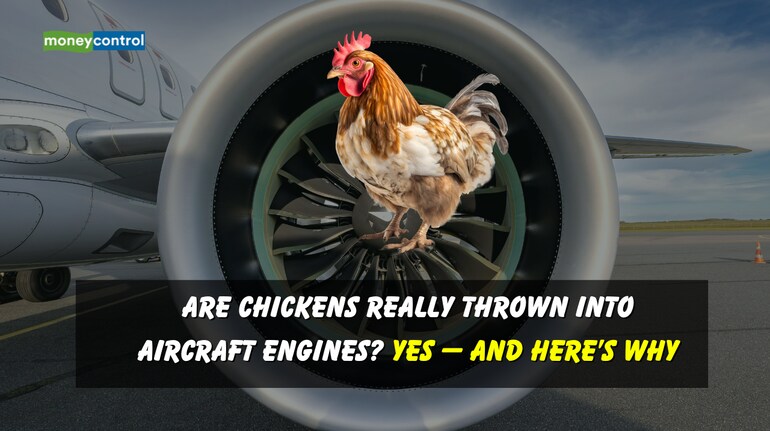
For lakhs of Indian air passengers, the journey begins and ends at bustling hubs like Delhi, Mumbai, and Bengaluru. While the focus is often on flight schedules and fares, a critical safety procedure, decades in the making, plays a silent role in ensuring every take-off and landing is secure. This procedure involves a surprising element: the deliberate firing of dead chickens at jet engines using a specialized cannon.
This test, known formally as a bird strike simulation, is neither a myth nor an exaggeration. It is a mandatory, globally recognized certification process. Its singular purpose is to guarantee that if an aircraft collides with birds during flight—a genuine and increasing risk—its most vital components, the engines and the cockpit windshield, can survive the impact without failing catastrophically.
The origins of this practice trace back to the 1950s and the British aerospace company de Havilland. As jet engines became more common, so did the serious threat posed by bird collisions. Engineers needed a reliable way to simulate these high-impact events on the ground. Their solution was to create a large compressed-air cannon, dubbed the "chicken gun." They loaded it with whole, dead chickens, whose mass and density closely mimic many common bird species, and fired them directly at test engines and aircraft canopies at speeds replicating those of take-off and landing.
Today, this remains a cornerstone of aviation safety. Before any new engine model is approved for commercial use, it must demonstrate it can "ingest" a large bird. The engine must contain all the resulting debris within its robust casing and either continue to operate safely or shut down in a controlled manner without breaking apart. The windshield, for its part, must not crack or shatter in a way that would endanger the pilots or depressurize the cockpit.
This rigorous testing is particularly pertinent for the Indian aviation sector today. Recent data from the Ministry of Civil Aviation paints a concerning picture: bird strikes are rising sharply at the country's major airports. From 2020 through the first half of 2025, close to 2,800 such incidents were recorded across just ten major airports. The numbers show a clear upward trajectory after the pandemic lull, climbing from 309 incidents in 2020 to a peak of 709 in 2023.
Delhi's Indira Gandhi International Airport reported the highest number at 695 incidents. It was followed by Mumbai's Chhatrapati Shivaji Maharaj International Airport with between 405 and 407 incidents, and Bengaluru's Kempegowda International Airport with 343, making it the most affected in South India. Aviation professionals and reports link this rise directly to two key factors: the massive post-pandemic recovery in flight operations and the rapid urban and industrial development encroaching on airport boundaries. This development, including new construction and waste disposal sites near facilities like the Bengaluru airport, disrupts local bird habitats and inadvertently draws wildlife into critical flight paths.
In response, Indian airport operators implement comprehensive Wildlife Hazard Management Plans, aligned with international standards. The approach is multi-faceted. Airfield teams engage in active deterrence, using specialized equipment that emits predator calls and distress signals, as well as lasers and pyrotechnics, to disperse birds. Proactive habitat management is crucial; grass on airfields is meticulously maintained at a precise height to discourage insects and rodents, which attract birds, while water drainage is controlled to remove potential feeding grounds. Advanced airports also employ real-time monitoring, sometimes using radar, to track bird movements. Furthermore, recognizing that the challenge extends beyond the perimeter fence, airports coordinate with local communities on awareness campaigns focused on proper waste management, as garbage dumps are a significant attractant for bird populations.
It is important to maintain perspective on the actual risk. The vast majority of bird strikes result in no damage or only minor, non-critical damage to the aircraft. However, the potential for severe consequences escalates with the size and number of birds involved. This is why the multi-layered strategy—combining the proven resilience of certified engines, thanks in part to the unconventional chicken gun test, with diligent, daily management on the airfield—is so vital.
For the Indian traveller, this narrative connects a little-known global engineering ritual to a visible, growing challenge at home. As the nation's air traffic continues its record-breaking growth, the unseen work of wildlife controllers on the ground and the proven fortitude of aircraft engines work in tandem to ensure that the journey through the skies remains as safe as possible.

Discover the latest Business News, Sensex, and Nifty updates. Obtain Personal Finance insights, tax queries, and expert opinions on Moneycontrol or download the Moneycontrol App to stay updated!
Find the best of Al News in one place, specially curated for you every weekend.
Stay on top of the latest tech trends and biggest startup news.