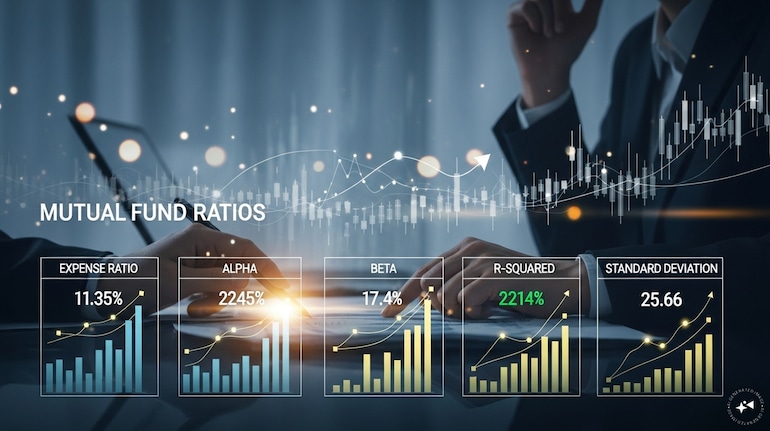

When investors compare mutual funds, the first number they often look at is returns. If one fund shows 18 percent and another 14 percent, the higher-return option seems like the obvious choice.
But returns alone don’t always reveal how a fund actually performed.
Two funds can generate similar returns but take different levels of risk to achieve them. One may experience sharp swings during market volatility, while another may deliver stable performance. Costs also play a role, higher expenses can gradually reduce long-term gains.
This is where mutual fund ratios come in handy. They help investors understand how risky a fund is, how efficiently it generates returns and whether the costs involved are reasonable.
Why returns alone don’t tell the full story
Consider two mutual funds with similar long-term returns. One fund may deliver around a 15 percent annual return but with sharp fluctuations, while another may generate around 14 percent with much lower volatility and better risk-adjusted performance.
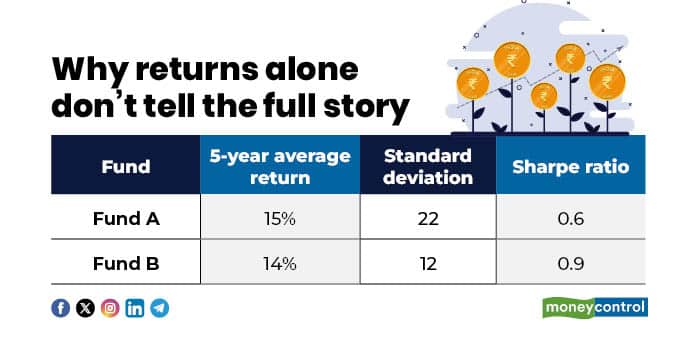
At first glance, Fund A looks better because of higher returns. However, Fund B delivers more stable returns and better risk-adjusted performance, as reflected in its lower volatility and higher Sharpe ratio.
Key mutual fund ratios investors should know
1. Beta: Measuring sensitivity to market movements
Beta indicates how closely a mutual fund moves in relation to the broader market.
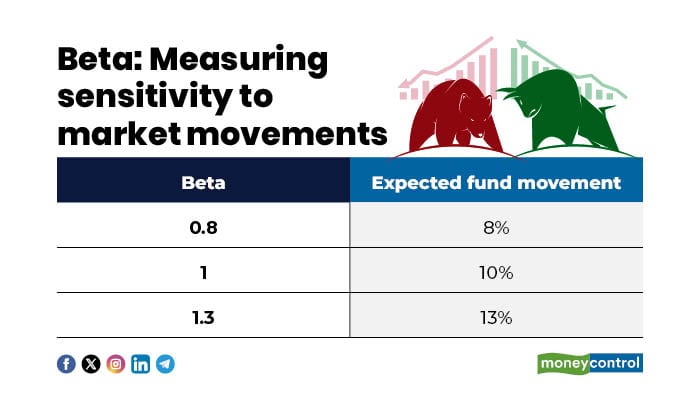
• Beta = 1: Fund moves broadly in line with the market
• Beta > 1: Fund tends to move more sharply than the market
• Beta < 1: Fund tends to be less volatile than the market
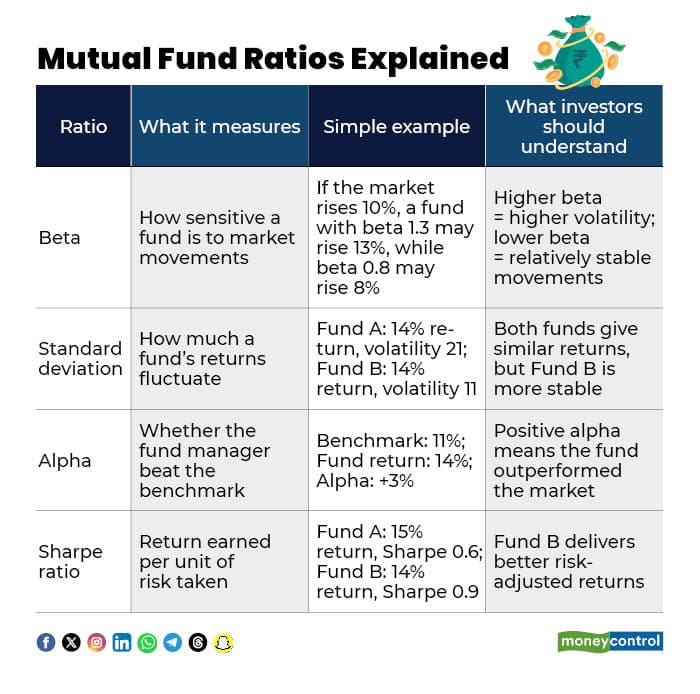
For instance, if the benchmark index rises 10 percent, a fund with beta 1 may also gain around 10 percent, while a fund with beta 1.3 could rise roughly 13 percent. The same logic also applies during market declines, when higher beta funds can fall more sharply.
According to Vijay Maheshwari, CWM, founder Stocktick Capital, retail investors choosing diversified equity funds should ideally look for a beta between 0.9 and 1.1.
“A beta close to 1 means the fund moves broadly with the market, avoiding excessive volatility. For example, if the Nifty rises 10 percent, a fund with beta 1 is expected to move similarly, balancing growth with risk,” he said.
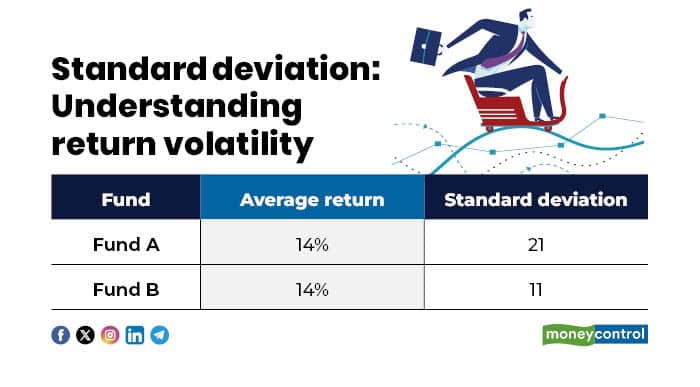
2. Standard deviation: Understanding return volatility
Standard deviation measures how much a fund’s returns fluctuate around its average return.
• Higher standard deviation - larger fluctuations
• Lower standard deviation - more stable returns
Two funds, for instance, may deliver around 14 percent average annual returns but one could see significantly larger swings than the other. Funds with lower volatility are often better for investors during corrections.
3. Alpha: Evaluating the fund manager’s performance
Alpha measures a mutual fund's excess return relative to its benchmark index..
• Positive alpha: The fund delivered returns above the benchmark
• Negative alpha: The fund underperformed the benchmark
If the benchmark delivers 11 percent returns and the fund generates 14 percent, the fund has produced an alpha of 3 percent. Investors, however, should look for consistency rather than short-term outperformance.
Maheshwari suggests tracking alpha over at least three to five years before drawing conclusions. “If a fund consistently delivers 2-3 percent higher returns than the Nifty over five years, it indicates a reliable and disciplined investment process,” he said.
4. Sharpe ratio: Assessing risk-adjusted returns
The Sharpe ratio helps investors evaluate whether the returns generated by a fund justify the level of risk taken.
A higher Sharpe ratio indicates better risk-adjusted performance.
For instance, Fund A may generate 15 percent returns with a lower Sharpe ratio, while Fund B may deliver 14 percent returns with a higher Sharpe ratio.
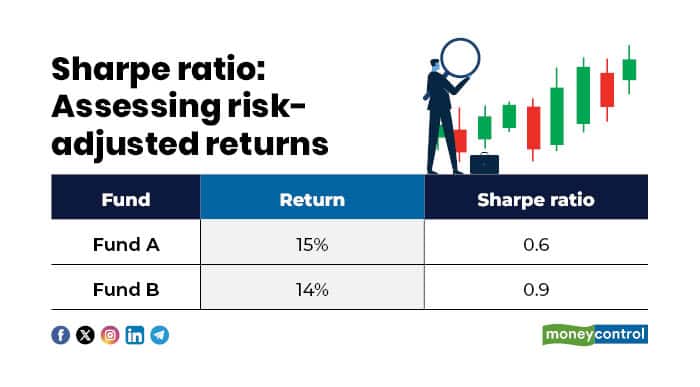
Although Fund A shows slightly higher returns, Fund B offers better risk-adjusted performance, as it generates returns more efficiently relative to the level of risk taken.
5. Expense ratio: The cost investors often overlook
The expense ratio represents the annual fee charged by a mutual fund to manage the scheme.
Even small differences in cost can significantly affect long-term returns due to compounding.
For example, if an investor puts Rs 5 lakh into two funds for 15 years, both generating 12 percent annual returns before costs, a fund with a 2 percent expense ratio could leave the investor with several lakhs less than a similar fund charging 1 percent.
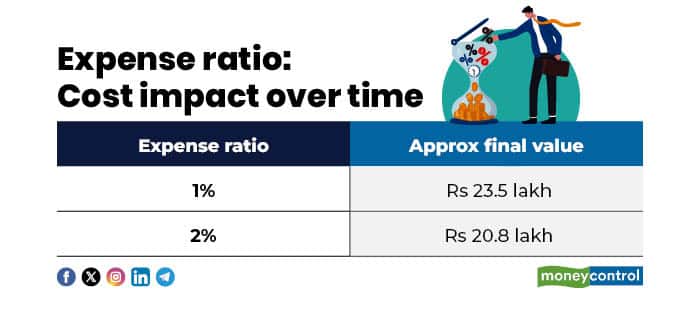
“Within the same category, an expense ratio difference of 0.5-1 percent annually is meaningful. Over long periods, this compounds significantly ,” he said.
While returns are important, they do not offer a complete picture. Metrics such as beta, standard deviation, alpha, Sharpe ratio and expense ratio help investors understand risk, volatility, cost and efficiency.
Disclaimer: The views and investment tips expressed by experts on Moneycontrol.com are their own and not those of the website or its management. Moneycontrol.com advises users to check with certified experts before taking any investment decisions.Discover the latest Business News, Sensex, and Nifty updates. Obtain Personal Finance insights, tax queries, and expert opinions on Moneycontrol or download the Moneycontrol App to stay updated!
Find the best of Al News in one place, specially curated for you every weekend.
Stay on top of the latest tech trends and biggest startup news.