-
Mars is changing and a hidden volcano could be driving it—Here's what scientists found
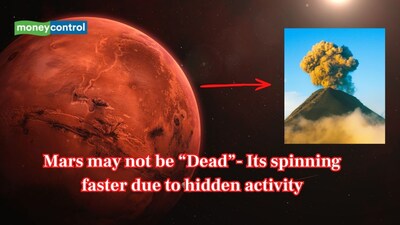
Mars is spinning slightly faster each year, and scientists believe solar system's largest vocano Olympus Mons is speeding it up. Scientists believe that hot magma could still be slowly rising beneath this region.
-

Volcano Kilauea erupts for the 43rd time with lava fountains reaching just over 300 feet in Big Island
One of Earth’s most active volcanoes, Kīlauea, has erupted again for the 43rd time in Hawai's Big Island. USGS reported the lava fountain reached up to 300 feet. Scientists have issued ashfall alert in the nearby areas.
-
Rare Geological Event: A mud volcano in Diglipur, Andaman Islands erupts after years, scientists put on alert
A long-dormant mud volcano erupted in Diglipur, Andaman Islands, prompting safety restrictions. Officials have cordoned off the site as scientists monitor continuing geological activity.
-
A supermassive black hole reawakens after 100-million-years like a cosmic volcano in distant universe
Scientists observed a supermassive black hole awaken after 100 million years, launching plasma jets across a million light-years like a cosmic volcano, revealing secrets of dormant black hole behavior.
-
Science explained behind this Indonesian volcano that glows bright in "blue" colour
Indonesia’s Kawah Ijen volcano appears to glow electric blue at night, but the colour does not come from lava. Instead, burning sulphur gases create this rare and dangerous natural spectacle.
-
Iran’s sleeping volcano, Taftan show signs of awakening after 700,000 years
After 700,000 years of near silence, Iran’s Taftan volcano is showing signs of underground movement. Satellite data reveals rising ground, prompting scientists to closely monitor the ancient giant.
-
Volcanic ash plumes impact flight services; Air India cancels flights, inspects aircraft
Air India said it has cancelled four flights on Tuesday -- AI 2822 (Chennai-Mumbai), AI 2466 (Hyderabad-Delhi), AI 2444 / 2445 (Mumbai-Hyderabad-Mumbai) and AI 2471/2472 (Mumbai-Kolkata-Mumbai).
-
Ashes of Hayli Gubbi volcano reaches India, affecting air quality and flights
Ethiopia’s Hayli Gubbi volcano erupted after thousands of years, sending ash clouds over India, disrupting flights, and raising air pollution concerns.
-
This underwater volcano off Oregon coast delays eruption until 2026
Scientists have delayed predictions for Axial Seamount’s next eruption off Oregon’s coast, now expecting it no earlier than mid-to-late 2026.
-
Why do Volcanoes erupt? The explosive science explained simply
Discover why volcanoes erupt, how magma and gas pressure trigger eruptions and the role of tectonic plates in explosive volcanic activity.
-
India's lone active volcano erupts again in Barren Island | In Pics
Barren Island is South Asia’s only active volcano and is situated about 140km northeast of Port Blair.
-
Philippines' Canlaon Reopens Tourism Sites After Kanlaon Volcano Alert Downgrade – All You Need to Know
Canlaon City in Negros Oriental has reopened its tourist sites following the downgrade of Kanlaon Volcano alert to Level 2. Visitors can now safely explore waterfalls, hiking trails, and scenic volcano vistas in this Philippine city.
-
10 active volcanoes around the world you can actually climb
Climbable active volcanoes around the world—from Ecuador’s Cotopaxi to Sicily’s Mount Etna—offering guided ascents and breathtaking summit views.
-
10 Pacific Countries That Are Volcanic Hotspots
Explore 10 Pacific countries that are volcanic hotspots in 2025. From Indonesia to the United States, discover the raw beauty of Earth’s most powerful landscapes.
-
Sicily’s Mount Etna Volcano Erupts Fiercely, Spewing Ash and Smoke: See Pics
On June 2, Mount Etna erupted fiercely, sending ash and lava flows high into the sky. Tourists fled, flights were alerted, and summit access was restricted for safety.
-
Mysterious steam rises in Yellowstone as new vent appears– Is the supervolcano waking up?
A new column of steam has appeared in Yellowstone National Park, fueled by magma beneath the surface.
-
Earthquakes under volcano near Alaska's largest city raise concerns
Mount Spurr, about 80 miles (129 kilometers) northwest of Anchorage, last erupted in 1992, spewing an ash cloud nearly 12 miles (19 kilometers) into the air, prompting flights to be cancelled and people to don masks.
-
Virgin Australia cancels flights to and from Bali due to volcanic ash
Indonesia's Mount Lewotobi Laki-laki erupted at least three times last Saturday, discharging a volcanic ash column that was 9 km (5.6 miles) high.
-
Indonesia to evacuate 16,000 people after Mount Lewotobi Laki-laki eruption
Mount Lewotobi Laki-laki, located on Flores Island in East Nusa Tenggara province, erupted on Sunday night, followed by a smaller eruption on Monday night, and remains on Indonesia's highest volcanic alert status.
-
Deadly Eruptions from Mount Lewotobi Force Mass Evacuations, Claim 10 Lives
At least 10 people have died following a series of eruptions from Mount Lewotobi Laki Laki on Indonesia’s Flores Island, as thick ash and hot debris damaged nearby villages, including a convent. Volcanic material blanketed the area, forcing around 10,000 residents to evacuate, while rescuers search for more victims. The volcano’s alert status has been raised to its highest level, expanding the exclusion zone to 7 kilometers. Indonesia, home to 120 active volcanoes, sits on the seismic “Ring of Fire.” This is the country’s second major eruption in two weeks, following Mount Marapi's eruption in West Sumatra.
-
Not Mount Everest, but this is the tallest mountain in our solar system; find out where it is
Discover the tallest mountain in our solar system. Learn about its massive size, volcanic activity, and unique features that make it a wonder of planetary science.
-
Iceland volcano erupts for the sixth time since December; worst in 50 years. Watch fiery display
According to the Met Office, the fissure’s total length reached approximately 3.9 kilometres (2.42 miles) and extended by 1.5 kilometres in just 40 minutes.
-
Iceland volcano erupts, spewing lava fountains
The total length of the fissure was about 3.9 km (2.42 miles) and had extended by 1.5 km in about 40 minutes, the Icelandic Met Office, which is tasked with monitoring volcanoes, said in a statement.
-
Russia's Shiveluch volcano erupts after 7.0 magnitude earthquake
There are no reports of people injured, TASS said.
-
What is cold lava and how it unleashed calamity by killing over 40 in Indonesia?
Cold lava remains hot internally due to chemical reactions within the volcanic material, but its external appearance and behaviour are more akin to wet concrete.