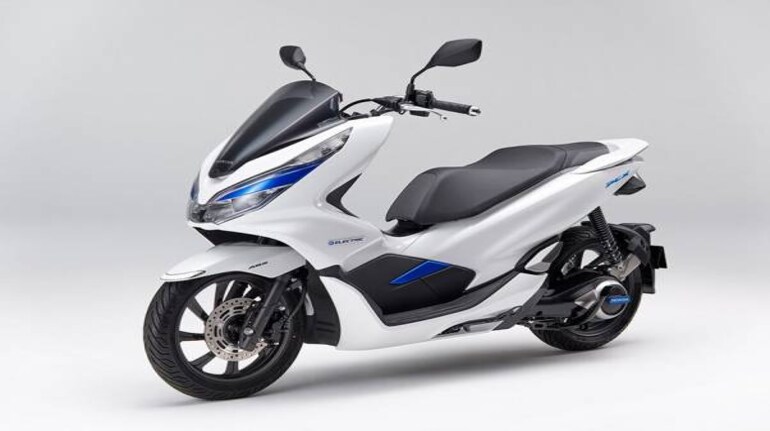
Honda -- the country's second largest two-wheeler manufacturer -- will wait for India’s ambitious electric mobility infrastructure to come up before launching any battery-operated vehicles in the country, a top company official said.
The decision comes even as Honda’s rivals Bajaj Auto, TVS Motor Company and Suzuki are in advanced stages of commercially launching electric two-wheelers in India.
“As an electric vehicle model we have it within Honda, but we need infrastructure to make it possible. We have to talk to the government to prepare for electric mobility. Even in Japan we are still talking to the government. We are preparing for electrification but we need infrastructure”, Noriaki Abe, Chief Officer, Honda Motor Company, said on the sidelines of EICMA.
In its global portfolio, Honda has the PCX electric scooter with swappable battery technology that it sells in Europe and Japan. The company had showcased a concept based on this at the 2018 Auto Expo. However, it has been hesitant to launch the same in India.
The management agrees that mobility needs in India and across the world are changing, given the case of rising fuel costs and general awareness towards the environment.
Due to limited charging infrastructure in public places and also due to high ticket price of products, electric vehicles have seen limited interest from established manufactures.
This even as dozens of startups, many of which are backed by China-based companies, have lined up launches in coming quarters.
“Mobility needs are rapidly changing. We need more environmentally friendly models. All manufacturers must change the model and this may be the opportunity for us. As a technology, electric vehicles have existed for more than 15 years, but it is difficult to make them popular as that requires supporting infrastructure,” Abe added.
Setting up a charger for two-wheelers is practically simpler than installing a charging station for a four-wheeler. Two-wheelers can use an air conditioner plug point to charger the batteries. However, as not all batteries are removable from the vehicle and as such plug points are not widely available in public areas it is considered as a hindrance.
Bajaj Auto, the country’s third largest two-wheeler maker, displayed its first fully electric two-wheeler, Chetak, in October. Promising to launch it commercially in January, Chetak will be a premium offering, with a mileage of more than 100 km per full charge.
TVS Motor Company, the maker of Jupiter and Apache range of models, has also promised to commercially launch a fully electric two-wheeler before March 2020.
Suzuki Motorcycles, the maker of Gixxer superbikes, will start testing a prototype electric scooter next year in India with a commercial launch scheduled for 2021 or 2022.
Meanwhile, Honda is expecting flat sales in FY20 in India. Including exports, HSMI’s sales are expected to close at six million units, which is nearly on par with 5.90 million the company sold last year.
“We are targeting sales of six million this year. There has been a small revision in the target because Indian economy has slowed down,” Abe said. When asked about an expected revival in India demand, Abe added, “It may be two-to-three years before demand comes back”.



Discover the latest Business News, Sensex, and Nifty updates. Obtain Personal Finance insights, tax queries, and expert opinions on Moneycontrol or download the Moneycontrol App to stay updated!
Find the best of Al News in one place, specially curated for you every weekend.
Stay on top of the latest tech trends and biggest startup news.