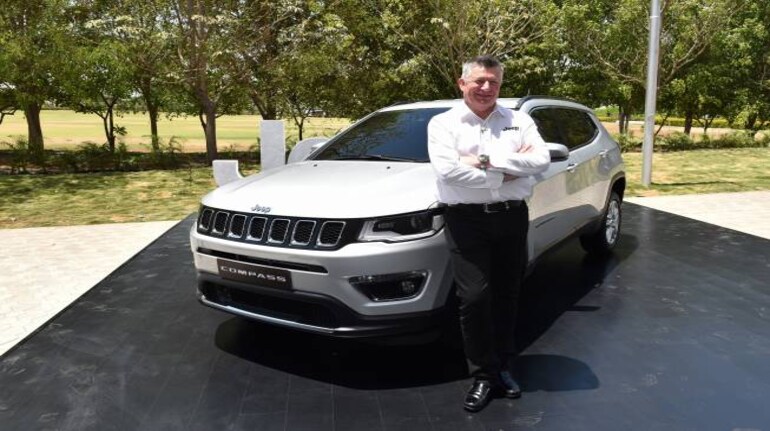
The excitement was palpable. "My phone has gone crazy since morning," beamed the 59-year-old head of Fiat Chrysler Automobiles (FCA) India, Kevin Flynn.
Jeep, the all-American SUV, had just beaten major brands like Toyota, Maruti Suzuki, and Honda to finish third in the JD Power Sales Satisfaction Index 2018, behind Mahindra & Mahindra and Hyundai.
Considered a yardstick to rate consumer experience by manufacturer, the JD Power Index analyzes customers' satisfaction with the pre-sales, sales and delivery experience.
Sitting in his brand new office in Mumbai's Bandra Kurla Complex, which FCA India moved into less than a year ago, a proud Flynn said: "I know how competitive the market can be and we take every thumbs-up as fuel to do more."
Now into its second year in India, Jeep has established itself as a strong player in the mid-size sports utility vehicle (SUV) segment. It sells about 1,500 units a month, each with an average price of Rs 20 lakh, and is the largest manufacturer of premium-only SUVs in India.
This is a far cry from the days when FCA India was struggling to sell the Fiat Palio and the Fiat Punto. Through the Jeep brand, the company now sells products that are priced at more than four times its earlier models.
Much of that success is credited to the way Flynn has steered the ship. And his passion has not gone unnoticed.
"Before appearing for the Compass Limited Plus video filming, Kevin was abroad. He took a return flight to India, went home to change into his business suit, came to office for important meetings, went to the studio at around 4 pm and filmed till 2.00 am the next morning. He was back in office the next day before 7 am for other meetings. He was practically up and active for close to 24 hours with hardly any sleep," recounted an FCA India executive.
A UK national, Flynn joined FCA India in early 2015, having quit Jaguar Land Rover South Africa as its Managing Director. The mandate from Italy was simple – establish Jeep as the go-to brand for SUVs. Except for Land Rover, India did not have a SUV-only brand in the premium space and this is where Fiat hoped to cash in with Jeep.
But only a year after launching the locally-made Jeep Compass in India, rumours about some of the biggest automotive names in the world exiting India started doing the rounds. The rumours culminated with the exit of General Motors from India, bringing an end to a fruitless journey for two brands -- Opel and Chevrolet -- that lasted 22 years.
The sudden negativity in the air about its future in India threatened to become a spanner in the works for Fiat. But unhindered, the company reassured stakeholders by making India one of only four centers in the world to manufacture the Compass.
Fiat went ahead with its plan of appointing new dealerships and fine tuning its factory near Pune to accommodate the Compass, spending Rs 1,800 crore in the process.
"Jeep is becoming more prominent in the way people refer to us now. Earlier it was just Fiat. (Brand) Fiat is not disappearing, it is the parent brand after all. Jeep is going to be a big part of what we are going to be in the future like it is today. It has brought a certain transformation in our organisation," said Flynn.
Fiat's Pune-based factory today exports the Compass to several key markets across the globe such as the UK, Japan, Australia and South Africa, all of which are right-hand drive markets like India. If required, the factory can make left-hand drive vehicles as well.
"It is not impossible to produce a left hand drive (LHD) Compass. (But) It will depend on how the dynamics play out with regards to LHD capacities around the world," Flynn said. Through a localized content of 72 percent, FCA has managed to leverage the low-cost manufacturing strength of India to its advantage.
FutureThe company's plans involve investing more in its India operations and making the country an export hub. Additional volumes are promised by at least two new products that are slated to arrive in 2021. One of them is a sub-4 meter compact SUV and the other is a three-row mid-range SUV.
Flynn is also keen to reestablish Fiat as a provider of powertrain (engine and transmission). The company had been supplying 1.3 litre multi-jet diesel engines to Maruti Suzuki and Tata Motors, but that arrangement has now come to an end.
Sources say that Fiat has replaced the 1.3-litre engine with a more powerful 2.0-litre engine, for which it already has two customers. The upcoming premium SUV Tata Harrier, due to arrive in early 2019, will sport this engine, and an MG Motor SUV, scheduled to follow the Harrier, will also use it.
CompetitionKnowing that India would be a 10-million-car market by 2030, more than thrice the current annual sales count of around 3 million, every car maker in the world is keen to get a slice of this burgeoning pie.
While traditional players such as Maruti Suzuki, Hyundai and Tata Motors are building up their arsenal, mostly in-house, others like Toyota, Ford, Renault, Nissan, and Volkswagen are doing it through partnerships. New players like SAIC, Kia and Peugeot have already lined up investments for new products and factories.
Fiat also has to be aware of the generational shift that the government is pushing as a priority, which is electric vehicles. By the time Fiat launches the next generation of vehicles in 2021, there will be at least half a dozen battery-powered models by competition on the roads.
"It is not the question of how, because we already have the technology. The question is about when (to bring EVs to India) because the infrastructure has to be ready first," said Flynn.
The auto veteran clearly seems battle-ready.



Discover the latest Business News, Sensex, and Nifty updates. Obtain Personal Finance insights, tax queries, and expert opinions on Moneycontrol or download the Moneycontrol App to stay updated!
Find the best of Al News in one place, specially curated for you every weekend.
Stay on top of the latest tech trends and biggest startup news.