Dear Reader,
The Panorama newsletter is sent to Moneycontrol Pro subscribers on market days. It offers easy access to stories published on Moneycontrol Pro and gives a little extra by setting out a context or an event or trend that investors should keep track of.
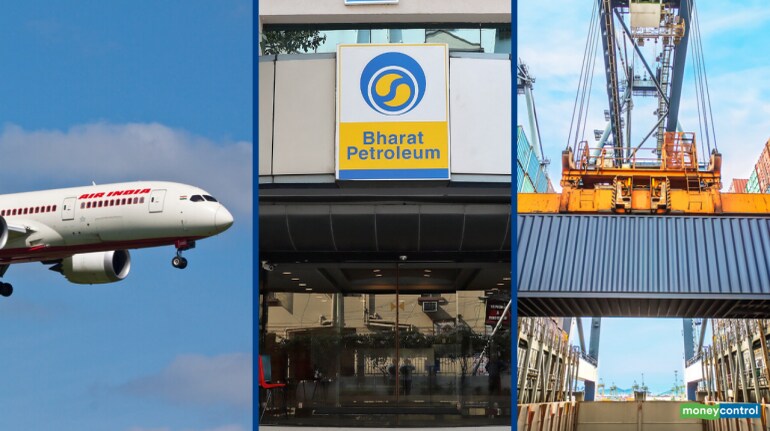
It is almost two years since the government first talked about the divestment of oil marketing firm Bharat Petroleum Corporation Ltd (BPCL). Pandemic and other issues have resulted in the government postponing the strategic sale of the company.
Now, the Minister of State for Finance, Bhagwat Karad, has informed the Rajya Sabha that the divestment process has moved to the second stage. The minister told the House that the transaction advisors say many Expressions of Interest (EoIs) have been received and negotiations are on with several potential buyers. Many potential bidders have come forward and submitted EoIs.
The government seems to be putting up a brave face in a divestment that has taken more time than earlier envisaged. The finance minister had taken into account the sale of BPCL in her Budget presentation in 2020 as well as 2021.
So, why is it that a prime asset and a maharatna like BPCL is unable to find a suitor?
There were media reports that the complex structure of BPCL, with its stake in oil production in Africa and a joint venture with Oman Oil, was creating problems. These were taken care of in subsequent years. But still, investors were hesitant to purchase the company.
With oil prices above $100 a barrel and refining margins at elevated levels, one cannot be blamed for assuming that BPCL divestment would be a cakewalk.
What seems to be the deal-breaker is the government’s interference in fuel pricing. Though the government has ostensibly freed oil marketing companies from price control on fuels like petrol and diesel, in reality, there is an invisible hand that prevents companies from doing so.
Election times are the worst for a fuel price hike for any government. This time too, state elections in five states coincided with oil prices rising in global markets. It's common knowledge that oil companies are nudged during such times to stop increasing fuel prices.
As a result of this, there has been under-recovery by these companies. Retail fuel prices have remained unchanged for nearly 130 days in India despite oil prices touching a 14-year high of $139.13 a barrel as compared to $61.3 a year ago.
Oil marketing companies will have to announce a price hike of Rs 20 a litre in petrol and diesel to maintain their margins.
However, high oil prices will help oil marketing companies by way of high inventory value and better refining margins on other products in reporting strong numbers.
Most commodity companies like metals and oil and refining keep on posting mediocre returns for years, waiting for those few months to reap riches when the commodity cycle is in overdrive. Take the case of oil which has after nearly a decade risen above the $100 a barrel mark.
It is the lack of freedom to control prices that is preventing buyers from buying a lucrative asset like BPCL. For the government, selling HPCL was easy as it could thrust the firm down ONGC’s throat but the same cannot be done with BPCL.
A foreign or a private investor would like to control prices, especially during those times when they can generate bumper profits.
The government is unlikely to commit political hara-kiri by allowing oil companies to increase fuel prices during elections. In such a case, the only alternative left is to foist BPCL on another public sector company in the same sector, like IOC, or scrap the process altogether.
Investing insights from our research team:Oil: Who pays for the gap on revision of retail fuel prices?
Bosch: What should investors do amid challenges?
What else are we reading?
Chart of the Day | How many Fed rate hikes is the market pricing in?
Crypto Conversations: Looking beyond the hype, spotting issues plaguing the Metaverse
Decoding PLI: Bid to make food processing industry globally competitive
India, China on the same page over Russia, non-dollar oil trade
Putin’s war demands a concerted global economic response (republished from the FT)
Why non-fossil fuels will not reduce India’s energy import dependence
Book Review: Total Economic War and its Consequences
Mettle of three exchanges, separated by two wars and 30 years
Personal Finance: Making a choice between gold funds and gold ETFs
Technical picks: Nifty, Birla Soft, Cyient, CG Power, and Castor seed (These are published every trading day before markets open and can be read on the app)
Shishir Asthana
Moneycontrol Pro

Discover the latest Business News, Sensex, and Nifty updates. Obtain Personal Finance insights, tax queries, and expert opinions on Moneycontrol or download the Moneycontrol App to stay updated!

Find the best of Al News in one place, specially curated for you every weekend.
Stay on top of the latest tech trends and biggest startup news.