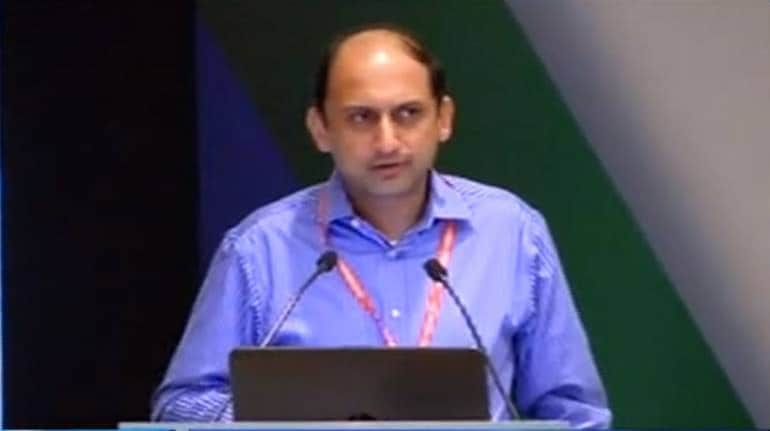
The government is worried that a recent speech made by Reserve Bank of India (RBI) Deputy Governor Viral Acharya, on the need to protect the central bank's independence, may adversely impact the market, The Economic Times reported.
In his speech, Acharya highlighted a perception that undermining of the central bank can not only lead to reduced confidence among financial market investors (especially foreign ones), but can also lead to systemic risks through a buildup of the shadow banking structure.
Acharya's speech came in the backdrop of RBI's debate with the government to offer greater control over PSU banks, the need to strengthen RBI's balance sheet instead of paying surplus as a dividend to the government and recent disagreement between the two regarding the RBI's regulatory oversight on the payment and settlement system.
Read — Rising tensions between Centre and RBI: Here's what happened
Reacting to Acharya's speech, Jahangir Aziz, Head of EM economic research at JPMorgan, said, "If you do have the relationship between the central bank and the government of India come to a point where we have a strong adverse reaction, the market will react badly. I don’t think that is something specific to India, I think that is true for almost everywhere in the world."
Clearing the air around RBI Governor Urjit Patel's resignation over the ongoing dispute, an official told the paper that there is no reason to believe he would be asked to resign.
"There is no question of asking Patel to go — we do not want him to go," the official said, adding that the only reason that the RBI governor should step down is if there is a health issue.
The remark comes after government sources told BTVI that Patel had come close to quitting at a recent meeting between the two parties.
Read — Market could react badly if RBI-govt relationship sees strong adverse reaction, says Jahangir Aziz of JPMorgan
The government is of the view that its main task is to stabilise the economy and shield it from global headwinds, another official said, adding that disagreements can spring up in any discussion between stakeholders.
Some sections of the government, however, feel that there was no need for a public airing of differences and that the central bank may have crossed a line with the Acharya speech. "Such statement and bluster create panic in the market," the first official was quoted as saying.
On October 27, Finance Minister Arun Jaitley said, "I think, for any regulatory mechanism, stakeholder consultation has to be of a very high quality, which will probably lead to a revisiting of traditional thoughts and opinions. And that’s why, when several regulators publish their approach papers or tentative drafts, they hold hearings, meet individuals, meet groups of stakeholders together and improve upon what is being said."
Editor's Take | Tensions between RBI and government escalate
The Centre has been unhappy with RBI's decisions regarding interest rates. It also disagreed with RBI's February 12 directive on a classification of non-performing assets (NPAs) and norms of loan restructuring, believing them to be harsh.
The government said that the directive would end up hurting state-run banks' profitability.
The Punjab National Bank (PNB)-Nirav Modi fraud, which surfaced at the beginning of the year, pushed the government to come down heavily on RBI for its supervision. Patel had immediately sought more powers to oversee public sector banks (PSBs) in order to bring them at par with private banks.
The government is insisting that RBI should intervene in the ongoing crisis at non-banking financial companies (NBFCs), which are facing a liquidity crunch following a series of defaults by infrastructure lender IL&FS.
Discover the latest Business News, Sensex, and Nifty updates. Obtain Personal Finance insights, tax queries, and expert opinions on Moneycontrol or download the Moneycontrol App to stay updated!
Find the best of Al News in one place, specially curated for you every weekend.
Stay on top of the latest tech trends and biggest startup news.