






India’s E20 policy aims to blend 20 percent ethanol with petrol vehicles to reduce country’s dependence upon crude oil imports, lower carbon emissions and support farmers.
Sugarcane was envisaged to be the main source of ethanol
E20 sought to provide a stable market for agricultural feedstock for manufacture of ethanol. It was envisaged that 55 percent of ethanol will come from sugarcane and 45 percent from food gains. In its early years, it came as a boon to sugar mills as their profitability improved and they were able to pay cane dues for farmers. The program was meant to support farmer income and enhance rural economic development.
Over the last few years, the situation has reversed. In the Ethanol Supply Year 2024-25 (November to October), only 31.5 percent of ethanol was sourced from sugarcane while 46 percent came from maize.
For ESY 2025-26, the demand of ethanol from OMCs is 11 billion litres but the installed capacity of distilleries is about 17.5 billion litres.
Famers choose maize in expectation of good returns
From food and feed to fuel and industry, maize has become one of India’s most versatile and strategically important crops. It is a key feedstock for ethanol.
India’s ethanol blending of petrol has surged from 0.31 billion litres (from about 0.8 million tonnes of maize) in 2022–23 to 4.78 billion litres (from 12.7 million tonnes of maize) in 2024-2025, making maize the dominant feedstock for ethanol.
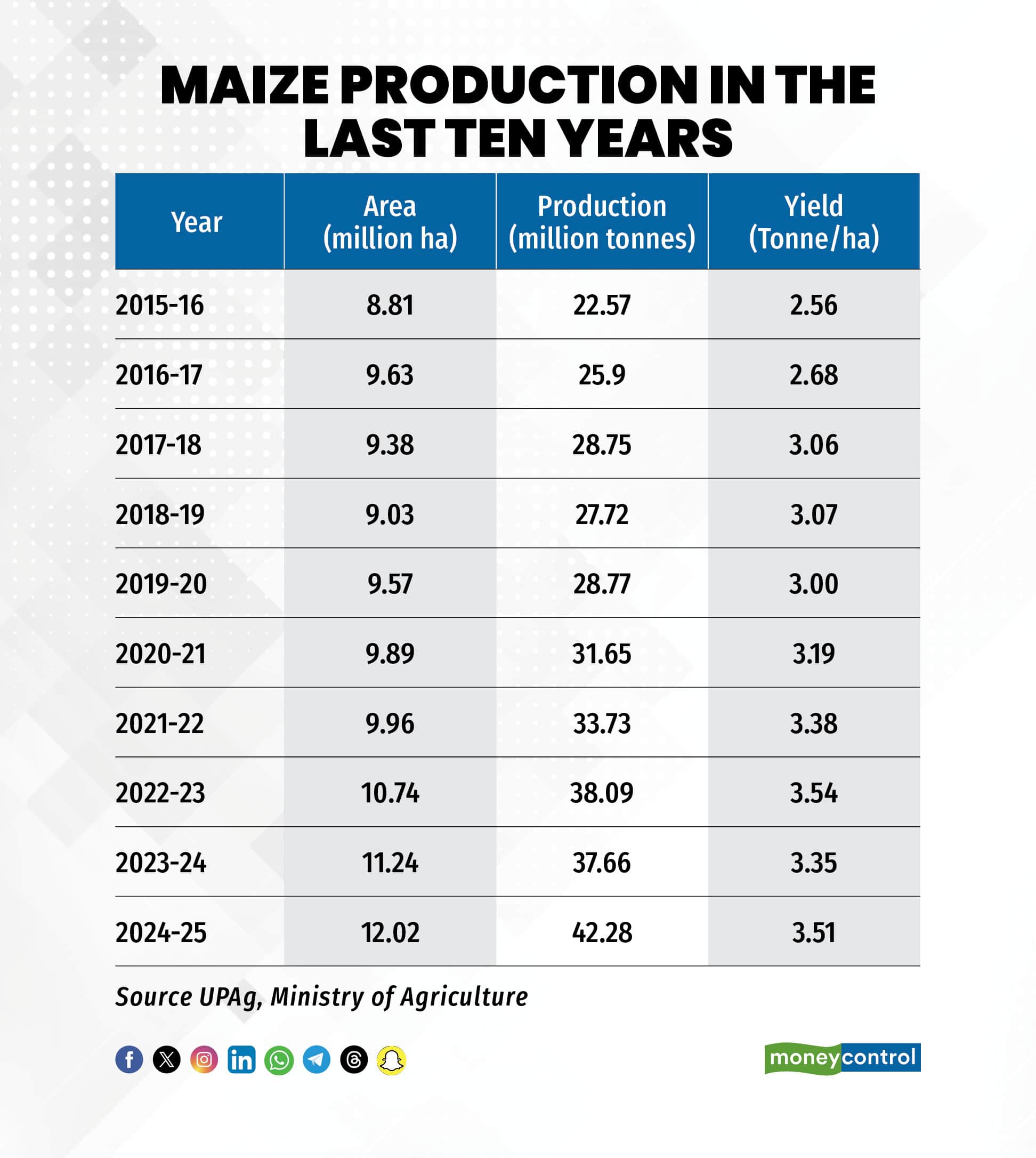
The area under maize has been going up to meet the demand for maize from ethanol distilleries. Last year, the maize farmers received higher prices also. Better hybrids, mostly sold by private companies like Corteva, also contributed to this substantial increase in production (Corteva refused to share the data of sale of maize seeds).
Kharif acreage in 2025 under maize has risen
In ESY 2024-25 , maize provided 45.7 percent while rice provided 22.2% of ethanol procured by OMCs.
For ESY 2025-26, the OMCs have contracted 10.5 billion litres of ethanol. Only about 2.9 billion litres will come from sugarcane while 7.6 billion litres will come from food grains. Out of this, 4.8 billion litres will come from maize and about 0.48 billion litres will come from damaged grains, which are sourced by distilleries from the open market. About 2.3 billion litres will come from rice issued by FCI at Rs 23,200 per tonne.
This year, the area under maize in kharif (2025) was 9.5 million ha, higher by about 1.06 million ha compared to kharif 2024. So, the production of maize in kharif this year (2025) is estimated to be 28.3 million tonnes, 3.5 million tonnes higher than last year.
Maize price realisation has been declining
Since the distilleries are not mandated by law to pay the MSP to maize farmers, they have been sourcing maize at prices much below the MSP. As a result, the average price of maize in recent months has been in the range of Rs 1,900 - 2,100 per quintal. This is lower than even the last year’s price and lower than the MSP of Rs 2,400 per quintal for 2025-26.
In Ganj Basauda APMC of Madhya Pradesh (district Vidisha, constituency of Agriculture Minister), the modal price of maize on 19th November 2025 was only Rs 1,450 per quintal. In APMC Guna (MP) it was Rs 1,565 on 25 November 2025.
The imperfection of private markets across India is quite visible, and the farmers’ hopes of earning good return from maize, especially in some states like MP are shattered. It also means that eNAM is yet to become a reality for several APMCs.
It may not be a bad idea for OMCs to pay the distilleries the price for ethanol (Rs 71.86 per litre) from maize on proof of payment of MSP to farmers.
The whole idea of promoting fuel from food may be in urgent need of a review by Niti Ayog which had projected in 2018 that 55 percent of ethanol will come from sugarcane and 45 percent from food grains.
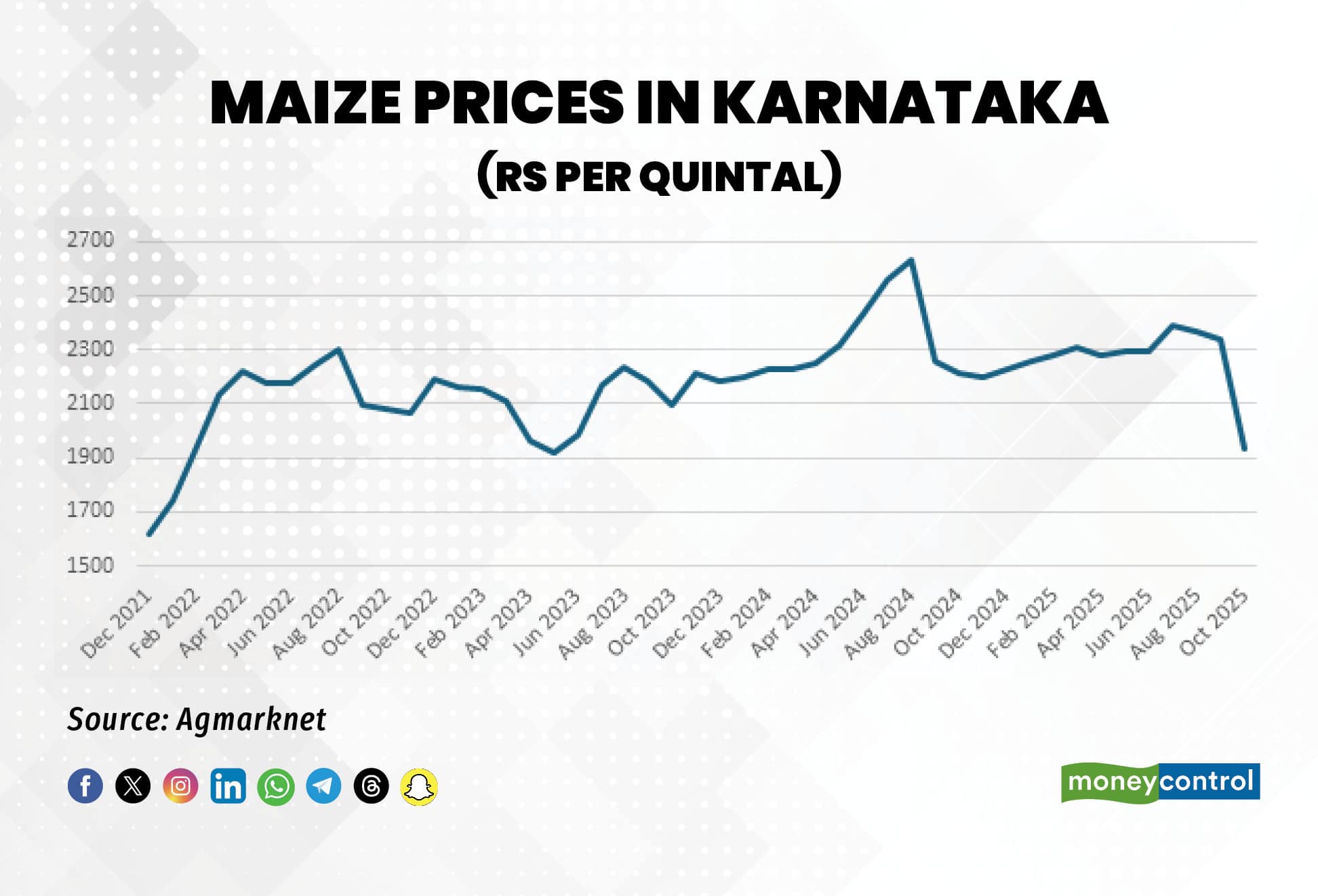
Higher production of maize in kharif coupled with availability of very cheap rice from FCI (Rs 2,320 per quintal) may also be contributing to low maize prices this year as rice is a better raw material for ethanol than maize.
This crash of maize prices is a repeat of soybean. It is bad news for farmers.
Policy choices: Agriculture for protein or fuel?
The maize price is not only a correction; it could well be a policy alarm.
The government has been supporting maize as a feedstock by fixing ethanol price at Rs 71.86 per litre while the same from sugar cane juice is only Rs 66 per litre.
Due to high return from cultivation of sugar cane it is unlikely that its area will witness a decrease. So, in years of high sugarcane production, it’s a good option to divert sugarcane to ethanol, instead of producing sugar. For this, the price of ethanol has to be the same from maize and rice, along with higher allocation of ethanol from sugarcane
India needs to incentivise protein crops
The bottom line is that the crop policy should be promoting pulses and oilseeds for which India is dependent on imports. Instead of incentivizing cultivation of too much maize for ethanol, it would be a good policy choice to provide high incentives to pulses. That will be good for soil also as pulses are better in fixing nitrogen, thus reducing application of urea.
Private seed companies should also be devoting their research budget to pulses as they have done for maize.
(Siraj Hussain is a former Secretary, Ministry of Agriculture, Government of India. Garima Jain has worked in reputed global commodity companies in leadership positions.)
Views are personal and do not represent the stand of this publication.
Discover the latest Business News, Sensex, and Nifty updates. Obtain Personal Finance insights, tax queries, and expert opinions on Moneycontrol or download the Moneycontrol App to stay updated!
Find the best of Al News in one place, specially curated for you every weekend.
Stay on top of the latest tech trends and biggest startup news.









