






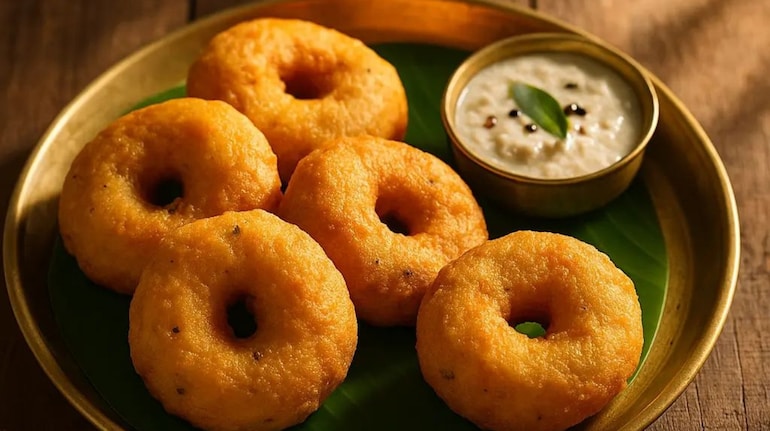

There is a moment, familiar across South Indian homes and eateries, when a freshly fried vada lands on your plate — golden, crisp, steaming gently — ready to be dunked into sambar or coconut chutney. Almost without thinking, you notice its shape: a neat circle with a hole in the centre. It looks simple, even obvious. But like many things in Indian food, that small detail carries more meaning than it appears.
The medu vada’s signature hole is not decorative. It is the result of generations of kitchen wisdom, where taste, technique and practicality quietly shaped what we now consider tradition.
At its core, the hole solves a cooking problem. Medu vadas are made from a thick batter of soaked and ground urad dal. When this dense batter meets hot oil, it needs help cooking evenly. The open centre allows heat to travel through the vada, ensuring the inside cooks as well as the outside. Without it, the surface would brown too quickly while the centre stayed underdone — a flaw no South Indian cook would tolerate.
Also Read: Simple physics trick to stop your dosa from sticking
The shape also makes the vada lighter. With more surface area exposed to oil, the vada fries faster, absorbing less oil in the process. This is what gives a good medu vada its defining contrast: crisp edges that crackle at the bite, and a soft, airy centre that melts in your mouth.
There is also a quiet choreography to how vadas are made. Traditionally shaped by hand, the cook places a spoonful of batter on a wet palm, gently presses a thumb through the centre, and slides the ring into hot oil. The hole helps the vada hold its shape and makes it easier to flip while frying. It is efficient, instinctive and almost meditative — a technique passed down more by watching than by written recipes.
Texture, of course, is everything. The hole creates more edges, and edges are where crispness lives. Each bite delivers that satisfying crunch, something a solid, fritter-like shape could never quite achieve. It is this balance of crunch and softness that has made the medu vada a breakfast staple across homes, temples and street corners.
Beyond function, the hole has become part of the vada’s identity. The doughnut-like silhouette is instantly recognisable, whether it appears on a steel plate at a roadside stall or on a banana leaf during a festive meal. Tell someone to sketch a vada, and they'll naturally draw a circle with a hole in the middle. This shape has become a cultural symbol over time — a visual sign of comfort, familiarity and tradition.
What's the reason for the hole in the center of vadas? Because Indian cooking seldom divides form from function. The design contains centuries of hands-on knowledge improved through daily cooking instead of culinary theory. It shows that in food, like in life, the tiniest details often hold the deepest wisdom.
The next time you rip off a piece of vada and dunk it in hot sambar, take a second to think.
That humble hole in the centre is doing more work than you realise — and it’s the reason the vada tastes exactly the way it should.

Discover the latest Business News, Sensex, and Nifty updates. Obtain Personal Finance insights, tax queries, and expert opinions on Moneycontrol or download the Moneycontrol App to stay updated!
Find the best of Al News in one place, specially curated for you every weekend.
Stay on top of the latest tech trends and biggest startup news.





