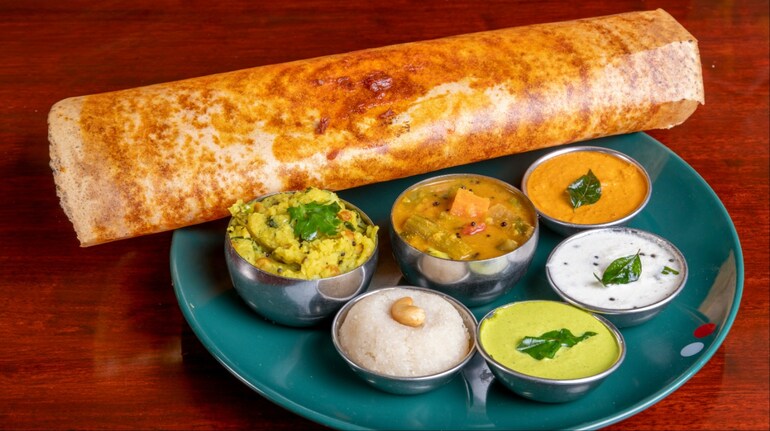
An IIT-Madras professor has decoded the physics behind the perfect dosa, linking its crisp exterior and soft centre to an 18th-century German scientific principle. Professor Mahesh Panchagnula told DT Next that the interplay of heat, batter consistency, and technique is governed by the Leidenfrost effect, a phenomenon that explains why water droplets “dance” on a hot surface.
“The key,” Panchagnula explained, “is ensuring the tawa reaches a temperature where this effect begins to work. That is when the batter spreads smoothly, lifts slightly, and crisps evenly without burning or sticking.”
The Leidenfrost effect, first observed in Germany, occurs when water hits a surface hot enough to form a thin vapour layer beneath the droplet. Instead of evaporating instantly, droplets hover and glide—preventing them from sticking. Generations of South Indian households have unknowingly applied this principle by sprinkling water on the tawa before ladling batter. If droplets dance, the pan is ready; if they vanish too fast or sit still, it is not.
"And that same effect ensures the dosa doesn't stick," Panchagnula added. "If the pan is too cool, the batter clings stubbornly, tearing into messy lumps. If it's too hot, the batter never grips at all, leaving burnt spots. But at just the right temperature, the result is a dosa that is crip at the edges, soft at the centre, and perfect all around."
Batter and technique matter
Panchagnula noted that fermentation creates tiny air pockets in the batter. These expand when heated, giving the dosa its signature texture. The spread technique shapes the rest: a smooth, even spiral ensures a thin, crisp structure while keeping the centre tender enough to fold without cracking.
“Making the perfect dosa is not just tradition—it’s a brilliant interplay of temperature, vapour, and technique," the IIT Madras professor concluded.
The physics lesson meant for students received mixed reactions from adults on X after IIT Madras shared the newspaper snippet. While many praised the research as “amazing” and “fun to explore,” others questioned whether a premier institute should highlight dosa thermodynamics when “far more impactful research is urgently needed and rarely showcased.”
“Street vendors perfected dosa long before any formal institute did. The science is fascinating, yes, but is this really the public-facing communication an IIT wants to highlight?” Another added: “Every South Indian paati reading this like ‘cute that Germany discovered it, we just call it Tuesday morning.’” Others defended the work, noting that “big food giants have the best chemists” and that “instinct and science meet on a hot tawa.”
Discover the latest Business News, Sensex, and Nifty updates. Obtain Personal Finance insights, tax queries, and expert opinions on Moneycontrol or download the Moneycontrol App to stay updated!
Find the best of Al News in one place, specially curated for you every weekend.
Stay on top of the latest tech trends and biggest startup news.