






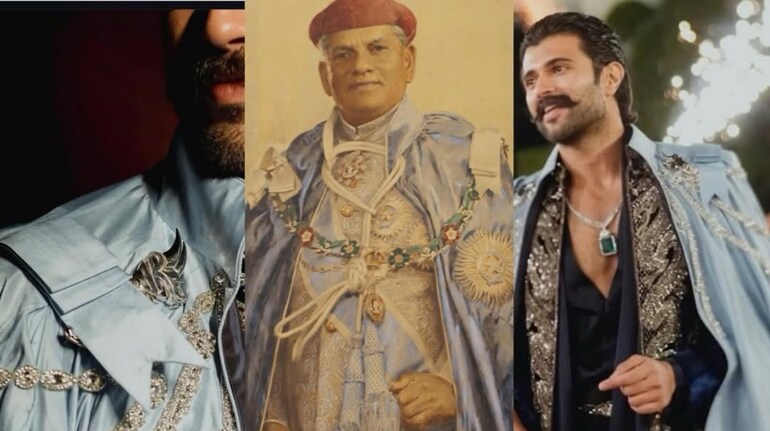

South superstar Vijay Deverakonda, who recently got married to actress Rashmika Mandanna in Udaipur, grabbed attention for his exceptional sartorial choices. From the sangeet to the wedding, each outfit reflected his cultural pride in traditions and his love for his roots.
While all his outfits were quite impressive, there’s one that seems to have caught everyone’s fancy. It was the one that the actor wore at his sangeet, designed by none other than Falguni Shane Peacock. His ensemble was layered and leaned towards a regal aesthetic with its shades of blue and fitted long coat with silver embroidery, styled with a sky-blue cape.
While many noted its resemblance to what erstwhile Maharajas wore, it was only recently that Radhikaraje Gaekwad, Maharani of Baroda, confirmed its striking similarity to an outfit first worn by Maharaja Sayajirao Gaekwad III, the former ruler of Baroda, in 1919.
Sharing a few pictures of Maharaja Sayajirao Gaekwad III and Vijay Deverakonda in the same cloak on Instagram, she first praised the actor for honouring his culture.
“South Star Vijay Deverakonda @thedeverakonda is being hailed as one of the best dressed bride grooms of recent years, honouring his heritage, swishing in and out of Dhotis and Veshtis, channeling ‘Mythology Core’ with a generous drizzle of Southern sass,” she wrote.
She also praised Bollywood stylist Ami Patel for dressing the two in the most beautiful wedding outfits. She added, “Fabulously styled by @stylebyami in an array of designers ranging from Anamika Khanna to Jade and Torani, what piqued my interest was the sky blue silk cloak by @falgunishanepeacockindia.”
Radhikaraje revealed that the cloak was worn by Maharaja Sayajirao first in 1919 when he received the “Most Exalted Order of the Star of India,” an order of chivalry bestowed by the British Empire and later in 1930 during his 60 years reign celebrations.
She also shared another tale from the Maharaja’s visit to Delhi. “Flashback to 1911 when the Maharaja had arrived at the Delhi Durbar to greet the emperor and empress of India dressed in the simplest garment of a plain, unembellished angarkha, his reluctance and diffidence more than apparent as he twirled his walking stick, curtly nodded at them and then swirled away,” she shared.
Radhikaraje added that clothes always held meaning for the Maharaja. “Coming back to the blue cloak, Sayajirao is seen in this robe of imperial symbolism only twice, and by what we know of him, it was a perfect camouflage to his deep commitment and support to the Indian Nationalist Movement. A lesson learnt from 1911 perhaps.”
This shows how fashion is truly cyclical and carries traces of roots even in its most evolved forms.
Discover the latest Business News, Sensex, and Nifty updates. Obtain Personal Finance insights, tax queries, and expert opinions on Moneycontrol or download the Moneycontrol App to stay updated!
Find the best of Al News in one place, specially curated for you every weekend.
Stay on top of the latest tech trends and biggest startup news.










