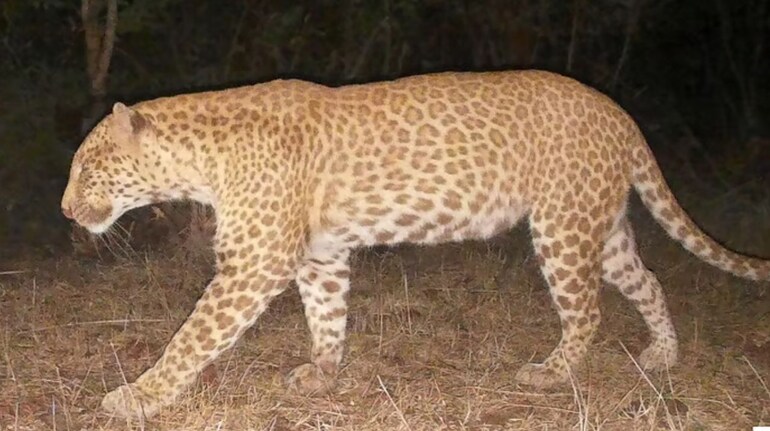

A rare leopard colour morph has been recorded in Karnataka. The sighting occurred recently in Vijayanagara district forests. Wildlife scientist Sanjay Gubbi documented the unusual leopard. His team works with the Holématthi Nature Foundation. The finding marks the first such record in Karnataka. Researchers confirmed the leopard using camera trap images.
The leopard displays an unusual pale reddish pink coat. Its colour resembles the shade of sandalwood. Unlike typical leopards it lacks dark black rosettes. Instead the rosettes appear light brown in colour. This striking appearance makes the animal extremely rare. Only a handful of similar leopards exist globally.
Why This Leopard Colour Morph Is Unusual
Internationally such leopards are called Strawberry leopards. Mr. Gubbi prefers a locally inspired name. He has proposed calling it the sandalwood leopard. Karnataka is among India’s largest sandalwood producers. The name reflects the state’s cultural heritage. It also highlights regional conservation significance.
The leopard photographed is a female individual. Researchers estimate her age at six years. The animal was recorded through systematic camera trapping. This was part of long term wildlife monitoring. The effort focuses on large carnivore populations.
What Science Says About The Rare Colour
Scientists believe the colour comes from genetics. It may involve excess red pigmentation. It could also involve reduced dark pigmentation. Such traits occur naturally in wild mammals. Conditions like hypomelanism or erythrism are possible.
In India only one similar leopard was recorded earlier. That sighting occurred in Rajasthan’s Ranakpur region. It was documented in November 2021. Globally few cases exist in South Africa. One individual was also recorded in Tanzania.
Mr. Gubbi says genetic testing remains necessary. DNA samples are needed for molecular analysis. Until then no precise condition can be assigned. Scientists rely on photographic and visual evidence. Therefore the leopard is described as a rare morph.
Why Vijayanagara Region Matters For Conservation
The discovery occurred in an understudied landscape. The region lies within Kalyana Karnataka. It remains poorly explored by wildlife scientists. Yet it supports diverse arid zone species.
The Holématthi Nature Foundation led the documentation. The team included Sanjay Gubbi and Sandesh Appu Naik. Other members included Shravan Suthar and Poornesha H.C. Ruma Kundarkar and Ravichandra Velip also participated. Dayanand Mirashi and Sumit Velip were involved. Aishwarya Karanth and Mayur Mirashi completed the team.
Their work aims to map leopard populations. It also identifies key conservation landscapes. The region supports species like Indian grey wolf. Striped hyena and Bengal fox also inhabit.
The foundation estimates Karnataka has around 2,500 leopards. Researchers say discoveries like this highlight knowledge gaps. They also underline the need for focused conservation.
Discover the latest Business News, Sensex, and Nifty updates. Obtain Personal Finance insights, tax queries, and expert opinions on Moneycontrol or download the Moneycontrol App to stay updated!
Find the best of Al News in one place, specially curated for you every weekend.
Stay on top of the latest tech trends and biggest startup news.