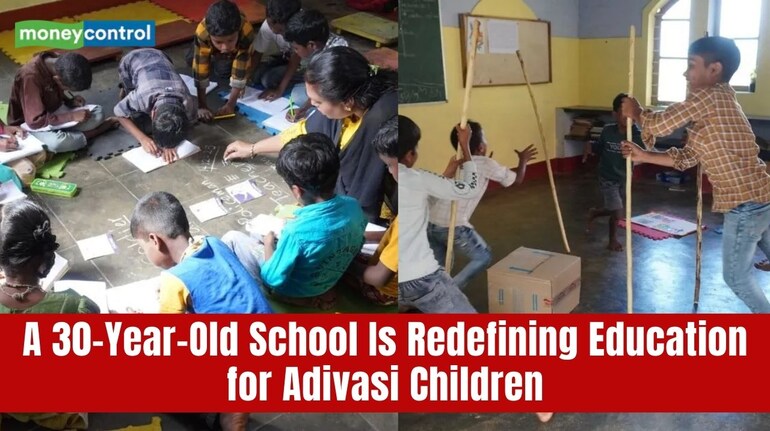

Education in India often overlooks Indigenous knowledge and traditions. In Tamil Nadu’s Gudalur valley, however, one school quietly reshapes this narrative through a community-driven model of learning. The Vidyodaya School, supported by the Viswa Bharati Vidyodaya Trust, reflects how education rooted in culture can empower Adivasi children while strengthening community identity and confidence.
Vidyodaya School blends Adivasi culture with education
Inside teacher Shanthi Kunjan’s classroom, learning begins with nature itself. Branches become measuring tools, forest leaves explain symmetry, and seeds represent small units of exchange. Lessons are designed around the natural environment familiar to the children. The approach recognises that students already possess deep ecological knowledge from their daily lives.
The school is located in Gudalur taluk within Tamil Nadu’s Nilgiris district. The region is home to the Bettakurumba, Kattunayakan, Mullakurumba, and Paniya communities. These groups are recognised by the Government of India as Particularly Vulnerable Tribal Groups. Their heritage is rich, yet they have long faced social and economic challenges.
Teachers at Vidyodaya believe that learning must connect with children’s experiences. Forest plants, rivers, and wildlife often become examples used during lessons. Cultural traditions also shape school activities throughout the week. Science videos open the week, storytelling follows on Tuesdays, while Wednesdays feature traditional Adivasi songs. Students perform dances on Fridays and conduct small experiments during weekly science sessions.
Arts and craft classes highlight skills that communities have practised for generations. Children make baskets, chains, and wire bags using bamboo, beads, and coconut shells. Environmental studies use a book documenting local food traditions. Hunting, honey gathering, and forest tubers form part of these lessons.
Origins of Viswa Bharati Vidyodaya Trust and the school
The roots of this educational model stretch back decades. Social workers Ramdas Bhaskaran and Rama Sastry originally experimented with activity-based learning in Puducherry during the 1980s. Their work involved children from fisherfolk and leprosy-affected families who struggled with conventional schooling systems.
Encouraged by these results, the couple later moved to Gudalur in 1990. What began as homeschooling for their own children soon attracted local students. The initiative gradually developed into a community learning space.
A turning point came during a large gathering of Adivasi elders in 1995. The meeting was organised by Action for Community Organisation Rehabilitation and Development, a Gudalur-based organisation supporting tribal communities. Elders proposed transforming the school into a centre managed by Adivasi communities themselves. The Viswa Bharati Vidyodaya Trust then converted the institution into an Adivasi school in 1996, beginning with 36 students.
Community participation shapes learning and future opportunities
Education at Vidyodaya extends beyond classrooms and textbooks. Parents frequently join work camps, helping maintain the campus and prepare meals. Elders sometimes visit to teach traditional songs, dances, and cultural practices. These activities strengthen students’ pride in their identity and heritage.
The school currently teaches about 125 children from kindergarten to Class 5. Teachers emphasise personal progress rather than exam rankings. Each student maintains a portfolio documenting work and improvement across subjects.
Nutrition also receives careful attention. Lunch boxes commonly contain ragi porridge, eggs, and sprouts. According to a UNICEF report, malnutrition remains a major challenge among tribal children in India. Nearly 40 percent of under-five tribal children experience stunting, while 16 percent suffer severe stunting.
Language has also been a barrier in many schools serving tribal communities. At Vidyodaya, teachers from the community help bridge this gap. They communicate with students using familiar languages when complex concepts require explanation.
Beyond the main campus, the Trust supports a wider Community Education Programme. The initiative reaches around 3,500 students across 320 villages in Gudalur and Pandalur taluks. Evening learning centres provide spoken English sessions, mathematics support, mentoring, and scholarships.
For students like Sijithra from the Paniya community, the programme opened new possibilities. With scholarship support from the Trust, she completed secondary school and now trains to become a nurse.
Educators say the larger aim remains simple yet powerful. Children should grow proud of their Adivasi identity while gaining skills for the future. For teacher Shanthi Kunjan, who has spent 25 years at the school, the reason for staying remains deeply personal. She describes the institution as a place that feels like family and gives her work a lasting sense of purpose.

Discover the latest Business News, Sensex, and Nifty updates. Obtain Personal Finance insights, tax queries, and expert opinions on Moneycontrol or download the Moneycontrol App to stay updated!
Find the best of Al News in one place, specially curated for you every weekend.
Stay on top of the latest tech trends and biggest startup news.