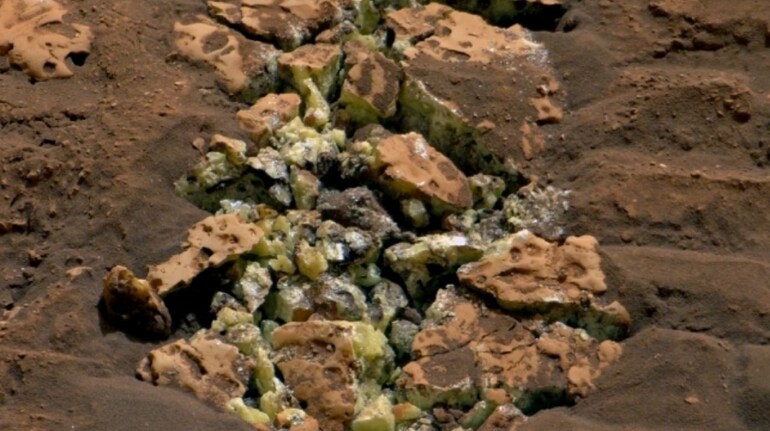

Planetary exploration continues to reveal unexpected secrets from Mars. A surprising discovery emerged when a robotic rover accidentally cracked open an ordinary looking rock on the red planet. The event exposed bright yellow sulfur crystals, giving scientists a rare glimpse into geological processes that may have shaped the Martian surface billions of years ago.
Curiosity rover discovery reveals pure sulfur on Mars
Scientists working with NASA’s Curiosity rover reported an unusual finding during exploration of Mars. While travelling through the Gediz Vallis Channel, the rover rolled over a fragile rock. The vehicle weighs nearly 899 kilograms during normal operations. Pressure from its wheels caused the rock to break apart. Inside the broken stone appeared bright yellow sulfur crystals.
Researchers identified the mineral as elemental sulfur, also called brimstone. Sulfate minerals have been discovered on Mars previously. However, pure sulfur in elemental form had not been confirmed before. This discovery surprised planetary scientists studying Martian geology. Curiosity project scientist Ashwin Vasavada described the finding earlier. Speaking from NASA’s Jet Propulsion Laboratory in July 2024, he highlighted its unusual nature. He compared the discovery to finding an oasis within a desert.
 Sulfur discovered on Mars by Curiosity (Image: NASA/JPL-Caltech/MSSS)
The rock was located in the Gediz Vallis Channel region. Scientists believe the area once hosted flowing water long ago. Rocks scattered across the channel resemble the sulfur bearing stone. This suggests similar deposits might exist across that location. Researchers are now examining how elemental sulfur could form there.
Why elemental sulfur discovery matters for Mars research
Sulfur minerals help scientists understand planetary environments and history. Sulfates usually form when sulfur combines with minerals in water. When water later evaporates, mineral salts remain behind. Such deposits reveal clues about ancient water activity.
Pure sulfur, however, forms only under narrow environmental conditions. Scientists do not yet know those conditions existed there. The unexpected presence of elemental sulfur suggests missing details about Mars geology. Researchers suspect unknown chemical processes may have occurred earlier.
Sulfur also holds biological importance for life on Earth. Living organisms use sulfur compounds to build proteins and amino acids. Scientists already knew sulfates existed across Martian terrain. However, the discovery does not confirm life ever existed there. Mars exploration still searches for definite biological evidence.
Mars exploration continues with Curiosity and Perseverance rovers
Curiosity continues exploring the Gediz Vallis Channel region carefully. The ancient channel preserves traces of water flow from billions ago. Rocks across the valley may reveal more geological secrets. Scientists expect additional analysis will involve modelling Mars geological history.
Meanwhile another robotic explorer continues studying the Martian surface. NASA’s Perseverance rover recently achieved a notable milestone. On June 19 2025 the rover completed a record drive. It travelled about 411 metres across rocky terrain in one journey. Compared with earlier missions, Perseverance moves relatively faster.
Both robotic explorers represent decades of engineering and scientific ambition. Their instruments allow researchers to examine distant landscapes in detail. Each discovery adds new pieces to the puzzle of Mars history. Hidden clues beneath the planet’s surface continue attracting scientific curiosity.
Discover the latest Business News, Sensex, and Nifty updates. Obtain Personal Finance insights, tax queries, and expert opinions on Moneycontrol or download the Moneycontrol App to stay updated!





Find the best of Al News in one place, specially curated for you every weekend.
Stay on top of the latest tech trends and biggest startup news.