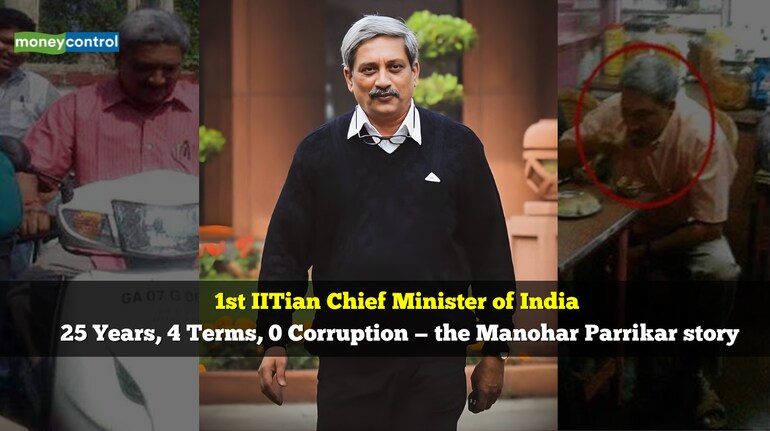

When Manohar Parrikar graduated from IIT-Bombay in the 1970s with a degree in metallurgical engineering, the conventional path would have taken him to America. Like many of his peers, he could have joined the rush to Silicon Valley, built a comfortable life abroad and climbed the corporate ladder. Instead, he chose politics.
What followed was a 25-year journey that made him the first IITian to become a Chief Minister in India, and arguably the tallest leader Goa has ever produced.
Born on December 13, 1955, in Mapusa, Goa, Manohar Gopalkrishna Prabhu Parrikar came from a modest business family in Parra village – the name 'Parrikar' itself derives from their ancestral village. His academic brilliance was evident early on, leading him to one of India's most prestigious institutions, IIT-Bombay.
His years at IIT shaped not just his technical mind but also his worldview. He joined the Rashtriya Swayamsevak Sangh (RSS) during his youth, where he imbibed values of nationalism and discipline. After graduation, he managed M/s Goa Hydraulics Ltd, a manufacturing unit. Politics was not on his radar.
In 1984, Parrikar's mentor in the RSS, Subhash Velingkar, asked him to do something unusual. The BJP was negotiating an alliance with the local Maharashtrawadi Gomantak Party (MGP). To build pressure on the MGP, the BJP decided to field dummy candidates against them – candidates who would contest aggressively but withdraw once the alliance was finalized. Parrikar was asked to be one of them, and he was told not to reveal the plan to anyone, not even his family.
When he announced at home that he would contest the elections, his family was extremely upset. His wife and parents could not understand why he would leave a respectable job for politics. But Parrikar kept his word. He worked during the day and spent nights painting party symbols and campaigning. When the time came to withdraw, he did so quietly, without ever revealing that this was the plan all along. The family's anger eventually subsided, but the seed was planted.
In 1991, he contested his first election as the BJP's candidate for the North Goa Lok Sabha seat. He lost, securing 26,003 votes against the Congress candidate's 88,139. But he persisted. In 1994, he contested the Panaji assembly seat and won. His journey as a lawmaker had begun.
In October 2000, Parrikar became Goa's first BJP Chief Minister. Over the next two decades, he would go on to dominate Goa's politics like no one else.
What set him apart was his style. His trademark half-sleeved untucked shirt and leather sandals became his identity. In Delhi later, when he became Defence Minister, he would wear the same sandals through the harsh north Indian winters – a quiet assertion that he remained a Goan at heart. His IIT background earned him the reputation of a "technocrat chief minister" who understood files, numbers and implementation.
During his tenure between 2000 and 2005, and again in later terms, he focused on tangible outcomes. When critics said Goa lacked the infrastructure to host a major film event, he ensured the International Film Festival of India came to the state in 2004 and became a regular feature. He prioritized road infrastructure, and the Atal Setu bridge over the Mandovi river – completed during his final days – remains a lasting solution to traffic congestion in the region.
In November 2014, Prime Minister Narendra Modi called Parrikar to Delhi. His transition from Goa Chief Minister to Defence Minister of India marked a significant shift. Parrikar, despite being "extremely attached" to Goa, accepted the responsibility.
As Defence Minister, his greatest contribution was the implementation of the One Rank, One Pension (OROP) scheme. When finance and defence ministry officials expressed concerns about the financial implications, Parrikar did what he did best – he prepared financial flowcharts and extrapolated the costs to show it was feasible. His argument was simple: if the Prime Minister had promised it, it must be delivered.
He also streamlined defense procurement, pushed for modernization and implemented the Shekatkar Committee recommendations to make the army fighting fit. The surgical strikes during his tenure demonstrated India's changed approach to cross-border terrorism. He emphasized indigenous production through the 'Make in India' initiative in the defense sector.
In early 2018, Parrikar was diagnosed with pancreatic cancer. For any leader, this would have been the moment to step back, focus on health and family. But Goa was in a political flux, with no stable government in sight. Despite his failing health, he returned to take charge as Chief Minister.
For over a year, the nation watched as a man battling a terminal illness continued to discharge his duties. He attended meetings in a wheelchair, worked from his bed, and ensured the government functioned. He oversaw the completion of the Atal Setu, the bridge he had envisioned years ago. Even in his final days, his commitment to duty never wavered.
On March 17, 2019, Manohar Parrikar passed away at the age of 63. His demise was mourned across party lines which is a rare tribute in today's polarized politics. From the Prime Minister to opposition leaders, from common citizens to political rivals, everyone acknowledged what he represented.
Manohar Parrikar could have chosen the comfort of a corporate career in Silicon Valley. Instead, he chose the uncertainty and grind of public service. For a generation of IITians who see politics as a dirty business best avoided, his life remains a counterpoint, a reminder that the country needs good people in bad jobs.

Discover the latest Business News, Sensex, and Nifty updates. Obtain Personal Finance insights, tax queries, and expert opinions on Moneycontrol or download the Moneycontrol App to stay updated!
Find the best of Al News in one place, specially curated for you every weekend.
Stay on top of the latest tech trends and biggest startup news.