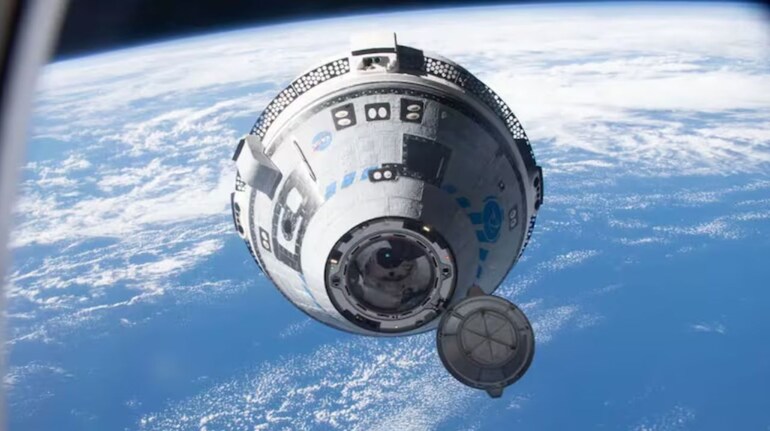
Boeing Starliner spacecraft, hailed as a space capsule "by astronauts, for astronauts," is set to return to Earth without its human crew. This decision comes as a surprise and highlights the challenges faced by one of NASA’s most ambitious projects.
The Boeing Starliner, which carried Indian-origin NASA astronaut Sunita Williams to the International Space Station (ISS) on June 5, was initially celebrated as a cutting-edge space capsule. However, due to ongoing technical issues, the spacecraft is now scheduled to return to Earth without any crew on September 6, operating in autonomous mode. The Starliner is expected to land approximately six hours after undocking from the ISS.
The spacecraft, which has been plagued by delays and setbacks, was on its first crewed test flight. Alongside Williams was astronaut Barry "Butch" Wilmore, both of whom were set for an eight-day mission that has now extended well beyond its original timeline due to propulsion issues.
Read Also: World's giant 'gateway to hell' in Siberia triples in size in 30 years and continues to expand: Why scientists are worried?NASA announced on August 24 that the astronauts would remain aboard the ISS until February 2025, while the Starliner would return to Earth uncrewed. This decision was made after careful consideration of the spacecraft’s performance and the desire to minimise risk to the crew.
NASA and Boeing held a "tense" meeting where the choice to bring the Starliner back without astronauts was unanimously agreed upon. The decision underscores NASA's commitment to safety, as emphasised by NASA Administrator Bill Nelson, who stated, "Spaceflight is risky, even at its safest and most routine. A test flight, by nature, is neither safe nor routine."
Despite the challenges, Boeing remains confident in the Starliner’s capabilities. The company highlighted that the uncrewed return would allow NASA and Boeing to gather valuable data while avoiding unnecessary risks. Boeing has assured that extensive testing has confirmed the health of 27 out of 28 RCS (reaction control system) thrusters, maintaining redundancy and stable helium levels within the propulsion system.
Boeing also confirmed that the issues with the spacecraft’s thrusters and helium levels had been addressed, and the data gathered would support future missions. "Our confidence is based on this abundance of valuable testing from Boeing and NASA," the company stated.
Read Also: What causes snakes to shed their skin? The reason might surprise youThe Boeing Starliner, which Sunita Williams had the opportunity to name "Calypso," after the famed oceanographic research vessel, was designed to carry up to seven crew members. It has a partially reusable crew module, intended to fly up to 10 missions. However, the development of the Starliner has been marred by delays and budget overruns, drawing comparisons to SpaceX’s Crew Dragon, which has been operational since 2020.
NASA awarded Boeing a $4.2 billion contract in 2014 to develop the Starliner, but the project has faced multiple setbacks. In contrast, SpaceX delivered the Crew Dragon at a lower cost and within a shorter timeframe.
NASA has affirmed its commitment to the Starliner’s development, with Administrator Nelson expressing full confidence in its future. However, Boeing will be responsible for any additional costs incurred in certifying the Starliner as a human spaceflight vehicle, under the terms of their fixed-price contract.
As Boeing continues to work on resolving the technical challenges, the return of the Starliner will provide crucial insights that could shape the future of human space exploration.
Read Also: Saturn's iconic rings to disappear before March 2025; will we ever see them again? Check what experts sayDiscover the latest Business News, Sensex, and Nifty updates. Obtain Personal Finance insights, tax queries, and expert opinions on Moneycontrol or download the Moneycontrol App to stay updated!
Find the best of Al News in one place, specially curated for you every weekend.
Stay on top of the latest tech trends and biggest startup news.