How on earth does one manage to get the name of the hero wrong in the series adaption of a novel that has been loved by millions of people over more than 150 years? But that is exactly what the new mini-series of Charles Dickens’ Great Expectations, co-produced by the BBC and streaming on Disney+Hotstar, does. I stopped watching after two episodes.
About 40 minutes into the first episode, Pip, the hero, is called “Phillip Gargery” by his friend Biddy. But Gargery is the family name of Joe, Pip's sister’s husband. In the very first line of the novel, Dickens reveals his first-person narrator’s name. “My father’s family name being Pirrip, and my Christian name Philip, my infant tongue could make of both names nothing longer or more explicit than Pip. So, I called myself Pip, and came to be called Pip.” This mistake is unforgiveable. Imagine Byomkesh Bakshi being called Byomkesh Bhatia in a film.
Great Expectations is perhaps Dickens’ most successful book, both critically and commercially, and regularly finds a place in lists of greatest English novels of all time.
When one watches a film (or limited series) of a beloved literary classic, the least that one expects is that the movie would be faithful to the author’s vision. This mini-series deviates so much from the original text that one begins to wonder whether the makers even read the book in full, or just relied on the Wikipedia entry on the novel’s plot.
This is not the Great Expectations that anyone has ever known.
Dickens’ story goes thus: Pip, a child from a poor rural family, is hired by the rich Miss Havisham to come once a week to her manor and play with her adopted daughter Estella. Miss Havisham, who was jilted by her fiancé at the wedding altar, is a half-crazed sociopath who has not taken off her wedding dress since then and dreams of wreaking revenge on all men. She has taught Estella to torment and spurn men, and Pip is a guineapig in this elaborate experiment.
Associating with the Havishams makes Pip aspire to become a wealthy “gentleman” and Miss Havisham cruelly manipulates this “great expectation”. Pip’s ambition and consequent snobbery make him reject people who truly love him and lead him into a life of misery. It takes him many years to realize that loyalty and compassion are much more important than social standing or wealth. The novel is intricately plotted, with breathtaking twists and turns towards its end—in fact, till its very last line.
So what have the makers of this mini-series done with it?
When we meet Pip in the novel, he is a pre-teen boy who has just begun to attend school and can barely read and write. He is described as an “undersized” child whom the convict Magwitch can easily pick up and dangle upside down. In fact, his brother-in-law Joe Gargery often carries little Pip on his shoulders. Pip’s age, educational level and innocence are absolutely crucial to how Dickens unfolds his tale. However, this new version introduces Pip as a strapping 15- or 16-year-old who is the most well-read boy in his village.
Perhaps the makers thought that Pip as a brooding intellectual teenager who uses cusswords would pack a bigger punch for young 21st century audiences, and plot logic be damned. Next what? A film in which Romeo and Juliet are thirtysomething lovers jaded with life?
And then come the horrors. Dickens’ Mrs Joe, Pip’s sister, has serious anger management issues and even beats up her husband. But here, the couple revels in kinky sex, with the wife caning Joe’s naked buttocks. I could not fathom what this achieves other than serving up some cheap thrills to a section of viewers.
In this mini-series, Miss Havisham and Estella give Pip a local housewife as a gift on his 18th birthday, so that he can lose his virginity. Apart from being another nauseating ploy to cater to viewer prurience, this makes no sense. All logic dictates that Miss Havisham would want to make sure that Pip stays a virgin and sexually frustrated for as long as possible, while she messes with his mind with the lure of Estella.
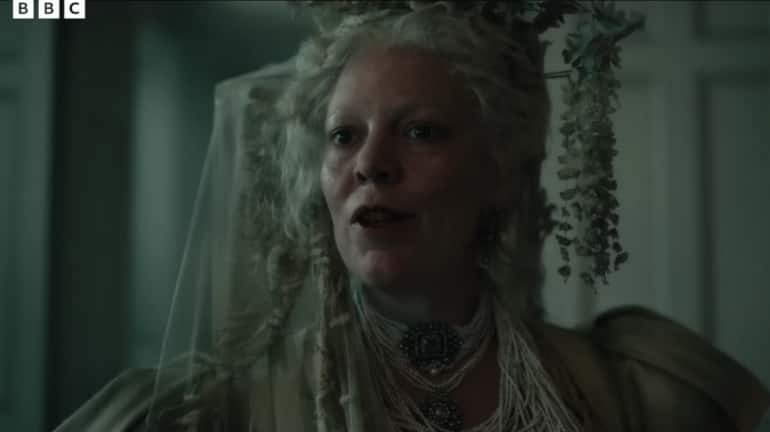 Olivia Colman as Miss Havisham. (Screen grab)
The makers also pile on extreme violence, in case the gratuitous sex cannot deliver enough number of eyeballs. And all of Dickens’ wit and humour is clinically drained out to create a morgue-like atmosphere.
Left-liberal analyses that are entirely irrelevant to Pip’s progress in life are inserted with as much nuance as the hammer that Joe the blacksmith wields.
We are told that the British empire thrived on slave trade, opium and indigo. Women in early 19th century Britain, it is pointed out, did not have the same rights that men enjoyed. Brilliant insights that have nothing to do with anything and only slow down the pace of the story.
And of course, we get a multi-racial cast. Estella and the sinister lawyer Jaggers are played by Black actors. Indian-origin men portray Jaggers’ clerk Wemmick and Pip’s friend Herbert Pocket. We have now got used to this, but I tend to agree with what Shekhar Kapur told a BBC interviewer last week.
Kapur said that the inclusion of ethnic-minority actors in shows where the characters are obviously white in body and mind is a “good thing” because it provides more opportunities to actors of colour. But, he added, this cast diversity is essentially a “guilt trip” that hides “a greater, more fundamental issue” about what stories are selected to be made into films. These are mostly “white” narratives. “Hollywood should be telling stories of that culture,” he said, “of the culture of the brown people, of the African-American people, of the Black people, of Asians.” Casting a few Brown or Black actors in White roles is much easier than a real effort to end racism.
Great Expectations is perhaps the most-filmed novel ever, with at least 17 film versions already there—and that’s only in English. So the world may not have been exactly hankering for another adaptation. But why did the makers alter so much of the source material?
They seem to have been intent on imposing modern values and political theories on a story set in the early 19th century and make it more “contemporary” and “edgy”— terms that are in vogue right now but mean little more than showing more sex and gore. So a blunt axe is used on a literary masterpiece, which has a timeless and universal appeal, far beyond any specific ideologies.
If viewers who are unfamiliar with the novel believe that this TV series represents what Dickens wrote, they would be sorely mistaken. And Dickens, if he were alive today, would be horrified. Lurid, humourless and pompously virtue-signalling, this Great Expectations is an insult to a great novel and its writer. But then, what can you expect from people who cannot even get their hero’s name correct?
Discover the latest Business News, Sensex, and Nifty updates. Obtain Personal Finance insights, tax queries, and expert opinions on Moneycontrol or download the Moneycontrol App to stay updated!
Find the best of Al News in one place, specially curated for you every weekend.
Stay on top of the latest tech trends and biggest startup news.