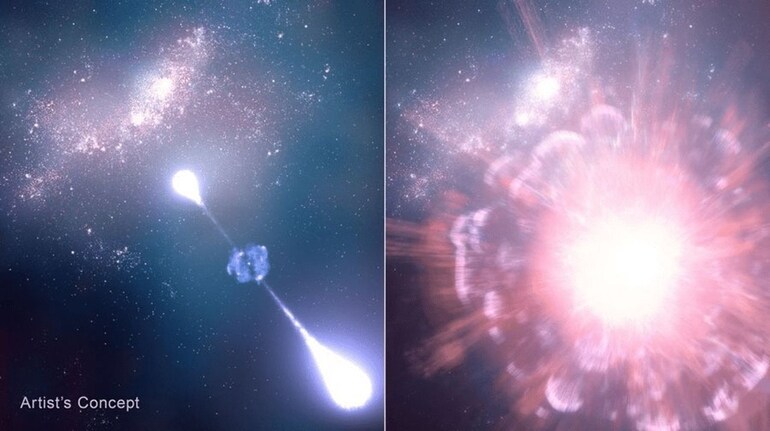
Astronomers have used the James Webb Space Telescope to study a distant supernova that formed soon after a major gamma-ray burst in March 2025. The event comes from a time when the Universe was only 730 million years old, researchers said.
Supernova Seen in Early Universe
The supernova appears in a galaxy from the Era of Reionisation. Webb observed the star months after the burst ended. Its light took months to grow because expansion stretched it. Astronomers waited about 3.5 months before using Webb. That was when the fading star should appear brightest.
The gamma-ray burst is named GRB 250314A. It was first detected by the SVOM telescope on 14 March 2025. Swift then located the x-rays. Other telescopes also gathered useful data. Weeks later, Webb found the star that created the burst.
 This JWST NIRCam image highlights the GRB and supernova set within a vast field of distant galaxies. Identifying a single star from such an early era is a remarkable achievement. (Image: NASA, ESA, CSA, STScI, A. Levan (IMAPP), Image Processing: A. Pagan (STScI))
Two papers in Astronomy and Astrophysics Letters outline the findings. One is led by Andrew Levan of Radboud University. The second is led by Bertrand Cordier of CEA Paris-Saclay. Both papers describe how Webb confirmed a supernova tied to a long gamma-ray burst. “Only Webb could reveal that this light comes from a supernova,” Levan said in a release.
Why This Star Matters for Research
Researchers say long gamma-ray bursts map star formation across time. Their supernovae show how stars lived in early epochs. Cordier said these bursts help reveal young galaxies usually too faint for Webb. This supernova brightened slowly because of its extreme distance. Webb gave rapid and sensitive support, said co-author Benjamin Schneider.
Levan said only a few such early bursts have been seen in five decades. CNN reported that this event is rare and significant. Stars then had lower metals and shorter lives. Yet Webb showed this supernova looks much like modern ones. “We went in with open minds,” said researcher Nial Tanvir.
The host galaxy appears faint and small in Webb images. More data may help reveal its true details. The team hopes deeper observations will uncover small differences that distance may hide.
What Researchers Plan Next
Scientists modelled expected light curves before using Webb. Observed light matched the predictions very closely. Levan’s team noted some uncertainty about faint galaxy light blending with the supernova. They wrote that more variability checks are needed. A later Webb visit could measure the galaxy’s own light more clearly.
Cordier’s team said a future mission that finds such bursts quickly could help greatly. They believe an independent detector could study early stars faster.
The JWST team has now been given more observing time. They plan to track warm afterglow from other early gamma-ray bursts. Levan said that glow may offer a clear “fingerprint” of ancient galaxies.
Discover the latest Business News, Sensex, and Nifty updates. Obtain Personal Finance insights, tax queries, and expert opinions on Moneycontrol or download the Moneycontrol App to stay updated!
Find the best of Al News in one place, specially curated for you every weekend.
Stay on top of the latest tech trends and biggest startup news.