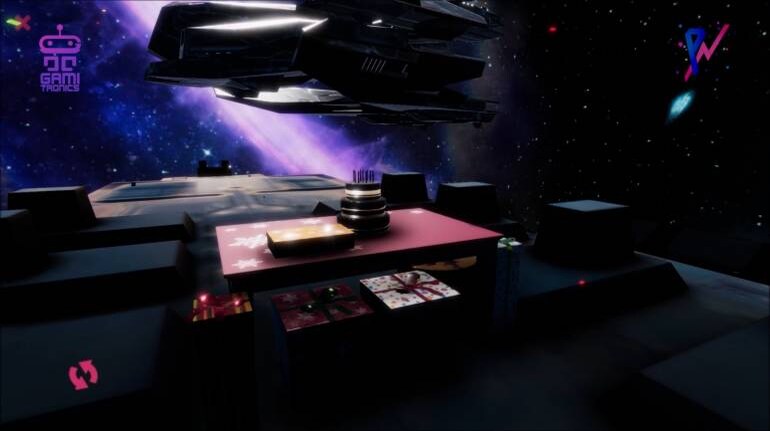
Imagine you are about to get married, and desire a spectacular wedding set on a spaceship with a backdrop of stars and galaxies. Or perhaps you are a car brand, eager to showcase your latest model atop Mount Everest. All of this can be made possible virtually, using just a few simple user commands.
Hyderabad-based Gamitronics is using the latest advances in generative artificial intelligence (AI) to build a tool that will help people create virtual 3D worlds through a single text prompt.
The tool, called Brahamand, enables developers and businesses to enter their descriptions into a text box and generate 3D scenes or build 3D worlds as per their needs, Gamitronics CEO Rajat Ojha told Moneycontrol. It will be initially available as an extension to Gamitronics's metaverse platform PartyNite.
Also read: In the AI age, expect new trends in demand for land, labour and energy
For instance, people can enter scenario descriptions, such as a seminar at the beach while it's raining or a car launch set-up while it's snowing at New York's Times Square, to a text box to generate virtual worlds that depict them on PartyNite.
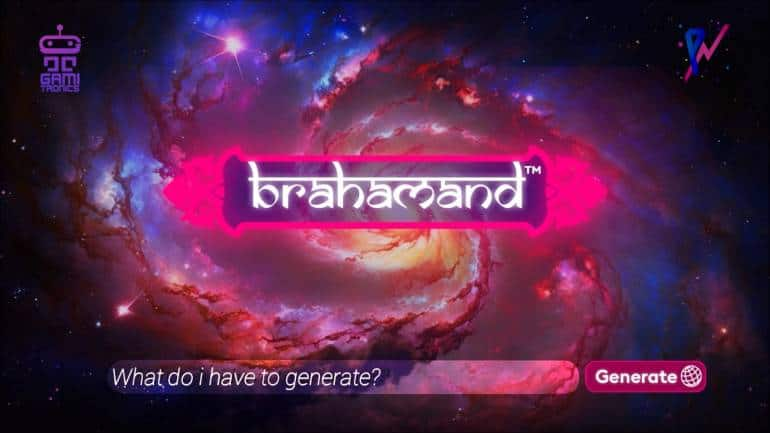 Brahamand enables developers and businesses to enter their descriptions into a text box and generate 3D scenes or build 3D worlds as per their needs
This launch comes amid a heightened buzz around generative AI – a technology that can generate text, images, sounds and videos based on short commands or prompts from users – spurred by the popularity of products such as ChatGPT and Dall-E, both developed by Microsoft-backed AI research lab OpenAI.
To capitalise on this rising trend, tech giants and internet companies such as Google, Microsoft, Meta, Adobe, Snap Inc, Grammarly, and Zoom have introduced or announced plans to launch products and tools infused with generative AI capabilities.
Shifting biz model from service to platform
Ojha said this launch will pave the way for the company to shift from a service-based business model to a platform-based model, similar to Roblox or Minecraft, thereby catering to a significantly broader audience with an ambition to touch the 100 million user mark by next year.
"We don't want to be in the service business, we want people to come and create their own world and spaces instead of us doing it for them," Ojha said "So far, we have been doing stuff for them, but we aim to be a Roblox or a Decentraland but a better version"
Ojha said this tool is currently being internally used by a few agencies with a planned initial rollout in April 2023 and a public launch in May 2023, when the company will allow people to buy virtual land on its metaverse.
It also plans to shortly extend the tool capabilities to support avatar creation, enabling users to create virtual human models with custom physical features such as height, weight, size, shape, hairstyle, and other features such as piercings and tattoos as per their needs.
"With this launch, I will give them the tool and the place. Agencies will come as the 'meta architects', wherein they will give the intent, build and customise the scenarios as per the customer's needs and deliver to brands," he said.
"This is currently in the hands of more than 250 people right now and our latency time has been like 3-4 seconds," he said. The tool will be offered on a monthly or an annual licence fee model, he added.
On March 21, rival Roblox announced a set of artificial intelligence-based tools – Material Generator and Code Assist – that helps developers create in-game 2D game surfaces with text prompts as well as assist them in creating simple code snippets with minimum effort respectively, in a bid to boost game and asset creation on the platform. Both the tools are however currently in the beta phase.
"What we have already started to see through internal prototypes is that specialised generative AI tools can not only accelerate creator productivity but can also significantly drop the technical skills needed to bring ideas to life," Roblox chief technology officer Daniel Sturman said in a blog post in February 2023.
Unity Software, which produces the eponymous game engine, announced plans to introduce game development tools based on generative AI to create 3D experiences for users on March 21.
Meanwhile, Microsoft has internally demoed a generative AI version of Minecraft wherein users can tell the platform what they want to build, according to a Semafor report.
Ojha, who started Gamitronics with Chhota Bheem creator Rajiv Chilaka in 2017, however, believes that they have an edge over its rivals since they bring an India context to these tools, powered by a homegrown AI engine and India-centric content that includes the country's traditional and cultural elements.
"We want the tool to have the flavour, look and feel, voices and the texture of India. For this, we are working with several folks in the country's creative industry," he said.
PartyNite currently works with prominent media agencies such as GroupM, Ogilvy and Madison and organisations such as Van Heusen, ICICI Bank, ISRO, Bharti Airtel, Paytm Insider and Bangalore International Airport Ltd (BIAL).
Brands that come on board to build their presence on the PartyNite platform pay the company platform fees, customisation fees and avatar creation fees. They also need to shell out land fees to the company in case they want to retain their virtual presence on the platform beyond a week.
"The larger vision, however, is to become a community-focused place rather than a brand-focused place and we're constantly working towards it. This tool is a step in that direction," Ojha said.
"While B2B (business-to-business) is great and that's where most of our revenues is coming from, with many big implementations coming our way, our primary focus right now is on B2C (business-to-consumer), since consumers will just run away from the place (PartyNite) if it becomes too much of B2B," he added.
Beyond the metaverse
Gamitronics plans to remain focused on the India market due to its captive audience, however, they are exploring different use cases for Brahamand beyond its metaverse offerings, Ojha said.
For instance, the tool will allow people to also submit a script which gets converted into visuals that can be used to create an entire animated episode with characters, events, and a 3D immersive world around it, he said.
In the coming months, Gamitronics plans to allow developers to export these 3D visuals to game engines such as Unreal Engine, Unity and Blender.
"Brahamand has the potential to be disruptive for pre-visualisation, animated shows and creating user-generated content," Ojha said.



Discover the latest Business News, Sensex, and Nifty updates. Obtain Personal Finance insights, tax queries, and expert opinions on Moneycontrol or download the Moneycontrol App to stay updated!
Find the best of Al News in one place, specially curated for you every weekend.
Stay on top of the latest tech trends and biggest startup news.