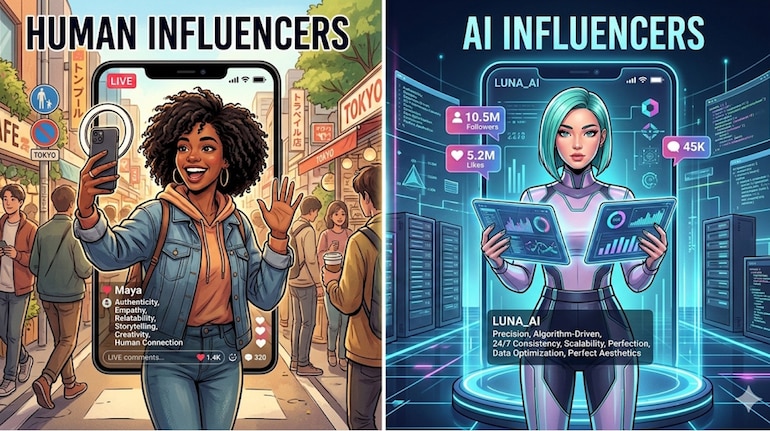
Artificial intelligence has already disrupted IT services, customer support and even parts of media production. Now, it is inching toward another fast-growing industry: the creator economy.
AI isn’t just helping influencers edit faster or draft captions. It is beginning to replace them — at least in certain use cases.
According to data from Qoruz, a creator intelligence and collaboration platform, there are currently around 200 active AI influencer profiles in India with a minimum of 50,000 followers. Nearly 90 percent of these accounts were created after 2023, with the remaining 10 percent launched between 2020 and 2022.
Though still a niche category, virtual influencers are expanding steadily, clocking about 6 percent month-on-month audience growth.
Most AI influencers in India operate in fashion and beauty (52 percent), followed by lifestyle and travel (25 percent), and arts and entertainment (12 percent). Of the 200-plus AI profiles tracked, 15–25 percent have secured at least one paid collaboration. On average, these accounts do 6–12 paid posts annually, with a repeat brand rate of just 4 percent — indicating that most partnerships are still experimental rather than long-term.
Edge of AI influencers
For brands, the appeal is obvious: scale, speed and control.
“Make hundreds of such accounts on social media. Gain followers over time by dancing to every next trend. And when the next song needs to go viral, use these hundreds of accounts. They may be AI, but their audience is real,” said Aditya Gurwara, Co-Founder – Brand Alliances at Qoruz, referring to an AI-generated influencer dancing to trending audio.
“So no creators needed?” he added, only half-jokingly.
Globally, virtual characters like Lil Miquela have long demonstrated the commercial viability of AI personalities. In India, brands across FMCG, fashion and even fintech are beginning to experiment with AI-generated faces for Instagram Reels and YouTube Shorts.
“We’re seeing AI influencers being deployed very strategically to drive conversations, product launches and even cultural moments,” said Raj Mishra, CEO of Chtrbox. “Agility is their biggest advantage. An AI influencer can be remixed and redeployed around a trend within hours — at a speed no human creator could match.”
For well-defined, lower-funnel campaigns focused on product demonstrations or aesthetic visibility, AI influencers are already competitive, said Ritesh Ujjwal, Co-Founder of Kofluence.
“For specific, ROI-focused campaigns, AI influencers are a commercially viable alternative, and brands will deploy them accordingly. That is a reality the industry must acknowledge,” he said.
In high-volume, brand-mascot style or repetitive content formats, AI personas could easily eat into opportunities that would otherwise go to human nano and micro influencers.
Growing concerns
But the rise of AI influencers also raises uncomfortable questions about authenticity, sustainability and livelihoods.
“The creator economy has always evolved with technology, and AI influencers are the next chapter of that evolution,” Mishra said. “That said, there are legitimate concerns around market saturation and dilution of authentic storytelling, which has been the backbone of influencer marketing.”
If hundreds of AI-generated personas flood social media feeds, competing for the same brand budgets, the immediate pressure will fall on smaller human creators who depend on collaborations for income.
Ujjwal warned that while AI influencers are cheaper and scalable, an ecosystem overloaded with undifferentiated synthetic content could lead to audience fatigue.
“AI influencers can produce at scale and at significantly lower cost, which is commercially attractive for certain campaign types. But when audience attention erodes, brand ROI follows,” he said.
The Qoruz data underscores this fragility. AI influencers currently generate significantly lower baseline engagement than their human counterparts.
The average engagement rate for AI influencers stands at 1.5 percent, compared to 4 percent for human creators. Engagement volatility is also 1.8 times higher, meaning AI profiles see sharper spikes during viral moments but struggle to sustain long-term loyalty.
In other words, novelty can spark clicks — but not necessarily community.
Where humans still win
Despite AI’s speed and scale, experts believe that human creators retain a durable edge.
“What we’re noticing is that trend-driving requires genuine cultural resonance, and that’s still an area where human creators have a clear advantage,” Mishra said.
A consumer considering a premium smartphone, for instance, may want more than a visually polished demo.
“A buyer still wants a human tech creator to validate the tactile experience of using it — not just enumerate its specifications,” Ujjwal said. “That emotional endorsement — the sense that someone authentic and credible recommends this — remains beyond AI’s current reach.”
Creators who have built trust, niche authority and long-term communities are less vulnerable to displacement.
“The creators who have invested in building genuine community authority and category depth have very little to fear from this shift,” Ujjwal added.
For now, AI influencers appear to be expanding the market rather than fully cannibalising it. But as tools become more sophisticated and cheaper, the lines between synthetic and human influence will blur further.
If IT professionals were the first to feel automation’s tremors, creators may be next. The question is not whether AI will enter the influencer economy — it already has. The real question is how quickly the balance between algorithms and authenticity will shift.


Discover the latest Business News, Sensex, and Nifty updates. Obtain Personal Finance insights, tax queries, and expert opinions on Moneycontrol or download the Moneycontrol App to stay updated!
Find the best of Al News in one place, specially curated for you every weekend.
Stay on top of the latest tech trends and biggest startup news.