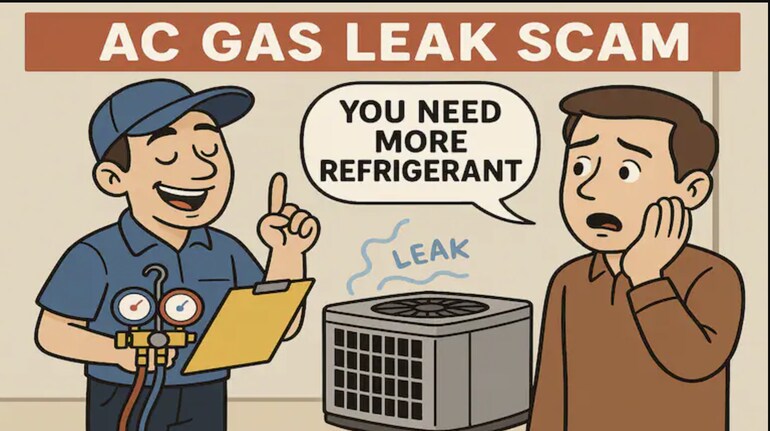

Summer is here, and that usually means it’s time to get your air conditioner serviced. And almost every time, there’s one familiar line you’ll hear from the technician: “Sir, AC ka gas leak hai. Refill karna padega.”
The real issue is this — most homeowners don’t know what the correct gas pressure level should be in their AC. Because of that, it becomes difficult to judge whether the technician is genuinely pointing out a leak or simply trying to upsell a refill. That’s exactly how the common AC gas leak scam plays out.
Let’s break it down step by step.
AC gas leak scam: How it works
Step 1: You book a routine AC service — either from a local technician or an authorised service centre.
Step 2: The technician begins the standard cleaning process.
Step 3: Midway through the service, you’re informed that the AC has a gas leak and needs a refill.
Step 4: You ask about the cost.
Step 5: The technician quotes a price.
Step 6: After some negotiation, you agree.
Step 7: The technician “refills” the gas and collects the payment.
On the surface, this process seems normal. And yes, sometimes an AC genuinely does have a gas leak that requires refilling. The concern arises when there is no actual leak, but the technician claims there is one and pretends to refill the gas — charging you for something unnecessary.
So how can you protect yourself?
What’s the solution?
The simplest way is to understand the correct gas pressure levels required for your AC to function properly.
We spoke with an AC installation professional to understand the standard pressure levels. Below are the approximate pressure ranges for a 1.5-ton AC:
| Refrigerant | Running Pressure (PSI) | Close Pressure (PSI) |
|---|---|---|
| R32 | 130–140 | 240–280 |
| R410 | Same as R32 | Same as R32 |
| R22 | 60–65 | Around 150 |
How to stay protected using this data
Before the servicing begins, switch on your AC and ask the technician to check the gas pressure while the unit is running. Compare the reading with the “Running Pressure” values in the table.
Next, ask for the pressure reading after the AC is turned off and match it with the “Close Pressure” range.
If the readings fall within the expected range, there is likely no need for a gas refill.
Simply being aware of these numbers can discourage dishonest practices. When a technician knows that you understand the correct pressure range, the chances of unnecessary refills being suggested drop significantly.


Discover the latest Business News, Sensex, and Nifty updates. Obtain Personal Finance insights, tax queries, and expert opinions on Moneycontrol or download the Moneycontrol App to stay updated!





Find the best of Al News in one place, specially curated for you every weekend.
Stay on top of the latest tech trends and biggest startup news.