-
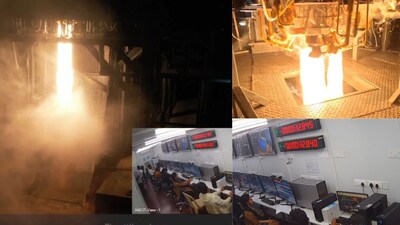
First Time in India: With ISRO and IN-SPACe, India conducts its "first semi-cryogenic engine" cluster test
India has achieved a major space milestone as Agnikul Cosmos successfully test fired three 3D-printed semi-cryogenic rocket engines together, marking a first for the country’s private space sector.
-

A 410-foot, building-sized asteroid to sweep past Earth today at 21,306 miles per hour, NASA alerts
Asteroid 2025 YU15 will sweep past Earth at remarkable speed this February, drawing global attention and raising questions about how closely scientists are watching the next celestial visitor.
-
ISRO rocket debris reaches Maldives shore. How did it drift this far? Here’s what you need to know
A fragment bearing the ISRO logo has washed ashore on an uninhabited Maldivian island. Experts believe it is a rocket fairing from a recent Indian launch, raising fresh questions about drifting space debris and its marine impact.
-
Meet Aditya Pandya: This 17-year-old became India’s youngest analogue astronaut to complete a lunar mission held in Gujarat
Seventeen-year-old Aditya Pandya becomes India’s youngest analogue astronaut after spending eight days inside a Moon-like habitat in Gujarat. He not only lived in a lunar-like habitat under strict isolation but also designed key hardware systems, including air-quality sensors and biometric monitoring tools.
-
ISRO fast-tracks space station while developing 80 satellites to support Mission Gaganyaan
ISRO is fast-tracking its space station and 80 satellites. Scientists say these missions will support research, communications, navigation and India’s human spaceflight programme known as Mission Gaganyaan.
-
After its failure in 2021, ISRO prepares for GISAT-1A launch, the satellite to head Sriharikota soon
After a failed launch in 2021, ISRO is preparing to send GISAT-1A into orbit. The powerful satellite will provide near real-time images to support disaster response, climate monitoring and national planning.
-
Sun emitting solar flares since Feb 1, disrupting communications: Why it’s happening and will India face blackouts?
In India, Indian Space Research Organisation said it is closely tracking the situation and warned of possible radio blackouts if solar activity continues.
-
India on high alert as Sun unleashes powerful solar flares towards Earth; ISRO warns of radio and power blackouts
India braces as the Sun unleashes powerful flares, threatening satellites, communications, and power grids. ISRO monitors over 50 satellites, warning of potential blackouts, while scientists watch for the next volatile solar outburst.
-
The mystery of Saraswati: Does this Indian river vanish or flow as the Ghaggar-Hakra beneath the Earth
Across India’s deserts, scientists trace a vanished river linked to Saraswati, where satellite clues, buried channels, and ancient settlements raise fresh questions about climate change, civilisation collapse, and myth history.
-
ISRO director confirms Chandrayaan-4 will bring back samples from moon
India’s Chandrayaan‑4 mission aims to bring Moon soil and rocks back to Earth. The ambitious mission could reveal the Moon’s ancient secrets and strengthen India’s space leadership.
-
Budget 2026: DoS, ISRO allocation rise to Rs 13,706 crore in FY27, space sciences see sharp jump
The increase in budget outlay includes expenditure on ISRO’s rocket and satellite projects, infrastructure at key centres and so on
-
IMEx‑2026 by ISRO: What, When, How and Where Indian scientists can explore space
ISRO has launched IMEx‑2026, inviting Indian scientists to conduct experiments in microgravity. From biology to materials science, researchers now have a chance to explore phenomena only possible in space. Proposals are open until 28 February 2026.
-
NASA-ISRO’s new radar vision peers through clouds to reveal the Mississippi river delta in striking detail
A new radar image from NASA and ISRO’s NISAR satellite cuts through clouds to reveal hidden landscapes, offering an early glimpse of how the mission could reshape Earth monitoring worldwide.
-
India’s next giant leap: ISRO shifts from space missions to permanent presence with Bharatiya Antariksh Station
This step, taken through an Expression of Interest, is the first tangible move towards placing Indians in a continuously occupied orbital laboratory, with the debut module targeted for launch in 2028.
-
Space Gen: Chandrayaan Review: An honest look at ISRO’s triumph, told without enough depth
‘Space Gen: Chandrayaan’ captures the struggles and determination behind India’s lunar mission. It tells the story of the scientists who turned failure into a historic success.
-
Gaganyaan Delayed: ISRO withdraws support from Hawaii, after PSLV failure
India’s Gaganyaan mission may face a slight delay after ISRO withdrew a Hawaii ground-station request. Officials deny links to the PSLV failure, confirming the human spaceflight programme remains on track.
-
When ISRO's PSLV-C62 failed, a football-sized satellite refused to go quietly: Inside story of Spanish 'KID'
The satellite was designed to test re-entry technologies and was meant to eventually splash down in the South Pacific Ocean
-
Why ISRO’s PSLV-C62 fell short: Ex-scientists explain what likely went wrong in crucial third stage
ISRO stated, 'The PSLV-C62 mission encountered an anomaly during the end of PS3 (third stage) of the vehicle. A detailed analysis has been initiated'
-
Rakesh Sharma turns 77: India’s First Astronaut who paved way for future space missions
January 13 marks the birthday of Rakesh Sharma who became India’s first astronaut in 1984 inspiring generations. He turned 77 today. His historic flight opened new paths for India’s space missions and human spaceflight ambitions.
-
16 satellites lost in space: What went wrong with Isro's PSLV-C62 launch
The incident marks the second consecutive failure involving the PSLV's third stage, following a similar issue in May 2025
-
PSLV-C62 Launch: ISRO launches PSLV-C62 with powerful surveillance satellite
ISRO has launched the PSLV-C62 rocket carrying the Anvesha hyperspectral satellite on 12th January 2026. The mission strengthens India’s Earth observation, defence surveillance and climate research capabilities from space.
-
ISRO to kick off India’s space year with PSLV-C62 launch on January 12: Key details
With an Earth observation satellite named 'Anvesha' onboard and a polar orbit ahead, PSLV-C62 marks how India is starting its space journey this year.
-
ISRO's Aditya-L1 decodes how solar storms impact Earth's magnetic field
The space agency noted that this phenomenon occurs only during severe space weather events.
-
ISRO rings in the new year with PSLV-C62, launching EOS-N1 and 18 satellites into orbit
India opens 2026 with a crucial PSLV launch carrying a powerful surveillance satellite and experimental payloads, marking a comeback mission that could reshape how the country watches Earth from space.
-
ISRO detects tiny interplanetary particles with ground-breaking DEX experiment
ISRO’s Cosmic Dust Experiment detects interplanetary particles in orbit, revealing hidden cosmic traffic, advancing India’s space science and providing global insights into space hazards and satellite safety.