-
Cosmic lens revealed hyperactive cradle of a future galaxy cluster
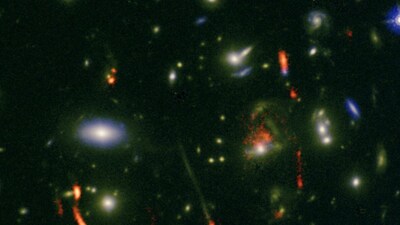
Astronomers used a cosmic lens to reveal a hyperactive protocluster. ALMA and VLA observations uncover tightly packed galaxies forming stars rapidly, offering unprecedented insight into the early universe’s largest structures.
-

James Webb Telescope finds mysterious "red dots" in early universe
James Webb has spotted mysterious little red dots in the early universe that may actually be hidden black holes, challenging long-held ideas about how galaxies and cosmic giants formed.
-
NASA James Webb telescope spots ‘Astronomy’s Platypus’ hiding in the early universe
NASA’s Webb Telescope has identified compact, mysterious galaxies nicknamed “astronomy’s platypus.” These strange objects defy classification, offering insights into the early universe, galaxy formation and unexpected cosmic structures billions of years ago.
-
What if the universe is 'lopsided"? This new study changes everything we know
New research suggests the universe may be lopsided. Cosmic microwave background and galaxy data hint at directional differences, challenging cosmology’s assumption of uniformity and standard Lambda‑CDM models.
-
A planet without a Sun: Astronomers detect rare free-floating World 10,000 light-years away
Astronomers have spotted an Earth-sized planet drifting alone through the Milky Way, detected briefly by bent starlight, raising fresh questions about how many hidden, starless worlds roam our galaxy.
-
A Galaxy in Trouble: NASA's Hubble reveals gas escaping into the cosmos
Hubble has captured a galaxy losing vital gas as it races through a crowded cluster, revealing how harsh cosmic environments can slowly shut down star formation.
-
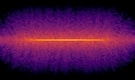
Dark matter "nuggets" could be lighting up our galaxy, here's what scientists think
Scientists suggest a mysterious ultraviolet glow across the Milky Way may come from dark matter nuggets, hinting that the universe’s invisible matter might not be completely dark.
-
Strange 7-hour deep space explosion leaves scientists searching answers
Astronomers tracked a gamma-ray burst lasting over 7 hours, unseen in visible light, from a dusty galaxy 8 billion light-years away, challenging existing models and raising new questions for science.
-
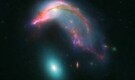
NASA reveals Penguin-shaped galaxies captured in a slow cosmic collision
New NASA images from Hubble and James Webb reveal the penguin-shaped Arp 142 galaxy pair, showing how gravity distorts galaxies and drives cosmic mergers across the universe.
-
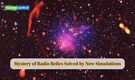
Astronomers finally explain the ghostly 'Radio Relics' in space
New simulations reveal how galaxy cluster collisions create ghostly radio relics. Turbulence and shock compression amplify magnetic fields, explaining their unusual brightness and radio emission patterns.
-
Milky way evolution revealed through AI-enhanced star-by-star simulation
Researchers combined AI and supercomputers to simulate 100 billion stars, reproducing galactic phenomena faster than ever, opening possibilities for astrophysics and other scientific disciplines.
-
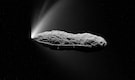
Alleged NASA leak of 3I/ATLAS image and Japanese ‘breathtaking view’ create online frenzy
Scientists believe 3I/ATLAS contains significant amounts of carbon dioxide, similar to comets formed in cold, distant star systems.
-
Astronomers detect mysterious ‘Blob of Darkness’ in a distant galaxy
Astronomers have detected a million-solar-mass “blob of darkness” in a distant galaxy, possibly a rare dark matter clump shaping the cosmos unseen.
-
NASA's hubble telescope spots asteroid trail while hunting supernova in distant galaxy
NASA’s Hubble Space Telescope captured a surprising asteroid trail while observing a distant spiral galaxy 102 million light-years away.
-
Enormous stellar jet erupting from monster star spotted by NASA’s Webb at Milky Way’s edge
NASA’s powerful telescope imaged a seething jet of gases. The eruption flows from a massive protostar in space. It speeds at hundreds of thousands of miles per hour.
-
NASA's Hubble shares image of ‘cosmic reef’ revealing galaxies shaped like an alien ocean
At the heart of the red nebula, called NGC 2014, lie bright young stars. Each is 10 to 20 times heavier than our Sun.
-
Superstructure 'Quipu' is officially the biggest thing in the Universe, stretching 1.3 billion light-years
The resemblance is striking when viewed through cosmic maps. The structure was found as part of the CLASSIX Cluster Survey using X-ray data.
-
Astronomers witness giant galaxy ‘turn on lights’ and awaken from 20-year slumber in real time
The light was coming from SDSS1335+0728, a modest spiral galaxy. This galaxy had been quiet for more than two decades.
-
Dormant black hole comes alive and spews explosive energy that stuns scientists
In a galaxy 300 million light-years away from Earth, a once-quiet black hole has woken up.
-
Samsung may launch Galaxy XCover 8 Pro globally soon: All the details
Samsung Galaxy XCover 8 Pro, the next rugged smartphone from Samsung, has allegedly appeared on the Geekbench benchmark platform, revealing a few key hardware details. Additionally, the device has reportedly been spotted on the TUV Rheinland website.
-
What Earth looks like from different planets in the Solar System
Have you ever wondered how our home planet, Earth, looks from other planets in our solar system? Let's take a cosmic journey to explore the breathtaking views of Earth from our celestial neighbors.
-
NASA's Hubble telescope captures beautiful supernova in Gemini constellation
NASA's Hubble Space Telescope captures stunning image of supernova SN 2022aajn, helping astronomers measure cosmic distances and refine our understanding of the universe.
-
Top 7 Most Beautiful Images of the Milky Way Shared by NASA's Hubble
Explore the breathtaking beauty of the Milky Way through stunning images captured by NASA's Hubble Space Telescope, revealing star clusters, nebulae, and cosmic wonders.
-
Citizen scientists discover a 'mysterious object' racing through space at 1 million miles per hour; find out what it is
This enigmatic object, now named CWISE J1249, has captured the attention of both amateur astronomers and experts alike due to its unprecedented velocity and intriguing characteristics.
-
NASA James Webb Telescope finds hidden supermassive black hole in distant galaxy, check image here
Astronomers using the James Webb Space Telescope (JWST) have made an astonishing discovery. A distant supermassive black hole is creating shockwaves of gas and dust in ways no one expected. This breakthrough offers new insights into the powerful processes shaping our universe.