Astronomers using the James Webb Space Telescope (JWST) have made an astonishing discovery. A distant supermassive black hole is creating shockwaves of gas and dust in ways no one expected. This breakthrough offers new insights into the powerful processes shaping our universe.
Surprising Findings About Shockwaves and Supermassive Black Holes
The JWST has imaged the structure of dust and gas around a distant supermassive black hole, revealing a surprising "shock" feature. The energy heating this swirling cloud of gas and dust comes from collisions with jets of gas traveling at near-light speeds. Previously, scientists believed the energy came directly from the supermassive black hole itself, making this discovery unexpected.
ESO 428-G14: A Galaxy with an Active Black Hole
The supermassive black hole in question is located in ESO 428-G14, an active galaxy approximately 70 million light-years from Earth. An "active galaxy" has a central region or "active galactic nucleus" (AGN) that emits powerful light across the electromagnetic spectrum due to the presence of a supermassive black hole consuming matter around it.
Insights from the Galactic Activity, Torus, and Outflow Survey (GATOS)
The shock AGN discovery was made by the Galactic Activity, Torus, and Outflow Survey (GATOS) collaboration, using dedicated JWST observations to study the centres of nearby galaxies. "We did not expect to see radio jets do this sort of damage. And yet here it is!" said GATOS team member David Rosario.
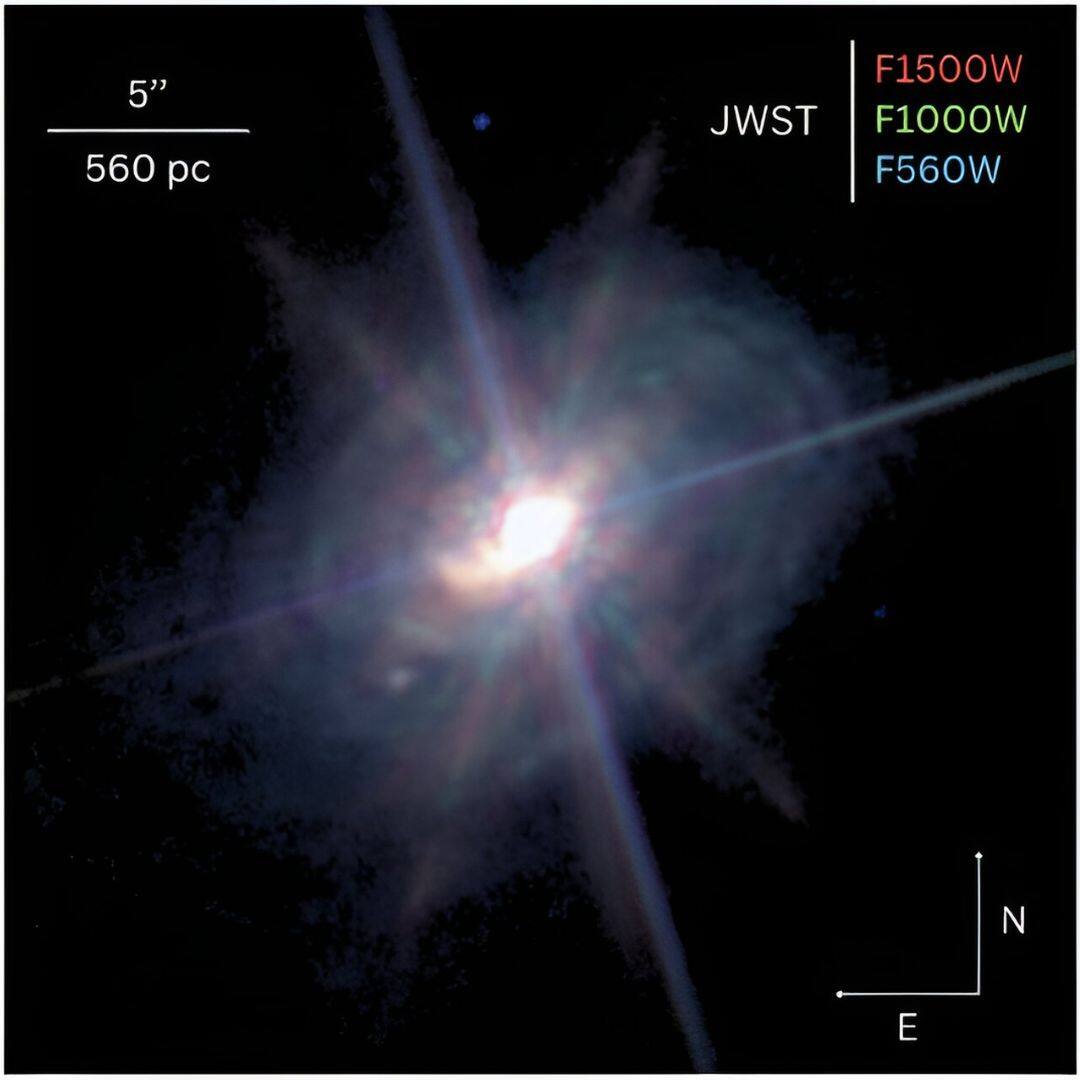 A three-colour image of the galaxy ESO 428-G14 taken by the James Webb Space Telescope. (Image: NASA/JWST)
The Role of Accretion Disks and Astrophysical Jets
Supermassive black holes, with masses ranging from millions to billions of times that of the sun, influence their surrounding matter in complex ways. For example, the black hole in Messier 87 (M87) is vastly more massive than the Milky Way’s Sagittarius A* (Sgr A*). The accretion disk around M87* shines brightly due to the friction generated by tidal forces, and powerful magnetic fields direct some of the matter towards the black hole’s poles, forming parallel astrophysical jets.
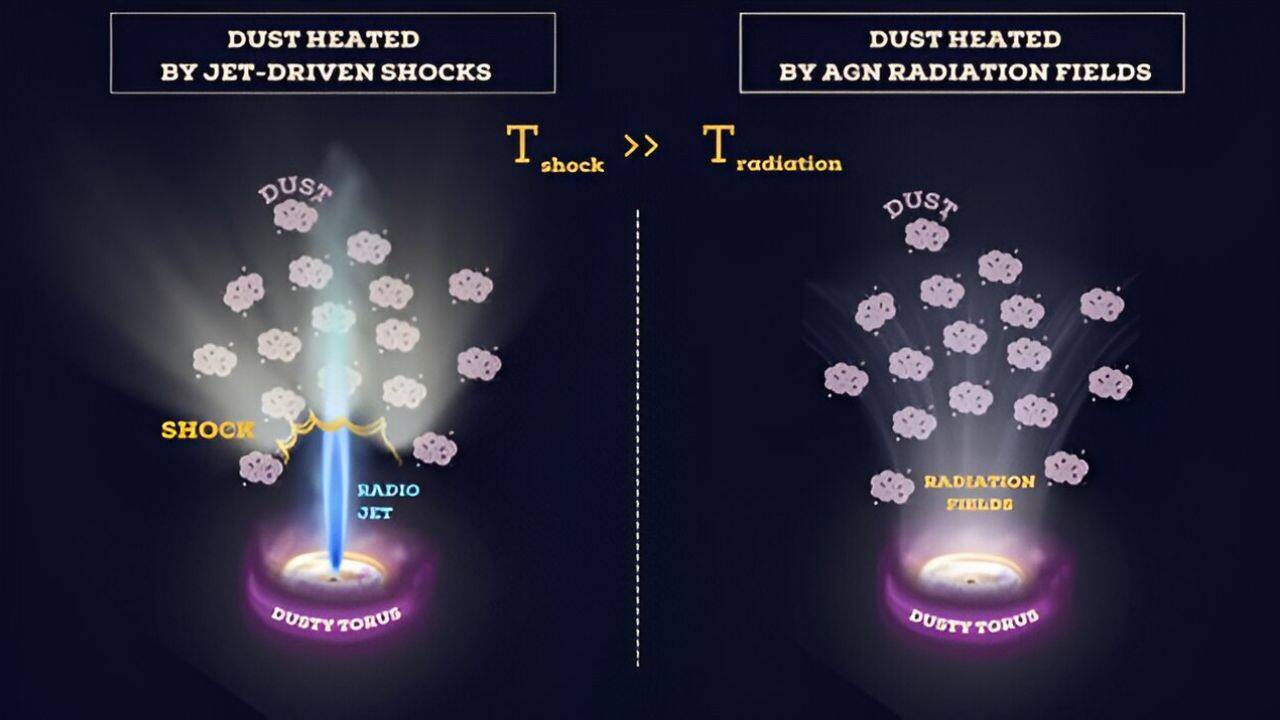 A diagram illustrating the impact of dust heated by jets (right) compared to dust heated by radiation fields (left). (Image: NASA/JWST)
Unlocking the Secrets of AGNs with Infrared Observations
Dust surrounding AGNs often blocks our view of their centres. However, infrared light can pass through this dust, and the JWST, which observes in infrared, is perfect for studying AGNs. The GATOS team found that dust near ESO 428-G14’s supermassive black hole spreads out along its jet, suggesting that these powerful outflows could be responsible for both heating and shaping the dust.
"Having the chance to work with exclusive JWST data and view these remarkable images before anyone else is incredibly exciting," said Houda Haidar, a PhD student at Newcastle University. "I feel very fortunate to be a part of the GATOS team and to collaborate with top experts in the field."
Discover the latest Business News, Sensex, and Nifty updates. Obtain Personal Finance insights, tax queries, and expert opinions on Moneycontrol or download the Moneycontrol App to stay updated!
Find the best of Al News in one place, specially curated for you every weekend.
Stay on top of the latest tech trends and biggest startup news.