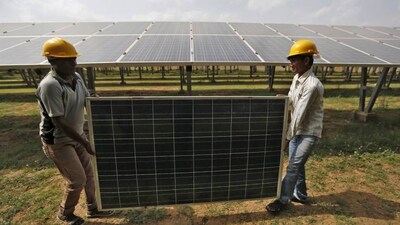
India spent $100 billion on clean energy in 2024, China $627 billion, say IEA
India looks set to reach its 2030 target of 50% non-fossil generation capacity ahead of schedule. There has been a surge in investment in renewables, led by solar PV, IEA has said in a report

Govt may extend PLI scheme deadline for solar module projects
Visa issues for Chinese technicians, supply chain disruptions, and slow technology transfer have hampered progress under the Production Linked Incentive scheme for solar modules.
The cautionary message from zero electricity prices
Supplies are exceeding demand during daytime and vice versa in the night on spot electricity market
Electricity prices crash to zero on exchanges as cooler weather cuts May power demand
With the monsoon arriving sooner, the Ministry of Power plans to reassess its peak power demand projections for this year, which are currently pegged at 270 GW.
Electricity trade between India-Bangladesh to continue amid other curbs
At 2.5 GW, Bangladesh is the biggest electricity export market for India as of now. Not just that, the neighbouring country uses India’s power grid to import electricity from Nepal.
Adani, Tata, Vedanta make a power play for coal-fired projects after five-year lull
The government expects Rs 6.67 lakh crore investment in thermal power by FY32 as firms rush to meet rising demand.
Incentivising adequate power capacity buildup to avoid blackouts
A countrywide blackout in Spain in April is a wakeup call for India’s power regulators on the downside of inadequate capacity in times of stress. It can be offset by a launch of short term standardized capacity contracts on exchanges and enforcing the resource adequacy obligations on utilities
India warns Pakistan of consequences if its infrastructure is targeted
India has beefed up its security for its strategic infrastructure such as power plants and refineries, even as the foreign secretary warned Pakistan against any attack on Indian assets.
Govt approves transmission network for biggest hydropower plant on Indus river system
The approval was notified in a record 40 days. The government usually takes several months to issue such clearances for hydropower projects, a ministry official said.
Union Cabinet approves revamped coal allocation policy as India plans to expand its thermal power capacity
The revised policy will offer an opportunity to a number of private companies who have won commercial and captive coal mines in the government's auctions to set up thermal power plants in the future.
Operation Sindoor: Hydropower plants, national grid activate crisis management plans
India's national grid is one of the largest unified electricity grids in the world, with an installed generation capacity of 475.211 GW
India to commission 2 power projects on Chenab in 2026, contractors summoned
The government has done a review of all under-construction projects in J&K and told contractors that delays are unacceptable, power secretary Pankaj Agarwal has told Moneycontrol
India looks at ‘pink hydrogen’ even as green hydrogen mission struggles to keep pace
The central government is toying with the idea of scaling up 'pink hydrogen'—hydrogen produced through nuclear power—in industries as part of its long-term plan for India to achieve net zero emissions by 2070.
Flood threat looms in PoK after India suspends Indus Waters Treaty
India opened floodgates of the Uri dam on April 26, after it suspended routine water data sharing with Pakistan, in the aftermath of the Pahalgam massacre.
Turning Off The Tap: Tearing up the Indus treaty won’t bite Pak anytime soon
More than controlling water supply to Pakistan, India needs mega infrastructure on the larger western rivers for its own water consumption and agricultural activities.
Gensol Engineering now under EoW lens as lender PFC files complaint
Power Finance Corporation Ltd (PFC) said it is exploring all possible options to recover an outstanding principal amount of Rs 307 crore from Gensol Engineering Ltd.
Govt looks to triple clearances for pumped hydro storage projects this fiscal
The government is focusing on pumped storage projects (PSPs) as a long-term solution for storing electricity since the use of batteries for longer hours remains unaffordable
The sun is shining bright on green power equipment suppliers
Renewable energy project tenders remained elevated for second consecutive year in FY25
NTPC begins getting coal delivered directly at plants, private miners get bigger play
NTPC’s new fuel sourcing strategy is a shift to a more market-driven approach and could be emulated by state and private companies to mitigate risks of supply chain disruptions
NTPC to add 30 GW coal-fired power by FY32
In FY25, the company awarded works totalling 8 GW of thermal capacity and it plans to award a similar quantum in FY26. A senior NTPC executive said thermal power plants are in a good position this year to meet the summer demand as coal stocks are adequate.
Exclusive | Can’t be rushing through with nuclear energy laws: Union minister Jitender Singh
The government is looking at models like IN-SPACe and the Bio-RIDE in the space and biotech sectors to involve private participation in nuclear power, Singh told Moneycontrol.
Trump's tariffs could bring scale to India’s solar manufacturing, even as fear of dumping looms
Trump's 26 percent reciprocal tariff will immediately slow down Indian solar exports to the US, but it will make the sector more globally competitive while also affording the opportunity to explore other global markets. The government will need to address fears of dumping by the Chinese manufacturers.
Power Watch | Officials say enough power to meet Delhi's summer demand, but overload and local failures a key risk
Delhi’s peak power demand is expected to cross last year's record this summer, and the state government is preparing for network overload and other local factors. A Tata Power-DDL spokesperson said dedicated round-the-clock teams have been set up to attend breakdown and for supply restoration.
No summer power woes, ample coal at thermal plants: Vismita Tej, Coal Ministry
She added that the barometer of better logistics is the fact that coal imports by domestic power plants have gone down by 30 percent.
Govt earned 24% average revenue share via commercial coal mine auctions: Minister G Kishan Reddy
Under round 12, a total of 25 coal mines are being offered, comprising 7 mines under Coal Mines (Special Provisions) Act, 2015 and 18 mines under Mines and Minerals (Development and Regulation) Act, 1957.