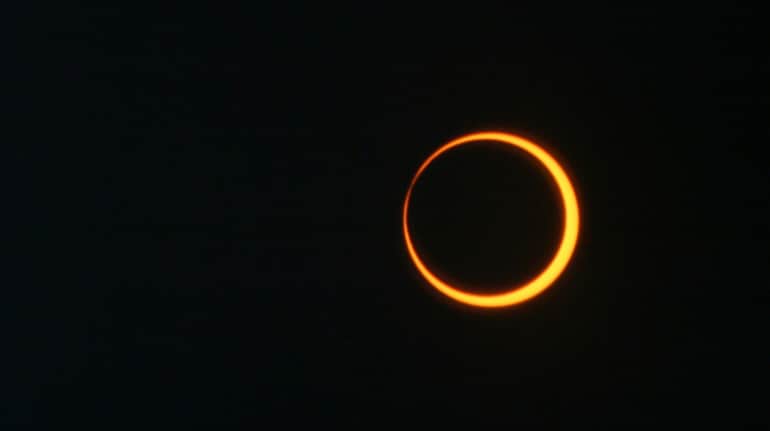
Every year, once or twice, somewhere in the world, the Sun briefly takes on the form of a blazing ring in the sky. This phenomenon is known as an annual solar eclipse. The upcoming eclipse on October 14, 2023, is classified as an annular solar eclipse and people will be able to see this spellbinding phenomenon in select regions of the United States, Mexico, and many countries in South and Central America.
But what exactly is an annular solar eclipse, and what causes the Sun to create the striking visual effect of a 'ring of fire' in the sky?
How Annular Solar Eclipse formsAn annular solar eclipse happens when the Moon passes between the Sun and Earth while it is at its farthest point from Earth. Because the Moon is farther away from Earth, it appears smaller than the Sun and does not completely cover the Sun. Instead, it leaves a bright ring of Sun visible at the peak of the eclipse. So, this eclipse is often referred to as a “ring of fire”.
What is the meaning of 'annular'?The term 'Annular' originates from the Latin word 'annulus,' which means a ring. The visibility of an annular eclipse varies depending on your location. To witness all stages of an annular eclipse, you must observe it from a position along the path of annularity, which refers to the areas on Earth where the Moon will seem to move directly across the Sun's center. Individuals located outside the path of annularity will only witness a partial solar eclipse.
When and Where: Specific time and location of the eventAs per NASA's information, the annular solar eclipse will commence in Oregon at 9:13 a.m. PDT and conclude in Texas at 12:03 p.m. CDT. Both regions will also witness a partial eclipse before and after these times. Additionally, all 48 contiguous U.S. states, as well as Alaska, will have the opportunity to view a partial solar eclipse.
Live coverageNASA TV and the space agency's website will be airing live coverage of the annular solar eclipse on October 14, from 11:30 a.m. to 1:15 p.m. Additionally, NASA's Facebook, X, and YouTube platforms broadcast a live stream.
Solar Eclipse stages: What one can expectAs the Moon begins to pass in front of the Sun, a partial eclipse begins. Gradually, the Moon will block more of the Sun, causing the Sun to change into a crescent shape, that eventually resembles a "C". Roughly 80 minutes after the onset of the partial eclipse, the Moon will completely cross in front of the Sun, creating a "ring" of Sun behind it. This phase is known as annularity and can last anywhere in duration from 1 to 5 minutes depending on the location.
The Moon will continue to travel across the Sun after annularity for another 80 minutes or more, producing another partial eclipse. The Moon's movement continues until it no longer covers the Sun's surface, signifying the end of the eclipse.
In its statement, NASA emphasized the importance of never looking directly at the Sun during an annular eclipse without the use of proper eye protection specifically designed for safe solar observation, as a ring of the Sun remains visible throughout the event.
NASA in its guidance said viewing any part of the Sun through cameras, binoculars, or telescopes without the protection of a special solar filter securely affixed to the front of these optical instruments can lead to immediate eye damage.
In its statement, NASA also emphasized that people intending to witness the October 14 eclipse must prioritize the use of eclipse glasses or solar filters, as a critical safety measure.
Last Annular Solar Eclipse in the US until 2039The upcoming annular solar eclipse on October 14, 2023, is the last visible from the US until June 21, 2039. Subsequently, the next solar eclipse visible from the United States will be a total solar eclipse occurring on April 8, 2024. Following this, the next annular solar eclipse observed from the US will be on February 5, 2046.
Discover the latest Business News, Sensex, and Nifty updates. Obtain Personal Finance insights, tax queries, and expert opinions on Moneycontrol or download the Moneycontrol App to stay updated!
Find the best of Al News in one place, specially curated for you every weekend.
Stay on top of the latest tech trends and biggest startup news.