






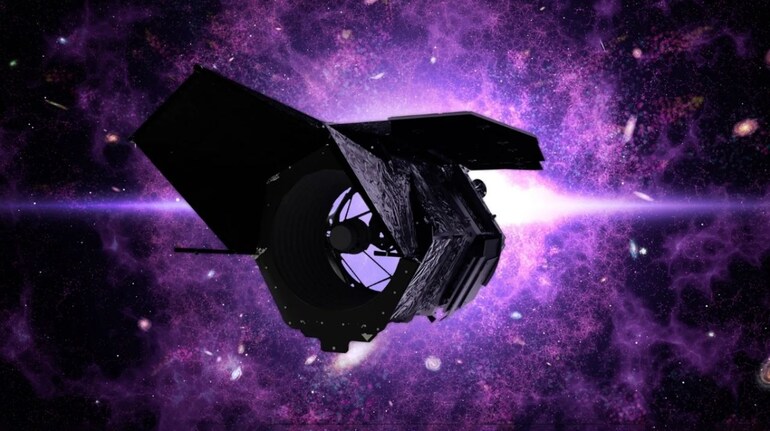
NASA has completed assembling the Nancy Grace Roman Telescope, marking a major step toward its planned launch later this decade.
The space agency joined the telescope’s two primary sections inside a controlled clean room at NASA’s Goddard Space Flight Center. Officials said the milestone keeps the mission progressing toward launch readiness. The observatory could be prepared for flight by fall 2026. A formal launch is currently scheduled for May 2027.
What the Roman telescope will study
The Roman Telescope is an infrared observatory designed for wide surveys. It carries two scientific instruments aboard the spacecraft. The Wide Field Instrument offers an exceptionally broad viewing area. Its field is around 100 times larger than Hubble’s. This allows rapid mapping of vast regions of space.
Roman is built to investigate dark energy and cosmic expansion. Scientists will also conduct a large census of exoplanets. The mission includes searching for primordial black holes. It will study stars, galaxies, and evolving planetary systems.
NASA Associate Administrator Amit Kshatriya said the observatory reflects disciplined engineering efforts. He said careful testing delivered the telescope piece by piece. Final testing will continue before shipment to Florida.
 NASA’s Nancy Grace Roman Space Telescope is now fully assembled after its two main sections were joined on Nov. 25 at the Goddard Space Flight Center in Greenbelt, Maryland, with the Solar Array Sun Shield clearly visible. (Image: NASA/Jolearra Tshiteya)
Why Roman matters for astronomy
Roman’s wide view enables studying subtle cosmic patterns. Understanding dark energy requires surveying enormous sky areas. The telescope will track galaxy clusters across cosmic time. Scientists aim to map large scale universal structures.
The mission is expected to gather massive scientific datasets. Roman will generate about 20 petabytes of data. That equals roughly 20,000 terabytes over five years. Other telescopes would need decades for similar coverage.
Julie McEnery, Roman’s senior project scientist, highlighted discovery potential. She said Roman could reveal over 100,000 distant worlds. The telescope may observe billions of galaxies and stars. Data will rapidly expand astronomical knowledge.
What comes next before launch
The observatory will undergo extensive environmental and performance tests. Engineers will verify systems before transport to Kennedy Space Center. A SpaceX Falcon Heavy rocket is assigned. It will send Roman toward the Sun Earth L2 orbit.
Roman does not rely on coolant for infrared operations. Fuel limits its operational lifetime instead. The primary mission is planned for five years. An extended mission remains possible if fuel allows.
The telescope’s Coronagraph Instrument will image nearby exoplanets. It blocks starlight to reveal faint planetary signals. This coronagraph will be the first active version flown. NASA says it will test advanced planet imaging technologies.
Feng Zhao of NASA’s Jet Propulsion Laboratory discussed its importance. He said the instrument advances the search for Earth like planets. The technology may support future missions studying habitability.
NASA science chief Nicky Fox said Roman addresses cosmic acceleration mysteries. She said understanding space and time remains incomplete. Roman’s surveys may help explain universal expansion behaviour.
Data from Roman will remain available for future researchers. Scientists expect discoveries long after the primary mission. Jackie Townsend of NASA Goddard said the telescope honours Nancy Grace Roman’s legacy.
NASA officials say the mission remains on schedule. An earlier launch remains possible if testing proceeds smoothly. Roman is expected to transform sky surveys across astronomy fields.
Discover the latest Business News, Sensex, and Nifty updates. Obtain Personal Finance insights, tax queries, and expert opinions on Moneycontrol or download the Moneycontrol App to stay updated!
Find the best of Al News in one place, specially curated for you every weekend.
Stay on top of the latest tech trends and biggest startup news.




