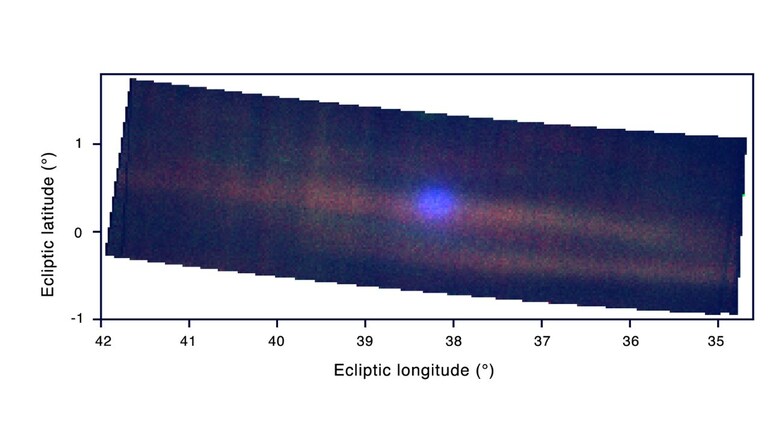
On 18 December, NASA shared new images of comet 3I/ATLAS captured unexpectedly by its Europa Clipper spacecraft during a rare interstellar flyby near Earth.
The spacecraft was not observing the comet intentionally. It was simply positioned ideally as both objects travelled through the solar system at extraordinary speeds. Scientists said the coincidence allowed a valuable scientific observation using instruments designed for another mission.
Close approach visible from Earth
The interstellar comet is racing through space at about 153,000 miles per hour. It reaches its closest approach to Earth overnight between 18 and 19 December. At its nearest, the comet remains about 168 million miles away. That distance equals roughly 270 million kilometres, according to NASA.
Despite the distance, amateur astronomers can observe the comet using powerful backyard telescopes. However, scientists caution viewers to expect only a faint, fast-moving green dot. Recent images taken by astrophotographers show limited visible detail.
Europa Clipper image reveals unseen details
The newly released image was captured using the Europa Ultraviolet Spectrograph instrument. Observations were conducted over seven hours on 6 November. At that time, Europa Clipper was about 102 million miles away.
Ultraviolet light cannot be seen by human eyes naturally. Scientists processed the data by separating and stacking wavelengths. This method reveals how the comet appears beyond visible light. Other observatories have also studied the comet in infrared and X-ray wavelengths.
What this means for Jupiter mission
Europa Clipper and comet 3I/ATLAS are both heading toward Jupiter. The comet will make its closest approach to Jupiter in March 2026. Europa Clipper is scheduled to arrive much later, in April 2030.
When it reaches Jupiter, Clipper will begin studying the moon Europa. The mission aims to search for conditions suitable for extraterrestrial life. Its instruments will examine Europa surface, atmosphere, and possible geysers. Scientists believe a liquid water ocean may exist beneath Europa’s icy crust.
Studying the comet without searching for life
The spacecraft is not searching for life in the comet. NASA said there is no evidence the object is anything unusual. It is considered a natural interstellar comet.
Using the same instruments planned for Europa, scientists analysed gases from the comet. These gases form a temporary atmosphere known as a coma. Earlier observations show the comet contains carbon dioxide ice. It also releases diatomic carbon gas, producing a green glow.
What scientists expect next
Detailed ultraviolet spectral data from Clipper are still being analysed. NASA said results will be shared once processing is complete. Until then, scientists say the images offer a rare view. They capture a visitor from beyond the solar system passing briefly by Earth.
Discover the latest Business News, Sensex, and Nifty updates. Obtain Personal Finance insights, tax queries, and expert opinions on Moneycontrol or download the Moneycontrol App to stay updated!
Find the best of Al News in one place, specially curated for you every weekend.
Stay on top of the latest tech trends and biggest startup news.