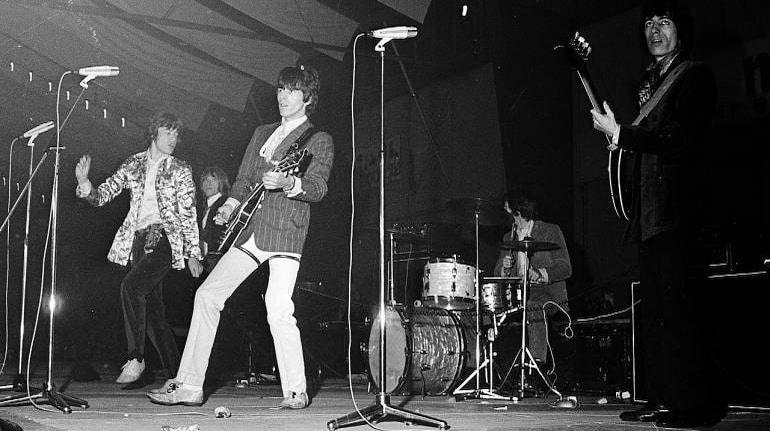
On July 12, 1962, The Rolling Stones made a nervous debut at the London Marquee Jazz Club on Oxford Street. A gaggle of sulky boys from London – Mick Jagger on vocals, Keith Richards and Brian Jones on guitars, Ian Stewart on the piano, Dick Taylor on bass and Mick Avory on drums – got their chance to play this prestigious venue when Alexis Korner’s Blues Incorporated opted out of their regular Thursday spot because they had a chance to record for the BBC.
And play The Rolling Stones did, dishing out covers of some of their favourite blues music of the time. By the time they reached a euphoric finish with Elmore James’ “Happy Home”, it was clear they were about to be the proverbial storm in a teacup – poets and bonafide rockstars, the anti-Beatles who’d soon become Hall of Famers, and perhaps most crucially, along with The Beatles and The Who, the leaders of the British Invasion.
A few months earlier, in April 1962, on the other side of the Atlantic, Bob Dylan had performed “Blowin’ In The Wind” for the first time at New York’s respected venue Gerde Folk City. The track would be released widely in 1963 as part of the landmark album The Freewheelin’ Bob Dylan, but not before doing the rounds among Dylan collectors. It would go on to become the anthem of 1960s counterculture that would colour the entire decade.
 Mick Jagger, Keith Richards, Ronnie Wood and Charlie Watts. (Image: Moxy / Michael Barera via Wikimedia Commons 2.0)
By the time "Blowin’ In the Wind" arrived on American airwaves, rock ’n roll was already an established genre of music – with several sub-genres branching out of a distillation of African-American music influences including rhythm and blues, jazz and swing along with country and folk music. From Sister Rosetta Tharpe to Arthur Crudup, an entire league of rock ’n roll artists were wielding their electric guitars in southern America. By the 1950s, it had reached mainstream status, especially with the iteration called ‘rockabilly’, or the rock ’n roll being played by white artists like Elvis Presley and Johnny Cash.
At the top of the 1960s rock ’n roll was the soundtrack of life in the US, but it was a distinctly American sound. In the UK, rock ’n roll was in its infancy – with very limited presence, thanks in no small part to BBC which had for long held a monopoly and “favoured a bland if nourishing diet of news, information, light entertainments and children's programs. In other words, the rock 'n' roll revolution that was spreading like wildfire in the United States had been all but banished from the British airwaves.”
And yet, it was rock ’n roll that was a big part of what came to be known as the British Invasion – the first time that pop culture (music to film to fashion) from the UK travelled and became influential far outside the island nation’s borders, and beyond the confines of that sliver of time in which it was born. It was, if you will, the hallyu of the 20th century. How did this happen?
Rock ‘n roll’s rise to popularity, and the British Invasion were products of an unexpected collusion of technological advancement and the zeitgeist. But it couldn’t have happened if blues and jazz music hadn’t made its presence felt here. There are contradicting explanations about how blues music made its way to the UK. What most agree on is that the American military brought blues records to British shores, though the degree of availability of these records, and consequently the interest in them, is debated.
Yet, as The Guardian notes, “the 1961 Census listed 2,471 licensed places of entertainment in London alone; an estimated 300 of these catered in one way or another to young groups such as the Stones, inspired by the urban R&B tradition of [American artists] Muddy Waters and Chuck Berry.” Mod or not, this sound with its fiery lyrics and danceability was infectious.
Bands played clubs and universities and spoke to the youth, but for the offensive to gather momentum, they needed more than stages. They needed the radio. Pirate radio, among the most rad phenomena of the 20th century, was born in the mid-1960s. Unlicensed stations like the immensely popular Radio Caroline, broadcasting from a ship anchored off the eastern coast of England, had DJs-turned-celebrities blasting popular music across the country. Pirate radio was rock ’n roll’s trojan horse.
![The Rolling Stones at Amsterdam Airport Schiphol (1964). (Photo: Hugo van Gelderen [ANEFO], via Wikimedia Commons)](https://images.moneycontrol.com/static-mcnews/2022/07/Rolling-Stones-at-Amsterdam-Airport-Schiphol-1964.jpg) The Rolling Stones at Amsterdam Airport Schiphol (1964). (Photo: Hugo van Gelderen [ANEFO], via Wikimedia Commons)Then came the rise of Britain’s independent record labels in the mid-1960s. Rock ’n roll was a new genre, which meant its bankability was in question. Big labels were reluctant to sign rising artists. Young promoters like Chris Wright and Terry Ellis (Chrysalis Records) and Chris Blackwell (Island Records), or the Decca offshoot London Records (Rolling Stones’ label) took their place.
The Rolling Stones at Amsterdam Airport Schiphol (1964). (Photo: Hugo van Gelderen [ANEFO], via Wikimedia Commons)Then came the rise of Britain’s independent record labels in the mid-1960s. Rock ’n roll was a new genre, which meant its bankability was in question. Big labels were reluctant to sign rising artists. Young promoters like Chris Wright and Terry Ellis (Chrysalis Records) and Chris Blackwell (Island Records), or the Decca offshoot London Records (Rolling Stones’ label) took their place.
They were the medium for a necessary cross-pollination of sounds from both sides of the Atlantic ocean, even as they galvanised the English language music that would come to define the 20th century. The Beatles and Rolling Stones launched their own labels too (Apple Records and Rolling Stones Records), with middling success – but that entrepreneurial spirit was essential to the formation of a definite musical identity.
Technology is key to the story of rock ’n roll. The microphone, the amplifier, the LP, the electric guitar, even the television set – all invented only in the decades prior – were all important tools for the production, transmission and consumption of music. Like smartphones, all of these were the great equalisers of the entertainment industry.
And finally, there was the music itself. Rock ’n roll – with its fast rhythm and pointed messages – stood for rebellion, defiance, sexual liberation and social defiance that spoke as much to kids screaming front row at Carnegie Hall at the Rolling Stones’ first American tour in 1964 as the long-haired boys and mini-skirt wearing girls in Korea also rebelling against their own hand-me-down society.
Music itself was becoming more integral to culture, in a way it hadn’t been till then. Beatlemania – unleashed all over the first world in 1964 after The Beatles’ appearance on The Ed Sullivan Show – was the product of a meticulous marketing plan that paid as much attention to merchandise as it did to the Fab Four’s hair. It was in the 1960s that the teenager became an important consumer demographic, and they were listening to rock ’n roll, especially the stuff that the British were drumming up.
On June 18, 1965, fourteen records of British origin occupied the US Top Forty. The Beatles’ Ticket to Ride was at number 11, and The Rolling Stones’ (I Can’t Get No) Satisfaction – released on June 5 in the US – was at number 26. A week later, it had climbed to number 4, and by July 10, it had transcended to the absolute top of the chart. This was The Rolling Stones’ first #1 track in the US, and it set the course for Out of Our Heads (1965) to become one of their biggest albums of all time.
Today, as The Rolling Stones fly around the world on their 60th anniversary tour, and casually induct whole new generations into their fanbase, it’s clear why their music has travelled with them over time. They may be septuagenarians now, and they never did age gracefully (upon the gentle joking plea of Pete Townsend as they were being inducted into the Rock n Roll Hall of Fame in 1988).
But with their two-hour long sets and Jagger’s voice that can still command the full attention of an arena, they can outlast musicians half their age. And really, with songs that speak to all of the human experience – “Gimme Shelter” (about war) to “Sympathy for the Devil” (with a reference to assassination) and, of course, “Satisfaction” (the perils of consumerism) – The Rolling Stones aren’t going out of fashion anytime soon.
Discover the latest Business News, Sensex, and Nifty updates. Obtain Personal Finance insights, tax queries, and expert opinions on Moneycontrol or download the Moneycontrol App to stay updated!
Find the best of Al News in one place, specially curated for you every weekend.
Stay on top of the latest tech trends and biggest startup news.