Stumped by the change in government policy, homegrown car makers such as Tata Motors and Mahindra & Mahindra (M&M) are staring at a huge challenge from their Japanese and European rivals when the market shifts towards hybrid technology.
Both Mumbai-based companies are advancing towards full electrification and thus do not have any significant plans for hybridisation of their products. Tata Motors and M&M are already supplying fully electric cars to a government-owned company --Energy Efficiency Service (EESL) --under a contract.
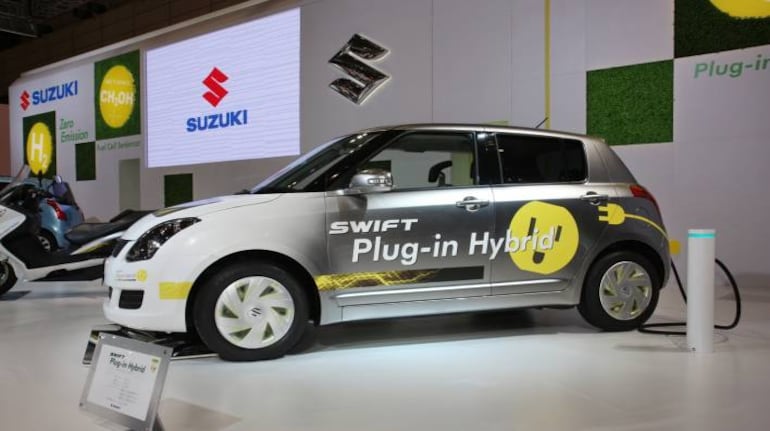
In contrast, car market leader Maruti Suzuki and its Japanese partner Toyota are working on ‘affordable’ hybrid technology, which the two companies believe are the ‘perfect stopgap solution before moving to fully electric mobility’.
After intense lobbying by the Japanese companies in the run-up to the MOVE Summit of last year, the government did an about-turn. From increasing GST on hybrids to bring them on par with other regular petrol and diesel cars, the government announced incentives to hybrids for their promotion.
Indian car manufacturers, who had aligned their business plans towards electrification, have been caught off-guard by the government's sudden U-turn.
“There will be a huge degree of confusion in the larger industry, including the private sector which is finalising investments. There are so many companies ready to set-up charging stations and even battery manufacturing factories. Now with hybrids, there is no need for those investments,” said Guenter Butschek, Managing Director, Tata Motors, in a recent interview to Moneycontrol.
While Tata Motors supplies an electric version of the Tigor sedan to EESL, it is also readying electrified versions of the yet-to-be-launched premium hatchback codenamed 45X. This car will be showcased at the Geneva Motor Show later this week. Besides the electric Tiago, Tata Motors has also developed an electric version of the Nexon. The company, however, has not shared any plans of going hybrid soon.
M&M is the only company at present that produces electric cars (Reva) for the retail market. The company was working on hybrid powertrain solutions a few years ago before the government announced plans of shifting to fully electric by 2030. After the announcement, M&M shifted its product development vision to electric. Now with the change in policy, M&M is in a fix.
“We will have an expanded range of electric vehicles coming up in the next two years. We can’t do anything about the government’s change of policy and have to follow their direction,” a senior M&M executive said.
With advancement in technologies and higher localisation, hybrid cars are expected to be priced on par with diesel cars in the post Bharat Stage VI stage, RC Bhargava, Chairman, Maruti Suzuki said in a recent interview to MoneyControl. Hybrid variants are expected to cost a premium of Rs 2.5 lakh over their petrol counterpart.
A fully electrified vehicle, however, costs more than double that of a petrol-powered car. While the cost of lithium-ion batteries have fallen, pace of the fall has slowed down over the past two years. This has posed challenges to the government's vision of producing electric cars for the masses at affordable prices.



Discover the latest Business News, Sensex, and Nifty updates. Obtain Personal Finance insights, tax queries, and expert opinions on Moneycontrol or download the Moneycontrol App to stay updated!
Find the best of Al News in one place, specially curated for you every weekend.
Stay on top of the latest tech trends and biggest startup news.