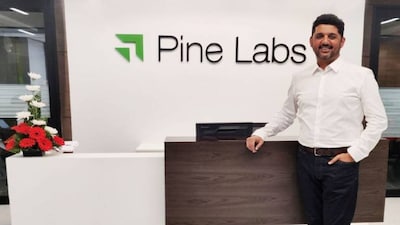
People mistake us for a PoS-only company, they're missing the full picture, says Pine Labs CEO Amrish Rau
Pine Labs has four equally important verticals, with prepaid business contributing to around 30 percent of the topline, Rau tells Moneycontrol

Daily Voice: Corporate earnings rebound to power markets in H2FY26, says Prescient Capital founder; 4 sectors in focus
Sectors that were laggards in the last quarter such as Banking and Consumption have likely found their base and are expected to show better results in the coming year, aided by macro stimulus from the Government and RBI, said Sonal Minhas.
Chartist Talk: Bank Nifty may hit 59,000 this month, but 60,000 hurdle strong, says Nilesh Jain; eyes BPCL, JK Tyre
The Nifty Realty Index has formed a strong base and recently broke out from a rectangle pattern on the daily chart, indicating the potential for a follow-up move on the upside towards Rs 1,050 in the near term, says Jain
Daily Voice: Bay Capital’s Nikunj Doshi sees strong FII comeback in Q1CY26, bullish on digital-first firms
While the India–US trade deal will certainly add another layer of confidence, the near-term market focus remains on sustained earnings delivery and macro stability, said Nikunj Doshi.
Chartist Talk: Mild Nifty pullback likely before next rise; Foram Chheda bets on CSB Bank, Force Motors
Foram Chheda has a neutral to mildly bullish view for the equities ahead in November.
Daily Voice: Generali Central Life CIO Niraj Kumar sees early-stage banking rally, turns bullish on microfinance
Investor sentiment is increasingly optimistic, with the market recognizing that the earnings cycle is nearing its trough. Expectations of a rebound into double-digit growth suggest a favourable setup for sustained momentum and further upside, said Niraj Kumar of Generali Central Life Insurance.
Daily Voice: Larger healthcare sector continues to provide exciting opportunities for alpha generation, says TCG AMC Chief
The risks to the market are more likely to emanate from financial stress in major developed economies and global geopolitical tensions, Shahzad Madon of TCG Asset Management Company said.
Chartist Talks: Sudeep Shah remains bullish on these 3 PSUs, flags caution on Sagility
Sagility breached its previous high of Rs 56.40 but failed to sustain, forming a bearish engulfing candle on the daily chart — a potential reversal signal, Sudeep Shah said.
Daily Voice: ‘Bachat Utsav’ may fizzle out? Dhananjay Sinha warns of over-optimism in market assumptions
The ongoing result season is on expected lines, which is pivoted on weak demand scenario, margin pressure and companies working towards cost optimisation to keep profitability afloat, said Dhananjay Sinha.
Daily Voice: LGT's Stefan Hofer expects India–US trade deal before Christmas, sees sharp fall in US tariffs on Indian exports
Following another cut in the federal funds rate, Stefan Hofer believes the Federal Reserve could move again in December with an additional rate cut—especially if lower tariffs help ease inflationary pressures.
Groww CEO Lalit Keshre on ₹62,000 Crore IPO, Sebi regulations, valuation expectation and more
India’s largest retail investing platform, Groww (Billionbrains Garage Ventures Ltd.), is set to launch its ₹6,632.3 Cr IPO from November 4–7, 2025, at a valuation of around $7.1 Billion.
In this exclusive conversation, Groww Co-founder & CEO Lalit Keshre speaks to Moneycontrol about:
? The journey from startup to IPO
? How Groww built a profitable fintech at scale
? What the listing means for India’s retail investors
? Navigating competition, regulation, and growth post-listing
? IPO Snapshot:
* Price Band: ₹95 – ₹100 per share
* Fresh Issue: ₹1,060 Cr | OFS: ₹5,572.3 Cr
* Investors: Tiger Global, Peak XV Partners, Ribbit Capital, Satya Nadella, GIC
* Valuation: ₹62,300 crore ($7.1 Billion)
* IPO Dates: Nov 4–7, 2025
Daily Voice: ‘Black swan aside, India’s bull run stays intact,’ Vikas Gupta on what’s next for markets
On a PE basis, Lenskart does look expensive but one should look at what the normalized margins would be in future when growth has stabilized or as compared to some global or domestic peers and then see if on that basis what would be the normalized PE ratio.
Daily Voice: Constructive progress in trade talks key for indices to hit new highs in November, says Green Portfolio’s Divam Sharma
Divam Sharma remains optimistic about the market’s trajectory in November, expecting a healthy mix of momentum and selective sectoral strength to drive performance.
India sitting on a $2 trillion treasure that’s unproductive. Navneet Munot on how to make it work for the economy
Navneet Munot said channeling idle gold, silver into equity instruments with lock-in and tax efficiency will unlock
Daily Voice: Right Horizons' Anil Rego explains why he prefers staples over non-staples currently, constructive on auto and component plays
Meaningful appreciation in the rupee against US dollar is unlikely in the near term given structural headwinds from trade imbalances and dollar strength, though tactical stabilization around current levels is expected.
India's Economic Boom: A look beyond the GDP numbers at the structural challenges ahead
If growth is strong, if companies are investing and the government is also spending, then a demand resurgence should be seen and it should also show up in product prices. Why then is core inflation (which is demand side) so low? Why is urban demand relatively weak? Is there a challenge from cheap Chinese imports?
‘Excellent hospitals, poor claims’: PB Fintech’s Alok Bansal says India’s insurance system needs urgent attention
Bansal said misaligned incentives make the insurance claims process subpar despite India’s medical excellence, as PB Fintech expands into healthcare with its new venture PB Healthcare.
Daily Voice: Christmas gift for markets? India-US Deal to revive global confidence in India, says this fund manager
Any constructive statements or forward-looking updates emerging from the Asian Summit could strengthen investor confidence and sustain the current market optimism, supporting equities in the near term.
Chartist Talk: Milan Vaishnav reveals what’s next for Shipping Corporation, Blue Star, HDFC Bank and Bharti Airtel
Milan Vaishnav said he would continue looking at HDFC Bank and Bharti Airtel.
Daily Voice: This CIO sees double-digit upside for Indian stocks for the year ahead, urges caution on US markets
Rohit Beri expects the trend in de-dollarization to continue and central bank demand for gold to stay strong. However, the current rally in gold prices may not last for long. So, one has to be very careful.
Chartist talk: Momentum cooling? Sudeep Shah flags caution after shooting-star formations in Nifty, Bank Nifty
Shooting Star candlestick pattern reflects that bulls attempted to drive prices higher but faced selling pressure near the top, said Sudeep Shah.
Daily Voice: Gold unlikely to outperform in the year ahead, says this CIO; bets on pharma, specialty chemicals
The year ahead is expected to deliver healthier stock returns — likely in line with the long-term average range of 12–15 percent, said Rakesh Vyas of Quest Investment Advisors.
Daily Voice: Three big shifts that could redefine markets in the year ahead, according to Edelweiss MF’s Trideep Bhattacharya
These three themes position India for global outperformance in the year ahead, both in relative growth and market returns, Trideep Bhattacharya believes.
Daily Voice: Saurabh Mukherjea flags Indo-US FTA as wildcard for markets, boosts luxury goods and US banks exposure
Demand recovery for Indian IT Services seems more likely than not in the next 12 months, said Saurabh Mukherjea of Marcellus Investment Managers.
Chartist Talk: Foram Chheda explains why Axis Bank, Bajaj Auto appear promising in F&O expiry week
Foram Chheda noted the Nifty 50 has broken out of a symmetrical triangle pattern, which confirms the potential for an upward move.