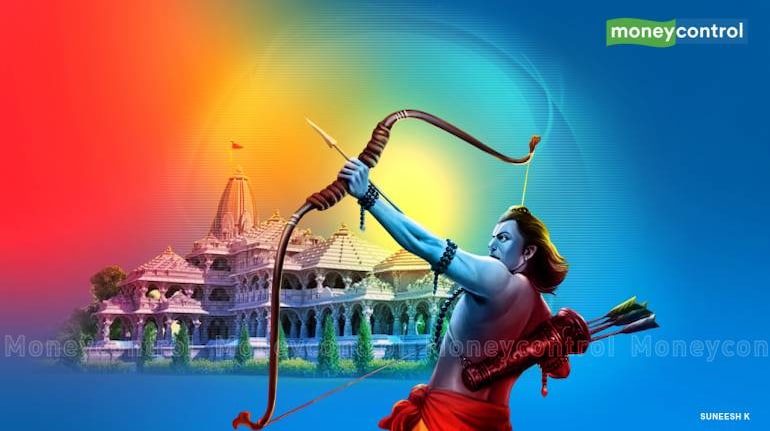
After decades of legal and social battles, the construction of the Ram temple in Ayodhya is now complete. The consecration ceremony for Ram Lalla is scheduled for January 22, marking a historic moment in Ayodhya's history. Reflecting on the city's past, three pivotal stages stand out: first, in 1949, when statues were installed at the disputed site; second, in 1986, when the lock on the disputed site was opened; and third, in 1992, when the Babri structure at the heart of the dispute was demolished. These milestones encapsulate the complex and tumultuous journey that Ayodhya has undergone over the years.
VHP-RSS turn aggressive in 1985
Starting in 1985, the Rashtriya Swayamsevak Sangh (RSS), Vishwa Hindu Parishad (VHP), and Hindu Mahasabha escalated their demand to unlock the disputed site and construct a temple in Ayodhya. The RSS representative assembly began urging the Rajiv Gandhi government at the Centre to hand over the Ram Janmabhoomi land to the temple trust. Their argument drew parallels with the restoration of the grand Somnath temple in Gujarat, advocating for a similar restoration of the old glory at the disputed site in Ayodhya. Despite several rounds of meetings between VHP leaders and officials from the Rajiv government, no resolution was achieved.
Also Read: Yogi Adityanath terms Ram temple consecration as restoration of India's faith and self-respect
Veer Bahadur Singh takes charge as CM
During this period, the political atmosphere in Uttar Pradesh was growing increasingly tense. The Congress party sought to secure support from both the Hindu and Muslim factions, but the then Chief Minister, ND Tiwari, faced challenges in reconciling the two. Eventually, on September 24, 1985, the Congress party removed Tiwari from office and appointed Veer Bahadur Singh as the new Chief Minister of Uttar Pradesh. The political upheaval in the state had not subsided when, on February 1, 1986, a local court in Faizabad issued an order to unlock the Ram Janmabhoomi site.
That order of 1986
Amid these events, the Congress attempted to navigate the situation, being cautious not to antagonise the Muslim community. As part of this approach, the government under CM Singh took action in June 1986 by seizing three chariots belonging to the Ram Janmabhoomi Mukti Yagya Samiti. However, under pressure, these chariots were later escorted to Lucknow with police protection on November 22. Notably, CM Singh had also participated in the Ramayana fair held in Ayodhya in December 1985, an event that was initially initiated by his predecessor, CM Shripati Mishra.
Also Read: Ram Mandir Prasad at your doorstep: Advance bookings available; delivery fee applicable
Secret meeting of Mahant Avaidyanath and CM
CM Singh actively pursued various efforts to find a resolution to the Ayodhya dispute, including engaging in talks with the Hindu Mahasabha. Singh attached significance to the Hindu Mahasabha, especially compared to the RSS or VHP, due to the shared Gorakhpur background of both Mahant Avaidyanath and himself. The late journalist Sheetala Singh, closely monitoring the Ayodhya dispute and involved in the mediation process, was cited by the News 18 Hindi website, stating that a clandestine meeting took place in Gorakhpur between Mahant Avaidyanath and the CM.
What was discussed at the meeting?
During the clandestine meeting, an agreement was reached to establish a committee consisting of residents of Ayodhya to initiate the construction of the temple and allocate an alternative piece of land for the mosque. This development unfolded around 1987. The resolution of the matter seemed imminent.
According to IAS officer SP Singh, who served as the joint secretary to CM Singh during that period, numerous secret meetings took place between Mahant Avaidyanath and the CM, focusing on the construction of the Ram temple. These discussions were often held in secret, with Gorakhpur being one of the locations, as reported by the News 18 Hindi website.
Then where did the matter get stuck?
According to Sheetala Singh, following the formula established in the meeting between CM Veer Bahadur Singh and Mahant Avaidyanath, a committee was decided to be formed, consisting of five individuals from both Hindu and Muslim communities in Ayodhya, aimed at resolving the dispute. The Muslim community proposed a list of five names, including Muhammad Shahabuddin and Muhammad Koya. On the Hindu side, a meeting was convened in Lucknow on December 25, 1987, to finalise the names for the committee.
Also Read | Ram Mandir Inaugaration: Check full schedule of Pran Pratistha ceremony here
The meeting to finalise the committee's members took place at the residence of Laxmikant Jhunjhunwala, an active member of the Hindu Mahasabha. However, when it was disclosed during the meeting that only local individuals would be included in the committee, the VHP staunchly rejected the proposal. This disagreement led to a deadlock in the proceedings, complicating the resolution efforts.
That incident of 1992
Following the deadlock, tensions escalated significantly. Organisations including the VHP, RSS, and Bajrang Dal announced Kar Seva in Ayodhya on October 30, 1990. Lal Krishna Advani initiated a journey to Ayodhya with a chariot from Somnath on September 25, 1990, but he was arrested in Samastipur, Bihar. During this period, Mulayam Singh Yadav served as the Chief Minister of Uttar Pradesh. The situation further intensified on October 30 and November 2, 1990, as violence erupted during the kar seva, leading to casualties among the participants.
Kar seva was once again announced on December 6, 1992. Kalyan Singh was the chief minister of UP at this time. A significantly larger number of kar sevaks reached Ayodhya compared to the events in 1990. The situation took a tragic and historic turn when a mob entered the disputed Babri Masjid on that fateful day and proceeded to demolish all three domes. This event marked a watershed moment in the Ayodhya dispute, having profound and lasting implications for the socio-political landscape of India.
(The article was first published on the News 18 Hindi website.)
Discover the latest Business News, Sensex, and Nifty updates. Obtain Personal Finance insights, tax queries, and expert opinions on Moneycontrol or download the Moneycontrol App to stay updated!
Find the best of Al News in one place, specially curated for you every weekend.
Stay on top of the latest tech trends and biggest startup news.