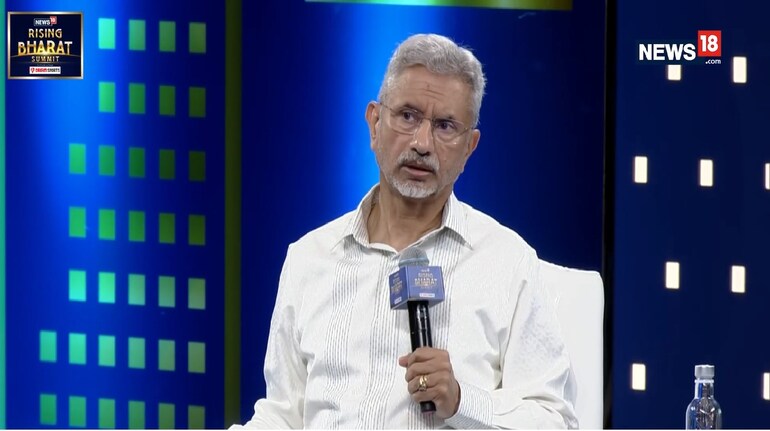
At the Rising Bharat Summit 2025, India’s External Affairs Minister, Dr. S. Jaishankar, looked back on his almost six years in office, reaching a key milestone as the longest-serving Foreign Minister since Jawaharlal Nehru. With 2140 days in the role, Jaishankar highlighted the challenging global situation India has faced during his time overseeing foreign policy.
Zakka Jacob:Thank you very much for joining us at the Rising Bharat Summit. You've come here every time we've had a Rising Bharat Summit, so this is your third edition here. But I want to start off with something significant, which some of our audiences may also be interested in knowing. It is the number 2140. Does that hold any special significance for you? I shall enlighten our audience and maybe even enlighten you. That's the number of days that…
S. Jaishankar:This sounds like one of Elon Musk's…
Zakka Jacob:That's the number of days he's been External Affairs Minister. He's the longest-serving External Affairs Minister of India since Nehru. So we can have a round of applause for that. And what a time to be in charge of India's foreign policy. You look back at the last five years and ten months now, it's going to be almost six years. What do you think has been Indian foreign policy's singular achievement in these last six years? One thing, if you were to name it.
S. Jaishankar:I would say, you know, this is Bharat Rising. So how do you manage the process of rise under extremely turbulent conditions? Because managing a process of rise is tough enough, but countries normally hope that you get a very conducive environment. We've got as tough an environment as anybody could sort of…
Zakka Jacob:Hope.
S. Jaishankar:No, not hope for. Anybody could actually imagine. And I think getting through that, I mean, just look at these last six years from a foreign policy perspective. I mean, you've had Ukraine, you've had the Middle East, you've had the whole Indo-Pacific turbulence, you've had Afghanistan, you've had Myanmar, you've had COVID, you've had meltdown of various kinds, you know, political changes in our neighbors. Actually, the stresses and the… it's not just change, you know. There have been big events, there have been fractures, there have been stresses, there have been surprises. So it's been as turbulent as it could have been.
Zakka Jacob:Since you said it's been challenging circumstances, it's beyond what anyone could have imagined, let's address the elephant in the room, and that is the tariffs that have kicked in today. That's what our business editors have been telling us, the reciprocal tariffs have kicked in today. First of all, I'd like to understand from you, what is your assessment? What is your reading of what is going to be the impact of these reciprocal tariffs on India? What is India's strategy to try and deal with the fallout of it? If you could sort of elucidate what your views are.
I don't think we can… it's possible to speak about what would be the impact, because we don't know. And what is our strategy? I think that's pretty clear. We decided that we will engage the Trump administration early on this set of issues, and we were very open with them, very constructive with them, as they were with us. And what we agreed to do was to try to negotiate a bilateral trade agreement by fall of this year.
To the best of my knowledge, and I stand, I could be corrected here, I think we are the only country after President Trump has assumed presidency the second time which has actually reached such an understanding in principle. So I don't know, you know, every country, because every country is tariffed, okay? So every country in the world today is fashioning its own strategy of dealing with the United States.
In our case, our strategy has a goal, and the goal is to see whether it's possible to actually deal with this situation by concluding a bilateral trade agreement. And I should add that in an interesting way, this has long been our objective. The present situation may have created the circumstances for such a serious conversation, but if you look at President Trump's first term, we were actually negotiating a trade deal which could not fructify.
And if one looks even at Biden's administration, we discussed trade possibilities and we ended up with the IPEF initiative. They were very averse to doing a bilateral agreement. So from the Indian perspective, actually doing, you know, working out something bilaterally with the United States is not at all sort of a negative or a sort of unwanted situation. On the contrary, it is something which has long been our objective.
Zakka Jacob:But tell me, Dr. Jaishankar, as you take a moment to drink water, you know, you've been part of many, many bilateral negotiations, trade negotiations in the past. These things take time. You said we're hopeful that the BTA will be wrapped up by the fall. Two things, what happens if it doesn't and if it takes longer than that? And two, how confident are you that you can actually wrap it up by the fall?
S. Jaishankar:Well, I've always wondered why it takes such a long time. You know, frankly, I've never figured it out.
Zakka Jacob:You tell us.
S. Jaishankar:No, I've never figured it out because we have trade negotiations which have been going on for decades and the negotiators meet, I think, every six months or three months or four months and I wonder why. I mean, if I were doing a negotiation, I'd be at it till I got the job done. And I think today, when I look back at the last, say, about, since the Prime Minister's visit, I'd say mid-Feb, so we're about six weeks since then, we've actually had multiple rounds in this period. I think we've had more periods, more discussions with the Americans in the last six weeks than I suspect we've had with the Europeans in the last two years.
Zakka Jacob:Wow. More discussions with the US in the last six weeks than what you've had with Europe in two years. But you're also sort of accelerating the FTA talks with EU, with UK and so on. Do you think that, this is a 35,000 feet view question, do you reckon that Mr. Trump, by doing what he's doing, is forcing other countries to start trading more with each other and start processing these FTAs in a quicker fashion?
S. Jaishankar:You know, look, you are attributing everything, in a way, to President Trump. I understand why. But I want you to look at it for a moment from an Indian perspective. Okay? Let us say, since the beginning of reform, 1990s, in 30 years, what are your FTA agreements? They're largely to the economies east of India, okay, with the ASEAN, with ASEAN members, with Japan, with Korea, Australia, which is not the same. Now, where are actually your big, many of these are competitive economies.
In fact, with most of these countries, we are running today trade deficits. Now, where is the natural growth potential for our exports? It's to the country's west of us. You know, it's in the Gulf, it's in Europe, it's in the UK, it's in the United States, possibly in Latin America. And actually, those are the agreements which have lagged behind. So, it's been our endeavour, I can tell you, I mean, from 2014, for example, we've been pressing the Europeans saying, look, can we re-engage, because we had stopped engaging. Then, after Brexit, we responded very quickly to the UK's interest in reaching an agreement.
And we see an opportunity, I mean, in the current situation vis-à-vis the United States. These are, to me, really the priorities which we should be doing. We should be doing it in our own interest, not because some other president of another country says we, you know, has created a situation.
Zakka Jacob:I want to talk a little bit about Europe, because you had sort of become a bit of a lightning rod for them about talking about oil imports from Russia, saying how can you import from a country that's gone into war and invaded and so on. And you've laid out very articulately for India and for the rest of the world what India's position is. Now, the same Europeans are scampering for an FTA with India. Do you see a double standard there?
S. Jaishankar:No, no, no. I think you're being unfair to Europe. You're being unfair to Europe. I think the Europeans were serious about an FTA earlier. It's just we haven't seen that kind of urgency. You know, maybe their way of working is different. So, I can't expect everybody to be the same. So, typically they have taken much longer periods between interacting with each other. So, my point is that, look, Europe today I think realizes the importance of deeper ties with India and the relevance of the FTA for that purpose.
We had in the end of February 21 European commissioners led by President von der Leyen visiting India. Very unique happening, not just for India, even for them. They don't normally do that. I think there's a very sort of serious message coming out of Europe saying we want to move forward on this. We welcome it. We reciprocate it. And I'm pretty confident that just as we are seeing a very intense engagement with the United States, and by the way, with the UK as well, I expect the pace to pick up with Europe. We have an aspirational goal. We'd like to close out the FTA this year.
Zakka Jacob:I want to talk about the neighborhood. Last time you were here at the summit, you know, the big concern, the big talking point was the relationship with China and you had said that the relationship is not normal and, you know, we need to deal with the situation at the border for the relationship to become normal. Now, there's been a disengagement process. Prime Minister has met with the Chinese President. You've met with your counterpart, I think, on a couple of occasions since then. How would you describe the state of the relationship with China? How far away from normal is it?
S. Jaishankar:Well, it's obviously better than the last time I was here. I think the disengagement, particularly the Demchok was important. We are now addressing, to some extent, issues on the border because there's been a force buildup over a period of years. But there were many other things which also happened during this period. You know, some of it was a collateral of the situation. Some of it was actually a carryover from the COVID era. For example, our flights, direct flights stopped during COVID. They were not resumed. The Kailash Mansarovar Yatra stopped during COVID. It did not again resume.
So, I think there is work to be done. We are at it. We are trying to see whether a lot of this post-COVID and parallel to the border tension, the combination of these issues, how much we can progress on this. We are looking at it because at the end of the day, we have always maintained that the situation which we saw between 2020 and 2024 was not in the interest of either country. It was not in the interest of our relationship. And I think there is a recognition of that now.
Zakka Jacob:So, it's on the road to being normal again?
S. Jaishankar:Well, I think we are moving in a positive direction. The problem with your profession is you want instantaneous transformation. The challenge of my profession is it's a very arduous and painstaking one.
Zakka Jacob:I'm glad that we are sticking to each other's respective professions. Because there's so much talk around trade and because President Trump has made that the point of conversation. You referred to, we have trade imbalances with a lot of countries to the east. Is this, you reckon, an opportunity, again, academically speaking, an opportunity for India to look at some of those trade relationships and say that these imbalances cannot sustain, just like America is saying that an imbalanced trade relationship is not working for them?
S. Jaishankar:Well, we have had concerns. We have articulated those concerns. This is not my direct remit, but I have a visibility into it and we work as a team within the government. I think one of the issues for us, for example, has been the review of the ASEAN-India trade and goods agreement, ITIGA, which we believe has been unnecessarily prolonged. And I think it's important for all countries today to realize that the nature of the global discourse on trade is changing. And there are new parameters, there are new metrics of judgment.
I think countries will do what they need to do to protect their businesses, to protect their labor, to protect their societies. We cannot be an exception to it. So I think we have concerns with many of the countries east of us, countries with whom we have FTA arrangements and also countries with whom we don't.
Zakka Jacob:Prime Minister was recently at the BIMSTEC Summit. You were there with him. It's the first time that he met with the new interim leader of Bangladesh, Professor Yunus. There's been a lot of concerns here in India about some of the statements that have been made by the leadership there, some of the goings-on on the ground, whether it's attacks on minorities, so on and so forth, from within whatever you can divulge in the public domain. What did the Prime Minister tell Professor Yunus, particularly on this comment about India's northeast being landlocked and Bangladesh being the gateway to the ocean and also on the attacks on minorities, on both those issues?
S. Jaishankar:I think the main messages from our side, which came out at the meeting, one, that our relationship with Bangladesh, for historical reasons, is a very unique relationship. It's very fundamentally a people-to-people connect, much more so, perhaps, than any other relationship that I can think of. And that's something we need to recognize, so it's not necessarily one of the garments of the day. Secondly, we have concerns. We have concerns about the rhetoric which is coming out of people in Bangladesh. We have concerns about the radicalizing tendencies we see. We have concerns about the attacks on minorities. And I think we were very open about sharing those concerns.
And again, as a country, no country wishes Bangladesh well more than us. That's in our, I would say, almost in our DNA, if you can say that. And as a well-wisher, as a friend, I think we hope that they go the right way and do the right things. And as a country which has a democratic tradition, democracies require elections. That's how mandates are given and mandates are renewed. So, you know, we hope that they go down that path.
Zakka Jacob:From well-wishers to not-so-well-wishers, I want to talk about Pakistan. Two questions. One, because this news just came this morning, the Tahawwur Rana who is the convict in the 26-11 attacks is likely to be extradited perhaps in the next 24 to 48 hours, so I want your comment on that. And second, this whole thing, you know, Balochistan seems to be in a bit of a flux and Pakistan has resorted to its old, you know, copybook that, oh, India is doing this, so on and so forth. So, on both those issues, I would like your comment.
S. Jaishankar:No, there's nothing really new that I can say on the Tahawwur Rana issue. I mean, obviously, we welcome the decision of the American legal process. On the Balochistan issue, look, I don't want to say anything. I mean, there is clearly a very disturbed situation there. People are suffering there. And if I say something, they'll be finger-pointing. So, I don't want to say it.
Zakka Jacob:But just on the principle that, you know, every time India says there is terrorism emanating on targeting India, you're meant with a stonewall.
S. Jaishankar:I don't have to say it. It's visible. Even they say it. It's not like I'm making an accusation and everybody in Pakistan is there saying, no, no, no, this is completely untrue. You have people in Pakistan who openly declare that they are doing terrorist activities in India. So, this is not an argument. I mean, this is not a hypothesis. This is something they proudly claim. So, I think, we've always maintained, not just us, I mean, all sensible people have maintained that if you start a terrorism industry, you will be consumed by it. And that is exactly what we are seeing today in Pakistan.
Zakka Jacob:So, at a time when, you know, there's an acceleration for regional partnerships and so on, you don't see any future for SARC, given if Pakistan does not change its stack and does not use or employ terror as an instrument of state policy?
S. Jaishankar:Well, let me pose that question to you. I mean, would you be okay if we were nice to each other in the morning and I come and attack your house at night?
Zakka Jacob:Certainly not.
S. Jaishankar:I mean, would you live with it?
Zakka Jacob:Certainly not.
S. Jaishankar:Then why would you even ask me that question?
Zakka Jacob:No, just in the context of SARC. Let me also come to the last few questions. The relationship with Canada, we've had a pretty certain issues that plagued the relationship in the last couple of years. There's going to be an election there soon in the next few weeks. Are you considering reinstating the Indian High Commissioner in Ottawa? Is there anything moving in that direction post the election?
S. Jaishankar:Look, again, I'm very cautious in anything I would say publicly about Canada. They're heading for elections. I don't want a remark to become an issue out there in their politics. For us, the direction in which ties have gone is something which, again, we believe has not served the interests of Canada. You know, the kind of latitude that was given to people espousing extremism, secessionism, violence, you know, if you import such people and encourage such people, it's going to have consequences in your own landscape. And what we were saying, in a way, the cautions we were uttering inside the room, unfortunately, played out outside the room as well.
So we would like certainly to see, you know, after all, it's a big country, Commonwealth country with whom we've had generally good relations. Yes, things, again, for almost exactly the same reasons that happened in the 80s. So to the extent that, you know, we see them recognising the problem and not giving that kind of political space to such forces, you know, if we would then naturally take that into account. I mean, I have no gain by having bad relations with Canada. I would like them-- actually, you know, I would like both sides to mend the relationship. But I would also like people to recognise that there's a real problem out there. And the problem is the kind of space given to these forces.
Zakka Jacob:One final question. We're anticipating President Putin of Russia to visit India at some point this year. In this new emerging global order, where President Trump wants to end the war, he's talking directly to both Russia and Ukraine. How does India figure in this emerging matrix? Because India is one of the few countries, yesterday the Prime Minister was here, it is one of the few countries that can speak to both Russia and Ukraine, and has good relations with both.
S. Jaishankar:
You know, we've had a very, I would say, both a sensible position and a helpful position. Sensible in terms of very early on, we took the view publicly that this conflict cannot be resolved on the battlefield, that it was necessary for a return to dialogue and diplomacy, that it was important for the parties concerned to talk to each other, you know, because that was not happening. And there was actually a view at that time that everybody else will gather together and somehow produce a solution. And the other party, in this case, Russia, would be confronted with that as a choice.
Now, much of what we held in 2022, 23, 24 has actually come to pass. And there's no vindication in it. I mean, there's, in fact, if anything, there is regret that, you know, so many lives have been lost, so much time has gone, so much damage has been done, not only to the countries, but to the global society and to the international economy. But, okay, now there is a greater understanding that we need appreciation, that we need to actually, they need to engage each other.
So to the extent we can sort of motivate that, foster that, encourage that, we would do that. And again, I maintain that we've always, you know, what we said in Moscow was not different than what we said in Kiev and what we said in third places. And we've tried to have conversations here, take those there with the approval of each party. And so that's one part of what we've tried to do. The other is, there have been different dimensions of this conflict, which have popped up from time to time. Different countries have weighed in. And I think it's such a really serious issue. I mean, it's natural. It's not a single or a small number of countries. We approve of all of that. I think every part, anything which any country can do or any group of countries can do to help, we welcome that.
We've tried to do a few things ourselves. We weighed in with other people. You know, it could be some of the nuclear related issues or it could be Green Corridor or whatever it is. But we have-- the objective is to help. The objective is not to put yourself ahead. I mean, we're not actively searching for a role. But if either of the parties or any other country comes and says, look, can you help out on this? We'd be open to doing it.
Zakka Jacob:All right, I'll wrap up. I know, I know you like cricket a lot. So these 2140 days as the longest serving foreign minister post Nehru, you look at it as a test match, as a T20, as a one day or this is your career with an asterisk, not out. S.J. Shankar batting at 2140, not out.
S. Jaishankar:No, I think on this one, look, it's been, again, it's been a very interesting heading to six years as foreign minister. But I treat it to some degree as a continuum of what I was doing earlier. And in a way, I think the next few years will be extraordinarily challenging. It'll be challenging for the world. It'll be challenging for us as a country precisely because we have to keep rising through all this clutter, through all these tensions. And to be associated with that process, to be given responsibility of that process, I think is a great honor. It's a great responsibility. And I'm very, very grateful for it.
Zakka Jacob:We have the best batsman batting at not out on that. Thank you very much, ladies and gentlemen, Dr. S. Jaishankar, the External Affairs Minister of India.
Discover the latest Business News, Sensex, and Nifty updates. Obtain Personal Finance insights, tax queries, and expert opinions on Moneycontrol or download the Moneycontrol App to stay updated!
Find the best of Al News in one place, specially curated for you every weekend.
Stay on top of the latest tech trends and biggest startup news.