The Indian Space Research Organisation (ISRO) on August 29 said observations made by the Laser-Induced Breakdown Spectroscope (LIBS) instrument onboard Chandrayaan-3's Pragyan rover 'unambiguously confirmed the presence of sulphur in the lunar surface near south pole, through the first-ever in-situ measurements'.
The space agency said this is the first time ever in situ that the elemental composition of the lunar surface close to the south pole has been measured.
ISRO said LIBS also detected aluminium, calcium, iron, chromium, titanium, manganese, silicon and oxygen, as expected.
"In-situ scientific experiments continue ..... Laser-Induced Breakdown Spectroscope (LIBS) instrument onboard the Rover unambiguously confirms the presence of Sulphur (S) in the lunar surface near the south pole, through first-ever in-situ measurements," ISRO said on social networking site X.
"Al, Ca, Fe, Cr, Ti, Mn, Si, and O are also detected, as expected. Search for Hydrogen (H) is underway," the space agency also stated.
ISRO further said the LIBS instrument is developed at the Laboratory for Electro-Optics Systems (LEOS)/ISRO, Bengaluru.
Chandrayaan-3 Mission:In-situ scientific experiments continue ..... Laser-Induced Breakdown Spectroscope (LIBS) instrument onboard the Rover unambiguously confirms the presence of Sulphur (S) in the lunar surface near the south pole, through first-ever in-situ measurements.… pic.twitter.com/vDQmByWcSL — ISRO (@isro) August 29, 2023
Just two days ago, ISRO said Chandrayaan's Surface Thermophysical Experiment (ChaSTE) measured the temperature profile of the lunar topsoil around the south pole, to understand the thermal behaviour of the Moon's surface. On August 26, ISRO had said Chandrayaan-3' achieved two of its mission objectives - demonstration of a safe and soft landing on the lunar surface, and demonstration of Rover roving on the moon.
Also Read: Chandrayaan-3 rover comes across crater on lunar surface, commanded to retrace path
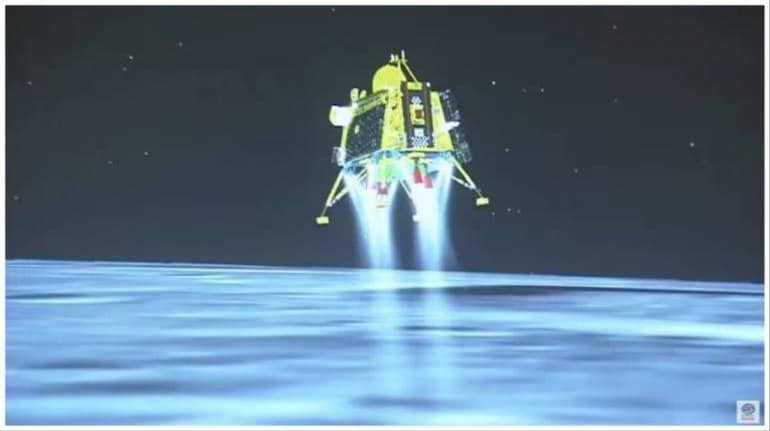
India on August 23 scripted history as ISRO's ambitious third Moon mission Chandrayaan-3's Lander Module (LM) touched down on the lunar surface, making it only the fourth country to accomplish the feat, and the first to reach the uncharted south pole of Earth's only natural satellite.
Also Read: India to celebrate August 23 as National Space Day, says PM Modi
The spot where Chandrayaan-3 Vikram lander made a soft landing was named "Shiv Shakti Point" and the site where the Chandrayaan-2 lander crash-landed on the Moon's surface in 2019 was given the name "Tiranga Point".
Discover the latest Business News, Sensex, and Nifty updates. Obtain Personal Finance insights, tax queries, and expert opinions on Moneycontrol or download the Moneycontrol App to stay updated!
Find the best of Al News in one place, specially curated for you every weekend.
Stay on top of the latest tech trends and biggest startup news.