Cast your mind back to about 15 years ago, when smartphones were just beginning to make their presence felt. Likely you still had a sturdy feature phone (perhaps one with a grainy camera, if you were reasonably chic), and were wondering what the full-touch smartphone buzz was all about – I know I was. Before you knew it, though, touch-based phones completely took over the mobile phone market, relegating feature phones virtually obsolete – which is kind of what is happening with electric vehicles vis-á-vis those with IC (internal combustion) engines. The future is upon us already, what with a new EV being announced virtually every week, so it’s probably best to not be a Luddite and to just go with the flow.
Which brings me to the TVS iQube, a scooter I’ve been curious about for a while now.
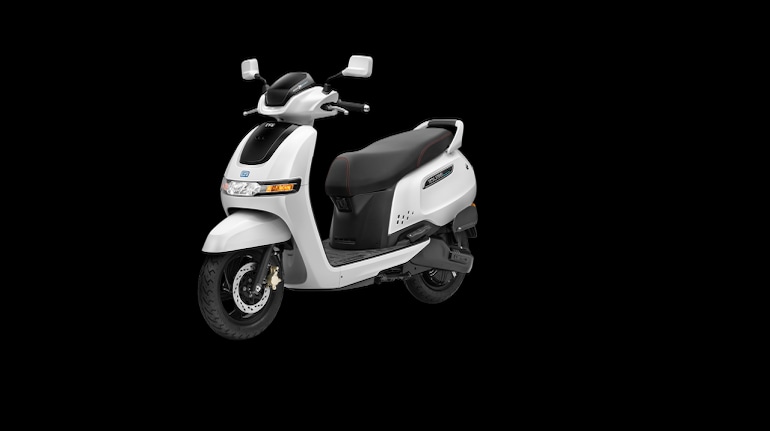
DesignThe Hosur-based firm really knows its scooters, and when it first announced the iQube, I was keen to see how TVS’ expertise translated to the electric domain. To begin with, it’s done an interesting job with the scooter’s design. Seen head-on, it looks like a cartoon robot, but it’s not cartoonish – in fact, from other angles, it looks rather conventional. The overall proportions are just right, too, and fit and finish are also of a high standard. The alloy wheels look great, too, and it’s nice to see floor mats back on scooters – they really help prevent scuffing of the floorboard.
FeaturesThe floorboard itself is nice and flat despite the battery pack, so the riding position is exactly like any other regular scooter – and the seat is nice and wide. In terms of storage, the space under the seat will swallow an open-face helmet and a few other knick-knacks.
One standout feature on the iQube is its extremely high-res TFT colour display. An app lets you hook up your smartphone to it, for navigation, call/message alerts and so forth, alongside your phone’s battery and signal strength.
Another nifty feature it has is a parking assist function, which is a button that allows you to switch between forward and reverse modes (speed is restricted to 10 kmph going forward and 3 kmph going backwards).
PowerThe iQube comes with a hub-mounted motor made by Bosch, and it puts out 4.4kW of power, with 33 Nm of torque. It’s a smooth motor to use, and its power delivery is reasonably linear, unlike some other electric two-wheelers where power delivery is reduced if you happen to start squeezing the brakes; this can make riding around in traffic conditions a bit of a jerky affair. On the iQube, regular city conditions are handled with ease, and if you wring the throttle open, the torque on offer propels you along just as rapidly as a regular scooter, like TVS’ own Ntorq, for example.
Ride modesIn Power mode, the iQube gets to about 80 kmph, which is more than sufficient for almost anyone. There’s also an Eco mode that saves on battery and restricts the top speed to around 50 kmph, and I was pleasantly surprised by the fact that it’s a reasonably useable mode and doesn’t feel deathly slow. Additionally, you can switch between the two modes on the fly.
What you do have to get used to is the regenerative braking system. If you start backing off the accelerator, the system cuts in and will slow the iQube down to a dead halt if you don’t get back on the throttle. This can be a little odd at first, but I found I adapted quickly enough and began using the system like regular brakes on occasion. Speaking of brakes, the scooter comes with a 220mm disc brake at the front and a drum brake at the back.
Ride qualityThe iQube comes with a telescopic fork up front and twin rear shock absorbers, and they keep the scooter reassuringly planted on the road; it has 12-inch wheels shod with TVS tyres, which offer plenty of grip. The scooter is able to soak up bumps in the road without unsettling you, and it feels confident around corners. This is not to say that it’s especially nimble around them, though – there’s a certain extra weight in the handlebar, which doesn’t turn sharply and thus makes the iQube feel a little slow in the bends.
RangeNow for the question I know is on your mind, namely “What kind of range does the iQube offer?” In all honesty, I must admit that I didn't set out to specifically find out, partly because I didn't want to get stranded with a dead battery. I did have an iQube with a full battery (it takes 5 hours to charge up), and after a fair bit of riding around in a mixture of traffic and open road situations – in both Eco and Power modes – I found that the range indicator consistently indicated about 75 km in Eco and roughly 50 km in Power. As for charging, TVS provides a portable charging cable, but for an extra Rs 10,000, you can buy a SmartXHome charging system, which comes with an RFID feature that doesn’t let anyone else use the charger (it doesn’t charge any faster, though). Fast charging isn’t supported – TVS explains this by saying that battery life is affected.
VerdictThe iQube is, all told, an extremely impressive scooter that should find many takers – once it’s actually widely available, that is. Right now it’s only sold in Delhi, Coimbatore, Chennai and Bengaluru, and TVS says that it will be available in 20 cities by March next year.
With the additional subsidies available after FAME 2, you can land one of these scoots for around a lakh of rupees all told, which is a very tasty price indeed, given its super low running and maintenance costs. TVS, you’ve served up another winning scooter.
Discover the latest Business News, Sensex, and Nifty updates. Obtain Personal Finance insights, tax queries, and expert opinions on Moneycontrol or download the Moneycontrol App to stay updated!
Find the best of Al News in one place, specially curated for you every weekend.
Stay on top of the latest tech trends and biggest startup news.