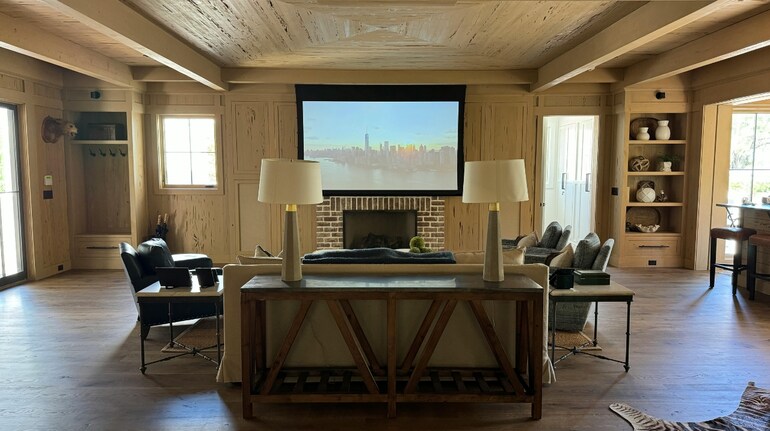

There was a time when the future arrived with a whirr, a beep, and an instruction manual thick enough to double as a doorstop. Today, in interior design, that silence is changing everything.
Walk into the modern home and you may not notice anything extraordinary, until you do. The light subtly warms as you settle in. The wall responds to your touch. The kitchen counter knows when you are about to cook.
According to Harshita Agarwal, Founder, Harshita Agarwal Interiors, this is the beauty of soft technology. “We are moving toward a design future where intelligence is no longer seen but seamlessly felt,” she says. “Nothing looks smart, but everything is.”
For designers, says Agarwal, this shift is nothing short of liberating. “As technology dissolves into materials and surfaces, the tyranny of visible gadgets finally loosens its grip.” she says. Rather than humans bending themselves around devices, soft technology bends to human need. “Colour-shifting metals, responsive walls, and discreet climate systems signal a fundamental reversal in thinking. Homes no longer ask us to learn new behaviours, they learn ours.”
This is technology, explains Agarwal, that’s moving around human needs rather than humans adjusting to technology,” She further adds, “And that changes everything.”
Also read: 9 longest living indoor plants that require minimal maintenance
For a generation growing up alongside artificial intelligence, this will feel instinctive. Screens and speakers may disappear altogether, replaced by projected walls and surfaces that transform when needed, and vanish when not.
What truly excites designers is that intelligence no longer means sterility.
“Design will remain emotional, intuitive, and deeply sensory,” says Agarwal, “while technology quietly elevates the experience from within.” The challenge, she notes, lies in restraint. Homes must not become cold laboratories simply because they are clever.
Interior design is no longer choosing sides. It is learning to harmonise. And as this revolution unfolds, one thing feels certain: the smartest homes of the future may be the ones that barely show it at all.
Pressure-sensitive wood floors and wall panels that react to movement and time, subtly guiding circulation or ambience while appearing natural, with no visible sensors or interfaces.
Integrated circadian lighting within ceilings adjusts colour temperature and intensity based on time, weather, and occupancy, supporting mood and wellbeing without switches, apps, or manual control.
Upholstered seating with embedded pressure sensors reads posture in real time, subtly adjusting support and tension to enhance comfort, reduce strain, and remain visually indistinguishable.
Radiant heating and cooling concealed within walls or floors regulate temperature evenly and silently, eliminating vents and drafts so occupants experience comfort without noticing any system.
Also read: 8 indoor plants that purify air in your bedroom in the night
Smart materials paired with wood, clay, fabric and stone: Phase-change, conductive, or responsive layers are hidden behind wood, clay, fabric, and stone surfaces, delivering intelligence and performance while preserving tactile warmth and natural aesthetics.
Paradoxically, as automation increases, people may slow down. Agarwal believes soft technology will push us back toward tactility and pause. “With so much automation, people will rediscover the beauty of materials that whisper, not shout.”
The future, then, is not a battle between progress and soul, but a careful synthesis.
Q. What is soft technology in interior design?
Soft technology refers to digital and smart solutions that enhance comfort without heavy hardware.
Q. How is soft technology used in homes?
Through smart lighting, climate control, voice assistants and app-based systems.
Q. Why is soft technology becoming popular in interior design?
It improves convenience, comfort and energy efficiency.
Q. Does soft technology affect home aesthetics?
Yes, it allows cleaner designs with fewer visible gadgets.
Q. Can soft technology make homes more energy-efficient?
Yes, smart systems help optimise lighting and temperature use.
Discover the latest Business News, Sensex, and Nifty updates. Obtain Personal Finance insights, tax queries, and expert opinions on Moneycontrol or download the Moneycontrol App to stay updated!
Find the best of Al News in one place, specially curated for you every weekend.
Stay on top of the latest tech trends and biggest startup news.