In India, it can be hard to divorce leather from - and see leather work sans - its caste connotations. Yet, an artist in the CultivateArt curation at India Design ID Mumbai - Meera - is trying to forge her own relationship with the material. On display at the Jio World Garden, Mumbai, from September 26-28, her work is shaped by the idea of "Cosmomorphia" - "how bodies and materials can be understood through the same forces that shape living matter: pressure, rupture, renewal, and symmetry. It rethinks form not as something fixed or pathologized but as a site of transformation."
The confluence of what would traditionally be considered fashion and art is hardly new. But with each passing year, designers and artists seem to push their marriage into new territories. Meera's pieces fall within this much larger set of contemporary artists experimenting with the materiality and potential of fabric, embroidery and craftsmanship in conceptual artworks.
For this collection, Meera has worked with artisans to mould, fold, hand-stitch, cut, dye, perforate full-grain leather into sculptural pieces that examine "architectures of potential". Though the forms and titles -- like "Touching Venus: Contact" -- evoke the female anatomy, and seedpods recur in the collection, Meera seems more interested in capturing something about the way biology is shaped by and responsive to cosmological forces. "The sculptures suggest a universe where cellular, anatomical, and botanical forms belong to a shared continuum, each animated by the same unfolding laws of growth," she explains over email.
Excerpts from the email interaction:
On training and my journey with leather
I trained in design and launched my own footwear label over a decade ago, working extensively with artisans across India. Leather was initially a material of utility for me, something I moulded, stitched, dyed, and constructed into shoes. But over time, it began to reveal itself as something far more complex. I didn’t go to art school in the traditional sense, but I’ve had a long apprenticeship with the material itself.
What drew me to leather was its inherent contradiction: it carries memory, responds to pressure, and ages with time. It is pliable but resilient. Working with it is an act of negotiation; it resists, stretches, remembers, and, to me, that’s a deeply sculptural quality.
On leather, caste, and cultural complexity
While my own relationship to the material is shaped by a more emotional and sculptural impulse, drawn to its memory, pliability, and bodily resonance, that personal engagement does not override or erase its larger social and historical connotations. On the contrary, I see my work as situated within this complexity. I approach leather as a carrier of meanings, both painful and powerful.
In my practice, I collaborate with highly skilled artisans who specialise in traditional leatherwork. Their knowledge, technical, embodied, and intergenerational, is integral to the process, and I am deeply committed to ensuring that their contributions are visible and valued. While I do not belong to the caste communities historically associated with leather, my work seeks not to appropriate but to amplify and bring forward the extraordinary craftsmanship that exists in India, situating it within contemporary sculptural discourse without disavowing its origins.
To work with leather today is to enter a space of ethical and conceptual responsibility. It is to hold the contradictions of a material that is at once sacred and profane, luxurious and stigmatised, natural and political. I do not claim to resolve these contradictions, but I believe that engaging them, rather than ignoring them, is what allows the work to carry meaning.
 Detail from Podule. Meera says: "Seed pods embody latency and eventual release."
On Form: Abstraction, Containment, and the Universe Within
Abstraction is central to my sculptural language. It creates a space where form is free from fixed representation, where the body can be evoked without being defined, and where meaning can remain layered, elusive, and open to interpretation. Especially in relation to the female body, abstraction becomes a way to shift the gaze, to focus on internal structures, on memory, on transformation, rather than on surface or spectacle.
Within Cosmomorphia, forms such as seed pods, shells, mirrored cavities, and folded anatomies become recurring structures. These are not literal organs or botanical specimens; they are architectures of potential. Seed pods embody latency and eventual release, shells record pressure and endurance, and anatomical rhythms extend the body into speculative terrains. Each carries within it a logic of containment and rupture, memory and renewal.
The underlying principle guiding these forms is what I understand as morphological intelligence, the structural knowledge embedded in living matter. This idea resonates with D’Arcy Wentworth Thompson’s On Growth and Form, where biology is understood as inseparable from physics and geometry. Growth, in this view, emerges from the interplay of force, symmetry, and constraint. My sculptures respond to this vision: each fold of leather, each recess or protrusion, becomes an echo of physical law, a visible trace of pressure and expansion.
Alongside this structural lineage, the work also inherits a speculative one. Ernst Haeckel’s drawings of microscopic life combined precision with mysticism, collapsing botanical, cellular, and cosmic structures into a single visual system. His vision of morphology expands beyond taxonomy into cosmology. In Cosmomorphia, this speculative spirit persists: the sculptures suggest a universe where cellular, anatomical, and botanical forms belong to a shared continuum, each animated by the same unfolding laws of growth.
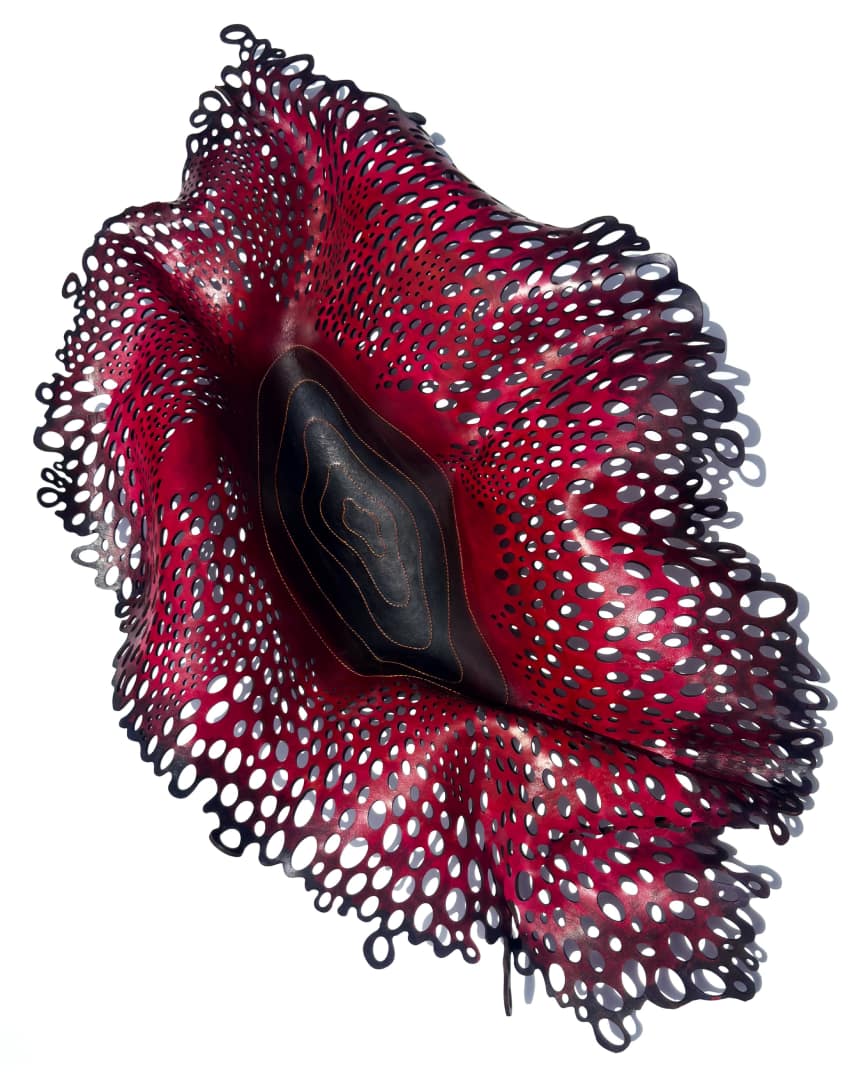 'Touching Venus: Contact' (above) has a counterpart in the show. Where this work seems open and accepting, 'Touching Venus: Containment' seems to capture the moment after contact where the leather is curled in on itself. Many of the works in this show draw attention to the sensuality and malleability of this material.
Creative process: Material knowledge and leatherwork
My process is grounded in material knowledge and traditional leather working techniques. Leather requires close attention; it behaves differently under tension, through folding, or when pierced. Understanding its weight, grain, and resistance is essential to shaping it with intention and control.
Each piece involves hand-dyeing, cutting, folding, and stitching. I use saddle-stitching for its strength and clarity, a technique that allows for firm joins and a visible rhythm across the surface. All construction is done by hand, with precise attention to edges, seams, and reinforcement, allowing the form to hold its structure while maintaining refinement.
This is not an industrial process. Every stage involves time, skill, and responsiveness, shaped by an ongoing negotiation between hand and material. Each decision is informed by feel, memory, and an accumulated knowledge of the craft.
While the ideas and designs originate in my studio, the making itself is deeply collaborative. Each work passes through multiple hands: artisans trained in leather craft, stitchers, and finishers, each contributing a layer of care and expertise.
It carries the imprint of many hands, as a quiet record of decisions made through touch, precision, and shared understanding. It is through this collective attentiveness that the piece finds its final form.
Discover the latest Business News, Sensex, and Nifty updates. Obtain Personal Finance insights, tax queries, and expert opinions on Moneycontrol or download the Moneycontrol App to stay updated!
Find the best of Al News in one place, specially curated for you every weekend.
Stay on top of the latest tech trends and biggest startup news.