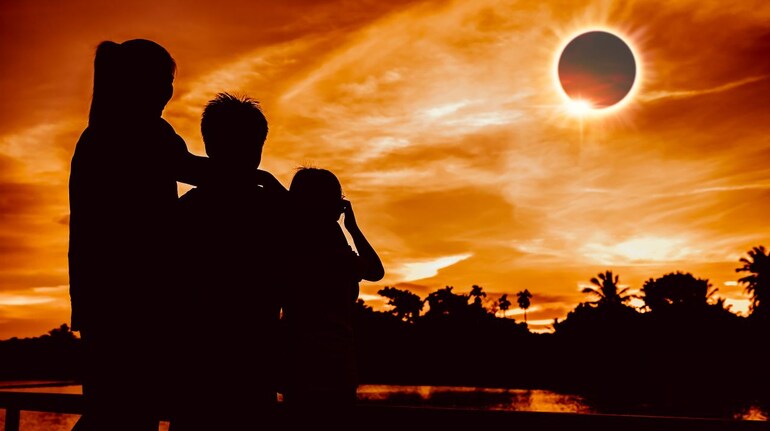
A breathtaking celestial event is on the horizon. On Wednesday, October 2, 2024, an annular solar eclipse will grace the skies, offering a stunning "ring of fire" view for those in certain regions. While this astronomical wonder will not be visible from India, it is set to capture the attention of observers across parts of the Southern Hemisphere.
An annular solar eclipse occurs when the moon passes between the Earth and the Sun, casting a shadow that only partially covers the Sun. Since the moon is not large enough to completely block the Sun, its shadow leaves the Sun’s outer edges visible. This creates the awe-inspiring "ring of fire" effect. Additionally, the moon will be at its farthest point from Earth, known as apogee, making its shadow too small to fully eclipse the Sun.
Read Also: List of astronomical events in October 2024: Know when and what to watch in sky this month
The eclipse will begin over the southern Pacific Ocean at 3:42 p.m. UTC. It will reach its maximum visibility over Argentina at 6:45 p.m. UTC, and the event will conclude over the southern Atlantic Ocean by 8:39 p.m. UTC. The entire phenomenon will last approximately six hours, with the moon’s shadow moving at varying speeds depending on location, from over 6 million mph to just 1,278 mph, the speed of a fighter jet.
Unfortunately, the annular solar eclipse will not be visible in India, as it will occur during the night. The eclipse will be seen over parts of the Pacific Ocean, Chile's Easter Island, Argentina, and other South American countries like Brazil, Paraguay, and Uruguay. NASA warns that it is unsafe to look directly at the Sun during the eclipse without proper protection, such as eclipse glasses or a handheld solar viewer.
As with any solar eclipse, it is crucial to avoid looking directly at the sun. NASA warns that looking at a partial or annular eclipse without proper protection can cause serious eye damage. It is recommended to wear eclipse glasses or use a safe handheld solar viewer at all times.
"Do NOT look at the Sun through a camera lens, telescope, binoculars, or any other optical device while wearing eclipse glasses or using a handheld solar viewer — the concentrated solar rays will burn through the filter and cause serious eye injury," NASA's advisory reads.
While those in India may miss out on this celestial event, enthusiasts worldwide will be able to witness this rare and breathtaking phenomenon.
Discover the latest Business News, Sensex, and Nifty updates. Obtain Personal Finance insights, tax queries, and expert opinions on Moneycontrol or download the Moneycontrol App to stay updated!
Find the best of Al News in one place, specially curated for you every weekend.
Stay on top of the latest tech trends and biggest startup news.