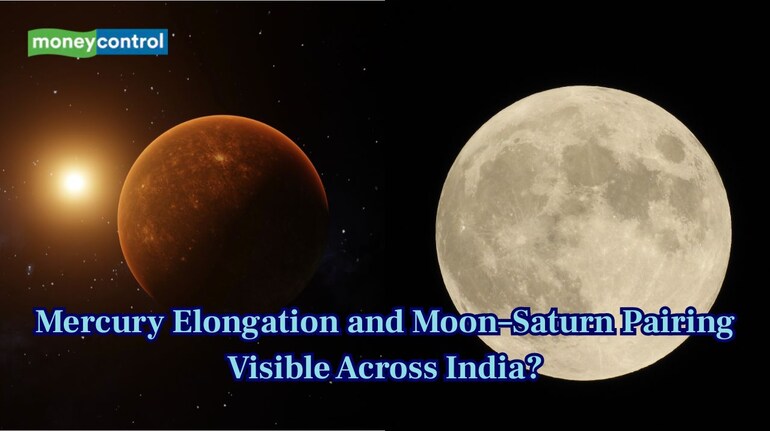

19th February promises astronomy fans not one, but two notable sky events over the western horizon after sunset. First, Mercury reaches its greatest eastern elongation. Then, as twilight deepens, the crescent Moon will appear close to the planet Saturn, creating a beautiful pairing in the evening sky.
What Is Mercury’s Greatest Eastern Elongation?
Greatest eastern elongation occurs when Mercury appears at its maximum angular separation from the Sun as seen from Earth. Because Mercury orbits so close to the Sun, it can be tough to spot in the glare, except at greatest elongation, when it climbs highest above the horizon after sunset.
On the evening of 19 February, Mercury will be about 18 degrees east of the Sun. This will make it easy to see low in the western sky just after sunset especially with a clear view toward the horizon.
The Crescent Moon and Saturn: A Twilight Pair
Also tonight, a thin waxing crescent Moon will pass near Saturn in the early evening sky. This type of proximity is known as a close pairing. thsi will offer a lovely sight as the crescent Moon hangs near Saturn’s faint golden dot.
Sky maps and simulations show that as twilight fades, the Moon and Saturn will be separated by only a few degrees, making them easy to spot together over the western horizon.
Will India See These Events?
Yes, stargazers across India can see both events tonight, weather permitting. Just after local sunset (around 6:00–6:30 pm), look toward the western sky. Mercury will be visible low above the horizon, brighter than usual because of its favourable elongation.
The Moon and Saturn will be visible slightly higher, making a beautiful twilight pairing. Even in moderately light‑polluted skies, both events should be noticeable with the naked eye.
Though binoculars or a small telescope can help make Mercury and Saturn stand out more clearly.
How to Spot These two events Tonight?
Catching both Mercury’s elongation and the Moon–Saturn pairing is easier than many might think. But it does require some careful timing and the right vantage point.
Start by looking toward the western horizon shortly after sunset, when the sky is still tinged with twilight.
Mercury, appearing as a small but bright point of light, will be the first to catch your eye. As twilight deepens, your gaze should shift slightly higher to spot the thin crescent Moon and Saturn.
Why These Events Are Special?
These night events are neither exactly rare but nor ordinary. Events like planetary elongations and Moon–planet pairings happen several times a year. However, two noticeable sky events aligning on the same date makes it special.
To witness both events on the same evening is uncommon. February 19th combines science and spectacle.
Discover the latest Business News, Sensex, and Nifty updates. Obtain Personal Finance insights, tax queries, and expert opinions on Moneycontrol or download the Moneycontrol App to stay updated!
Find the best of Al News in one place, specially curated for you every weekend.
Stay on top of the latest tech trends and biggest startup news.