The noise rippled through the crowd gathered near Buckingham Palace to mark Queen Elizabeth’s death — a rustling of phones, a sudden cheering, a burst of applause. “I just saw her!” a woman exclaimed excitedly as a dark car sped past, possibly containing some royal, or royal-adjacent, passengers.
“Camilla!”
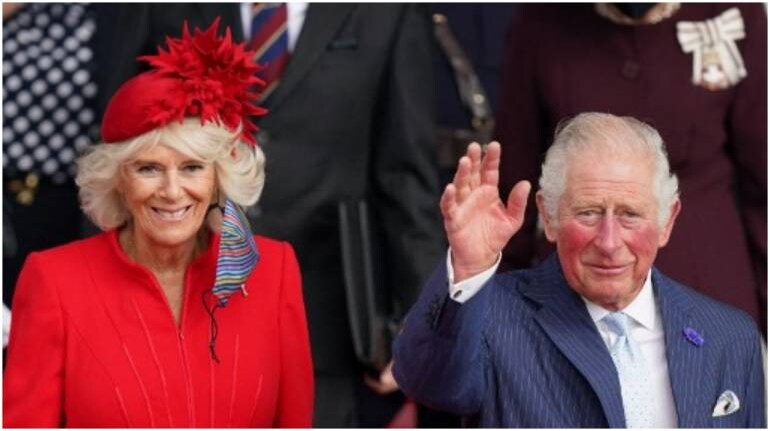
How different from a quarter-century ago. Reviled then as the woman who wrecked a royal marriage and destroyed a modern fairy tale, Camilla is now Britain’s Queen Consort, her image buoyed by the softening of a country’s judgments and the sheer passage of time.
“I think she’ll support Charles just the way Philip supported the queen,” said a well-wisher in the crowd, 52-year-old Diane Pett, speaking of Elizabeth’s late husband and the new King Charles. “Who are we to judge?”
As thousands of people converge on palaces in England and Scotland to mark the (so far) seamless transition from one monarch to another, it’s hard not to be transported back to 1997, another national inflection point. That was when Diana, the 36-year-old Princess of Wales and the ex-wife of Charles, was killed in a car crash, and London erupted in a collective howl of anguish and outrage.
It felt feral, bewildering, a rupture to the natural order of things. There was a dangerous crackle in the air, a fury at the royal family for what was seen as callous treatment of Diana in life and a gross misjudgment of the depth of grief at her death.
Prince Charles, accused (along with Camilla, then his girlfriend) of having been instrumental in Diana’s unhappiness, worried that he might be jeered at or even attacked by the crowd as he and other male members of the royal family briefly followed Diana’s coffin on foot in London. Emotions were so high that there was talk that the monarchy itself might be on the verge of collapse.
But not anymore. As Britain settles in to wait for the queen’s funeral Monday, it is as if that earlier time has been all but forgotten.
For now, there is a mood of quiet agreement, if not about the monarchy’s long-term future, then about the importance of the moment. There is respect for the queen’s long reign and even a kind of appreciation for the baroque rituals — the reading of proclamations, the signing of documents, the swearing of oaths, the sounding of trumpets, the courtiers’ costumes with their be-furred and be-feathered hats — that have been dusted off for the occasion.
Possibly the 1,000-year institution makes sense after all?
“The monarchy is an apolitical symbol of national unity and of Britain’s long history and deep stability,” said Gideon Rachman, chief foreign affairs columnist for The Financial Times.
Rachman, whose parents emigrated from South Africa to England, noted that every royal coronation since 1066 has taken place in Westminster Abbey. “I think that kind of thing is a source of pride and comfort for people,” he said in an interview, “maybe particularly those of us whose parents came here from much more turbulent countries.”
But after Diana’s sudden, violent death in Paris in 1997, Britain was wracked with turbulence, uncertainty and incipient republicanism. Then, as now, crowds flocked to royal palaces, blanketing the grounds with flowers. Then, as now, there was wall-to-wall coverage of a royal death and endless TV chatter about the arrangements for a royal funeral. The grief was different, for the sudden death of a young woman rather than the sad but expected passing of an elderly monarch.
“It was as if you were living in a revolutionary time,” novelist and political commentator Robert Harris said. “I’ve never known an atmosphere in London like it. It was borderline hysteria, as if a coup might take place. Nobody knew what might happen.”
Harris wrote about Diana’s funeral, at Westminster Abbey, for The Mail on Sunday. He was seated not far from Diana’s brother, Earl Spencer, whose stirring funeral address included a biting attack on the decision to strip Diana of her “royal highness” appellation and made a pointed distinction between the family she married into and her “blood family.” (That he came from an ancient noble family, far older than the queen’s, and that the queen was his godmother, added to the punch of the insult and gave his remarks the sense of a brewing mutiny.)
“There was a pause after he finished speaking,” Harris recalled. “Then there was this curious sound, like rain drumming on the roof, and it became clear that it was the distant sound of applause from all the people gathered outside” — watching on a giant screen near the abbey. Eventually, the applause swept through the church, though the queen and the senior royals did not participate.
“It felt like if we’d been living in Shakespearean times, the Spencer forces would have marched on London, and there would have been a Spencer regency with the two princes,” Harris said, speaking of Diana and Charles’ sons, Princes Harry and William.
It was virtually the only time in her long reign that the queen cast tradition aside and bent to popular will. Under prodding by Tony Blair, then the prime minister and alarmed at what he saw as a crisis of royal legitimacy, Elizabeth returned to London from Scotland and gave a televised address the night before the funeral acknowledging the people’s bewilderment and pain. That helped defuse some of the urgency of the emotions.
Subsequent events — Charles’ marriage to Camilla and Camilla’s gradual acceptance by the queen; the passage into adulthood of William and Harry; Elizabeth’s general imperturbability; the burst of goodwill following her death — seems to have done the rest.
As she stood in Green Park near Buckingham Palace the other day, bouquets of flowers strewn every which way, Janet Ratcliffe, 75, said that after the unpleasantness of the Diana era, she had come to believe that the monarchy could thrive under Charles and even under Camilla.
“People were very sad, and it was very traumatic,” she said of Diana’s death. She mentioned Camilla, who by now had driven past (or not driven past) in the possibly royal car. She said that Charles had, as far as she could tell, grown into his new role.
“I thought Camilla was the baddie,” she said, “but I’ve come to realize that it’s more complicated than that. They care about each other, and they can do good for the country.”
(Author: Sarah Lyall)/(c.2021 The New York Times Company)
Discover the latest Business News, Sensex, and Nifty updates. Obtain Personal Finance insights, tax queries, and expert opinions on Moneycontrol or download the Moneycontrol App to stay updated!
Find the best of Al News in one place, specially curated for you every weekend.
Stay on top of the latest tech trends and biggest startup news.