
co-presented by
ASSOCIATE SPONSORS
co-presented by


ASSOCIATE SPONSORS




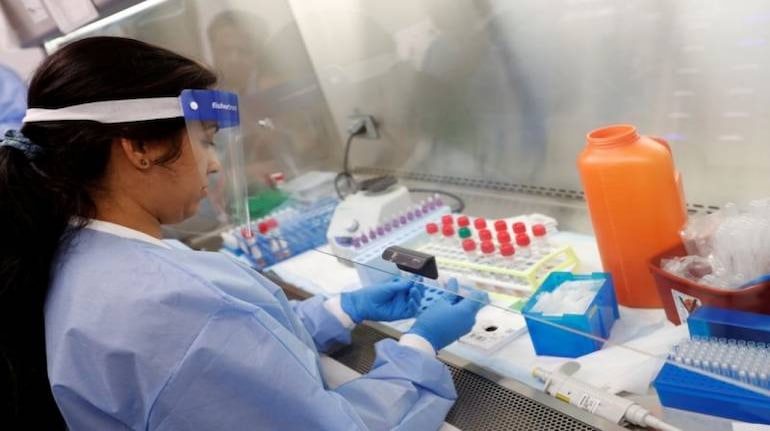
A team of three Israeli scientists has pioneered a coronavirus testing procedure that they say is faster and more efficient than any now in use, testing samples in pools of as many as 48 people at once.
The Israeli government plans to roll out the new method in 12 labs across the country by October, anticipating that another wave of coronavirus infections could coincide with influenza season with potentially calamitous results.
“We’re doing everything we can in order to be ready,” said Ronen Walfisch, an engineer at the defense ministry who oversaw a pilot project to test the method’s efficacy. The method passed with flying colors, he said.
Moran Szwarcwort Cohen, who runs the virology lab at Rambam Health Care Campus in Haifa, said the new pooled-testing method, which was formally approved for clinical use by the Israeli health ministry Tuesday, could allow schools, college campuses, businesses and airlines to clear whole groups of people far faster than has been possible until now.
“It’s a huge game-changer,” said Cohen, who was not involved in the new research.
Pooled testing for the coronavirus has received much attention in the United States as inundated labs struggle to cope with backlogs and shortages of chemicals, pipette tips and other supplies.
Most pooling efforts elsewhere are relying on a simplistic approach developed to test World War II draftees for syphilis. That so-called Dorfman method, named for the economist who dreamed it up, calls for testing pools of samples from several people at once. If the pool tests negative, then all individuals are considered negative. If the pool tests positive, then additional samples from each individual must be retested to see which are positive.
The Israeli method, by contrast, is designed to only require one round of testing — a crucial savings in time, laboratory workflow and supplies.
It accomplishes that by building on a combinatorial algorithm that one of the three scientists, Noam Shental of the Open University of Israel, in Raanana, developed a decade ago to speed the detection of rare genetic mutations. It works much like error-detecting codes that filter out noise in telecommunications and computer science.
In a study published Friday in the journal Science Advances, Shental and his colleagues, Tomer Hertz and Angel Porgador of Ben-Gurion University of the Negev, report that their method — called P-Best, for Pooling-Based Efficient SARS-CoV-2 Testing — successfully detected positives in pools of as many as 48 samples. The method accurately screened 1,115 health care workers with just 144 tests, the study found.
In one typical iteration, the Israeli team took samples of 384 people and divided them into 48 pools, so that each person’s sample wound up in a unique set of six pools.
Each of the 48 pools was then tested. If one person was positive for the virus, then each of the six pools containing that sample should test positive — resulting in a unique combination of positive pools revealing the identity of the person (or people) carrying the virus.
The algorithm optimizes the design of its pools according to the expected prevalence of the virus, making it possible to pinpoint all of the positive individuals in a batch, as long as the total number of positives does not sharply exceed the expected number.
Like all types of pooled testing, the usefulness of this method drops as a community’s “positivity rate” — the proportion of tests that come back positive — climbs.
But when positivity rates are lower, the Israeli method is dramatically more efficient than others, Hertz said. At an infection rate of 1%, he said, the new method is eight times as efficient as individual testing and nearly twice as efficient as an eight-sample Dorfman pool.
Israeli officials and researchers are working with an artificial-intelligence company to help cull samples that are likely to be positive, based on known hot spots, to keep positivity rates lower, Hertz said.
A frequent concern raised about pooled testing is that samples will be diluted, causing a loss of sensitivity that could result in false negatives. But Shental said the new method was effective even with low viral loads because each sample is tested in multiple pools.
Israel is in the grip of a rough second wave of the pandemic, and many expect that it will only be brought under control by reimposing a nationwide lockdown. Because of delays in purchasing the sophisticated pipetting robots necessary to run the new method quickly, officials said they expect it will only kick in when that next lockdown is eased.
The three scientists who devised the method have formed a company, Poold Diagnostics, and are looking to bring their algorithm to labs in the United States. Michael S. Lebowitz, chief science officer at 20/20 GeneSystems, in Rockville, Maryland, which has plunged into the COVID-19 testing market, said it was in talks with Poold to file a joint application to the Food and Drug Administration for emergency authorization to try out its method.
He said the method could be enormously useful in getting businesses or college athletic programs back up and running and ensuring that their populations remain healthy. “The ideal situation is getting results in 24 to 48 hours,” he said. “If you can get compression of about eightfold, you’re now running many fewer samples.”
The inspiration for the Israeli method came from Shental’s mother. A few years ago, he said, she attended a lecture he gave to an audience of nonscientists in which he described his earlier research about using pooled testing for rare birth defects and urged that it be made more widely available. As the coronavirus pandemic spread this spring, she asked him if that old algorithm might be deployed to test for COVID-19.
But Shental’s head was elsewhere: He had not worked with group testing in years and was instead focused on research that got him on the cover of the journal Science in late May, in which he established associations between certain types of bacteria and certain kinds of tumors.
“I was dismissive of her at first,” Shental said, smiling sheepishly. “But when I was driving home, I realized it could work.”
Shental called his best friend, Hertz — the two got their Ph.D.s together — and within two days, Porgador, who has since been named Ben-Gurion University’s dean of the health sciences, had set up an experiment using samples from Soroka Hospital across the street. A short time later, Ben Gurion’s president, Daniel Chamovitz, who had solicited suggestions for how to fight the pandemic with a promise to fund the best ones, found $150,000 to buy an advanced pipetting robot to try out their idea.
c.2020 The New York Times Company
Discover the latest Business News, Sensex, and Nifty updates. Obtain Personal Finance insights, tax queries, and expert opinions on Moneycontrol or download the Moneycontrol App to stay updated!
Find the best of Al News in one place, specially curated for you every weekend.
Stay on top of the latest tech trends and biggest startup news.