






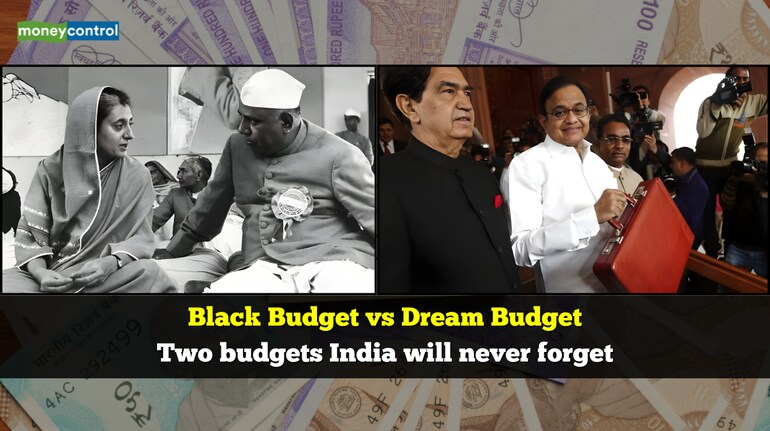

India's journey since independence has been marked by several landmark Union Budgets that have shaped its economic destiny. Among these, two stand in stark contrast, remembered for the vastly different circumstances and impacts they had on the nation: the "Black Budget" of 1973 and the "Dream Budget" of 1997.
"Black Budget" of 1973: A Budget of Crisis
Presented by Finance Minister Yashwantrao B. Chavan during Prime Minister Indira Gandhi's tenure, the 1973-74 budget earned its dark nickname for one primary reason: it revealed a massive fiscal deficit of Rs. 550 crore. This figure, unprecedented at the time, was a glaring sign of deep economic trouble.
The budget was the result of a perfect storm of crises:
Aftermath of War: The 1971 India-Pakistan war and the subsequent liberation of Bangladesh had severely drained India's financial resources. Defence spending soared to Rs. 1,600 crore.
Refugee Crisis: The government faced the enormous task of rehabilitating over 1 crore refugees.
Devastating Drought: The 1972 drought was one of the worst in decades, crippling agriculture and causing severe food shortages across rural India. Urban areas battled power cuts and rising unemployment.
Finance Minister Chavan's call for "bold action to secure our future" was backed by difficult measures. The budget allocated Rs 56 crore to nationalise key industries like coal mines and general insurance, aiming for greater state control. It also set aside Rs 220 crore for drought relief and Rs 160 crore to import 2 million tonnes of food grains to fight scarcity. This budget, born out of necessity and crisis, highlighted a period of severe economic strain for the country.
"Dream Budget" of 1997: A Budget of Reform
Over two decades later, a different economic vision took centre stage. Presented by Finance Minister P. Chidambaram for the United Front coalition government, the 1997 budget was instantly hailed as a "Dream Budget." It came at a time when India's economic growth lagged behind its Asian peers, and there was a strong demand for stimulative policies.
Chidambaram's approach was built on a simple but powerful belief: lower tax rates would encourage more people to pay taxes honestly, ultimately increasing government revenue. His bold reforms included:
Lowering Taxes: The maximum personal income tax rate was cut sharply from 40% to 30%. The corporate tax for domestic companies was reduced from 40% to 35%.
Encouraging Disclosure: He introduced the Voluntary Disclosure of Income Scheme (VDIS), allowing people to declare hidden income by paying tax at the new rates without penalty.
Simplifying Systems: He simplified the complex excise duty structure and reduced the peak customs duty from 50% to 40%.
Broadening the Tax Net: New rules required individuals who owned assets like a car, telephone, or property, or who had travelled abroad, to file tax returns.
The market's reaction was wildly positive, with the stock market surging 6.5% on budget day. More importantly, the strategy worked in the long run. Income tax collections, which were around Rs. 18,700 crore in 1997, grew dramatically to over Rs. 2 lakh crore by 2013, according to a Forbes report, proving the success of its core philosophy.
These two budgets tell the story of two different Indias. The Black Budget of 1973 was a defensive response to external shocks and internal crises, focusing on survival through state control and welfare spending. In contrast, the Dream Budget of 1997 was an offensive play for growth, trusting citizens and markets, and aiming to unlock India's economic potential through liberalisation and rationalisation.
As Finance Minister Nirmala Sitharaman prepares to present the Budget for 2026, the lessons from these two historic moments remain relevant. They remind us that a budget is more than just numbers; it is a reflection of the nation's challenges, its ambitions and its economic philosophy at a point in time. One is remembered for steering the country through a storm, the other for setting it on a path of accelerated growth—both leaving a permanent mark on India's financial history.

Discover the latest Business News, Sensex, and Nifty updates. Obtain Personal Finance insights, tax queries, and expert opinions on Moneycontrol or download the Moneycontrol App to stay updated!
Find the best of Al News in one place, specially curated for you every weekend.
Stay on top of the latest tech trends and biggest startup news.










