






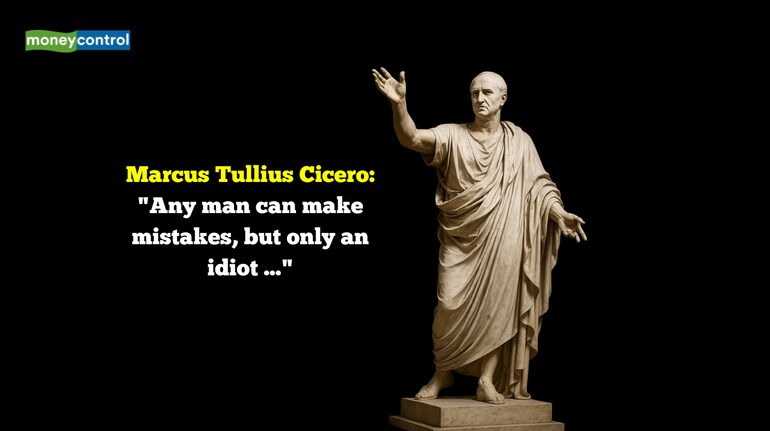

The ancient Roman statesman and philosopher Marcus Tullius Cicero understood something fundamental about human nature that remains as relevant today as it was two thousand years ago. In a world where pride often prevents progress, his words cut through with timeless clarity:
"Any man can make mistakes, but only an idiot persists in his error."
This sharp observation separates the universal human experience of failure from the willful choice to remain in it. It offers not judgment for stumbling, but a clear path forward for those willing to take it.
Universality of Error
Cicero begins with a generous acknowledgment: "Any man can make mistakes." This is not a condemnation but an acceptance of human limitation. To err is not weakness; it is simply part of being human. Every person who has ever lived, regardless of intelligence, status, or achievement, has made errors in judgment, action, or belief. The first part of Cicero's statement relieves us of the impossible burden of perfection. Mistakes are not the mark of a fool—they are the mark of a person.
Threshold of Foolishness
The distinction comes in what happens next. The "idiot," in Cicero's formulation, is not the one who errs, but the one who refuses to acknowledge and correct the error when it becomes known. Persistence in error transforms a simple mistake into a character flaw. It is the difference between a traveler who takes a wrong turn and immediately corrects course, and one who, realizing the mistake, continues stubbornly in the wrong direction, insisting the destination will eventually appear.
Psychology of Persistence
Why do intelligent people persist in error? Pride plays a central role. Admitting a mistake can feel like admitting weakness, especially when we have publicly committed to a position or invested time and energy in a course of action. Sunk cost fallacy—the feeling that we have come too far to turn back—keeps us locked in failing strategies. Fear of appearing inconsistent or foolish to others can trap us in positions we no longer believe. Cicero's wisdom exposes these psychological barriers as the true idiocy, far greater than the original error.
Freedom of Correction
What Cicero offers, beneath the sharp wording, is actually a message of liberation. If only an idiot persists in error, then wisdom lies in the willingness to change. This means we are free to be wrong, as long as we are also free to learn and adjust. There is no shame in saying, "I was mistaken." There is only shame in knowing you are mistaken and continuing anyway. This perspective transforms mistakes from threats to our ego into opportunities for growth.
Relevance in Modern Life
In an age of social media, where public positions are staked and defended with increasing rigidity, Cicero's words carry urgent weight. We see public figures, politicians, and even friends double down on clearly false statements rather than admit error. We feel the pressure ourselves to maintain consistency at the cost of truth. Cicero calls us back to sanity: consistency with error is not a virtue; it is foolishness. The brave and wise path is correction.
For personal development, this quote offers a simple metric. When you make a mistake—and you will—the question is not whether the error occurred, but how quickly you recognize it and what you do next. The person who learns, adjusts, and moves forward demonstrates true intelligence. The one who clings to the mistake, defending it against all evidence, earns the title Cicero reserves.
In the end, Cicero's observation is not cynical but deeply hopeful. It separates our identity from our errors. You are not your mistake; you are your response to it. And that response is always within your control.
Discover the latest Business News, Sensex, and Nifty updates. Obtain Personal Finance insights, tax queries, and expert opinions on Moneycontrol or download the Moneycontrol App to stay updated!
Find the best of Al News in one place, specially curated for you every weekend.
Stay on top of the latest tech trends and biggest startup news.





