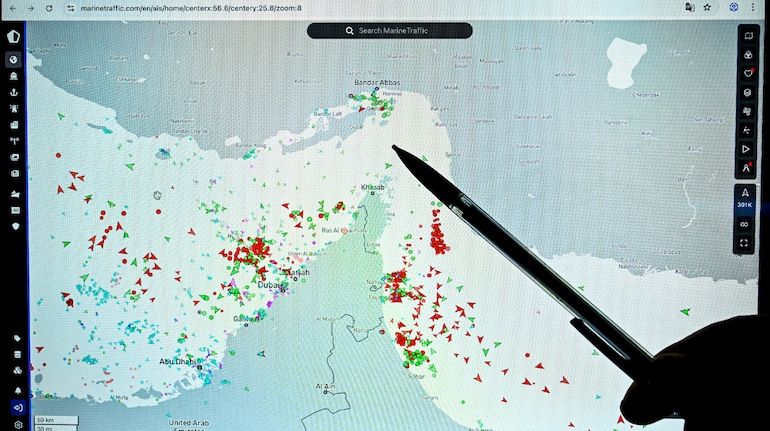

Strait of Hormuz -- the world's most critical oil transit corridor has effectively been sealed shut. Since the US-Israeli war against Iran began on February 28, traffic through the Strait of Hormuz has collapsed by 97%, according to United Nations data -- sending shockwaves through global energy markets and raising the spectre of an economic crisis not seen since the 1970s oil shocks.
Here is all that you need to know about the Strait Of Hormuz and Iran's blockade —
What is the Strait of Hormuz — and where is it?
The Strait of Hormuz is the world's most vital oil transit choke point, connecting the Persian Gulf with the Arabian Sea. It borders Iran in the north and is bound by Oman and the UAE to the south. The strait measures roughly 50km (31 miles) wide at its entrance and exit, narrowing to about 33km at its tightest point. The navigable shipping lanes within the corridor are just two nautical miles wide — a factor that makes the passage particularly difficult to defend, as vessels must execute a turn close to Iranian islands and a mountainous coastline that provides natural cover for Iranian forces. In 2025, approximately 20 million barrels of oil passed through it every day — nearly $600 billion worth of energy trade annually, as per the U.S. Energy Information Administration.
Which countries control the Strait of Hormuz?
Iran sits on the strait's northern coast, while Oman and the UAE lie to the south. Iran holds the dominant strategic position, particularly given that shipping lanes at the narrowest point run through its territorial waters. The U.S. military, meanwhile, has said it has destroyed 16 Iranian mine-laying vessels in the strait since the conflict began.
Who is blocking the Strait of Hormuz?
Iran has effectively closed the strait following the outbreak of hostilities with the U.S. and Israel on February 28. Iran's Revolutionary Guards have warned that any vessel attempting to pass will be fired upon, and at least 11 ships have been attacked since the conflict began. Most remaining traffic has halted — partly out of caution, and partly because insurance premiums have surged by as much as 300%.
Can Iran legally close the Strait of Hormuz?
Under United Nations rules, countries may exercise control over territorial seas within 12 nautical miles of their coastline. At the strait's narrowest point, its shipping lanes fall entirely within Iranian and Omani territorial waters — giving Iran a legal basis to assert control. However, international law also recognises the right of innocent passage, making any outright closure legally contested.
Which countries are being affected by the closure of the Strait of Hormuz?
The impact is near-universal. The strait is the only sea exit for Kuwait, Iran, Iraq, Qatar, and the UAE. Oil from Saudi Arabia also transits the waterway. Beyond energy, about 33% of the world's fertilisers — including sulphur and ammonia — pass through it, according to analytics firm Kpler. India alone sources 55–60% of its liquefied natural gas via the strait. Oil prices have already briefly climbed to their highest level since 2022, and a prolonged disruption risks triggering a cost-of-living crisis comparable to what followed Russia's invasion of Ukraine in 2022.
Has Iran allowed Indian ships to pass through the Strait of Hormuz?
Sources told Moneycontrol that two India-bound tankers carrying a total of 3 million barrels of Iraqi and Arab crude oil transited the Strait of Hormuz between March 5 and 10, with their transponders off. As per data from ship-tracking firm Kpler accessed exclusively by Moneycontrol, one of these tankers was loaded from Al-Basra oil terminal located in southern Iraq while the other from east coast of Saudi Arabia.
Also Read- Two India-bound tankers pass through Strait of Hormuz with tracking switched off: Source
How long does it take ships to traverse the Strait of Hormuz?
Ship-tracking data from Bloomberg, Kpler, and Vortexa show that vessels typically travel at 11 to 13 knots through the strait. At 11 knots, crossing 31 nautical miles takes approximately 2 hours and 49 minutes. In recent months, some vessels have accelerated to 17 knots to clear the waters as quickly as possible — cutting transit time to around 1 hour and 49 minutes.
Are there any alternative routes?
The options are limited and vulnerable. The UAE and Saudi Arabia have invested in oil pipelines designed to bypass the strait, but none are currently operational at sufficient scale. A Houthi militia attack on a key east-west Saudi pipeline in 2019 also demonstrated that overland alternatives carry their own risks. For context, Yemen's Houthis — far less well-armed than Iran — managed to shut down most Red Sea and Bab al-Mandab traffic for over two years despite U.S. and EU naval protection. Most shipping companies diverted to the longer route around the southern tip of Africa (Cape of Good Hope) in response — a detour that would add significant cost and transit time.
Discover the latest Business News, Sensex, and Nifty updates. Obtain Personal Finance insights, tax queries, and expert opinions on Moneycontrol or download the Moneycontrol App to stay updated!
Find the best of Al News in one place, specially curated for you every weekend.
Stay on top of the latest tech trends and biggest startup news.