






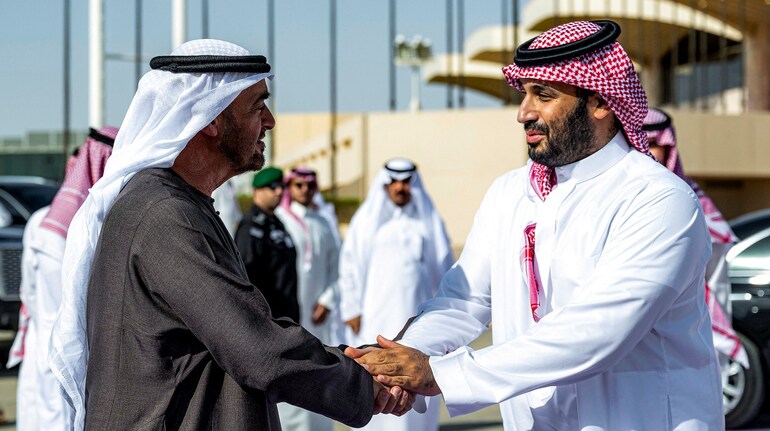

For years, Saudi Arabia and the United Arab Emirates appeared inseparable at the core of Gulf power politics. Their alignment shaped wars, diplomatic crises, and economic strategies across the Middle East. Together, they projected a sense of permanence in a region defined by volatility.
That era is now over.
What once functioned as a tightly coordinated axis has fractured into a quiet but consequential rivalry. The shift was gradual, unfolding through economic competition, diverging security priorities, and clashing regional ambitions. Yemen became the most visible battleground, but the rupture runs far deeper, reshaping alliances, military planning, and the future balance of power in the Gulf.
From alignment to ambition
The Saudi-UAE partnership rested not just on shared interests, but on a personal bond between Saudi Crown Prince Mohammed bin Salman and UAE President Sheikh Mohamed bin Zayed Al Nahyan. In the mid-2010s, MBZ was widely regarded as a mentor figure to the younger Saudi prince. Diplomats at the time described their relationship as a “mentor–protégé" dynamic, with MBZ guiding MBS through Washington, security strategy, and regional statecraft.
Their cooperation peaked between 2015 and 2017. They jointly launched the Yemen intervention against the Iran-backed Houthis, enforced the blockade of Qatar in 2017, and positioned themselves as the region’s most assertive counterweight to political Islam. Their militaries coordinated closely, and their foreign policies moved in lockstep.
This alignment benefited both. Saudi Arabia projected newfound assertiveness under MBS, while the UAE consolidated its reputation as a capable and disciplined regional actor. For a time, their ambitions appeared complementary.
That balance began to shift once MBS consolidated power at home. Vision 2030 signalled Riyadh’s intention to compete directly for global capital, influence, and prestige. At the same time, the UAE expanded its footprint across the Red Sea and the Horn of Africa. Their ambitions increasingly overlapped, and neither side was willing to yield.
The economic rupture
The first open cracks emerged in the economic sphere.
For decades, Dubai had served as the Middle East’s commercial gateway. Multinational firms ran regional operations from the UAE even while Saudi Arabia remained their largest market. Riyadh decided to challenge this model head-on.
In 2021, Saudi Arabia unveiled “Project HQ". Companies were told they must relocate their regional headquarters to Riyadh by January 2024 or lose access to Saudi government contracts. By 2025, more than 600 multinationals had complied.
The move struck at the heart of Dubai’s economic identity. It was not merely a regulatory change, but a declaration of intent. Saudi Arabia was no longer content to coexist with the UAE’s dominance. It wanted to rival it.
A similar challenge followed in aviation. The launch of Riyadh Air in 2025 was widely interpreted as a direct bid to undermine Emirates. Backed by the Public Investment Fund, the airline targeted the long-haul transit market that had made Dubai a global hub. Saudi Arabia was no longer just modernising. It was encroaching on the UAE’s core strengths.
By late 2025, tensions spilled into the open. In a rare off-record briefing in Riyadh, MBS reportedly accused the UAE of betrayal. The personal bond that once defined the partnership had frayed.
Yemen as the fault line
Yemen became the clearest arena where this rivalry turned tangible.
Initially united against the Houthis, Saudi Arabia and the UAE eventually backed rival factions within the anti-Houthi coalition. Riyadh threw its weight behind the Presidential Leadership Council, which supports a unified Yemeni state that could stabilise Saudi Arabia’s southern border and potentially enable an oil pipeline to the Arabian Sea.
The UAE backed the Southern Transitional Council, which seeks autonomy for southern Yemen and control over key ports such as Aden and Mukalla. For Abu Dhabi, maritime dominance and control of shipping lanes near the Bab al-Mandeb are central to its strategic model.
The confrontation peaked in late 2025 when STC forces pushed into Hadramout, Yemen’s oil-rich province bordering Saudi Arabia. Riyadh declared the move a national security threat. Days later, Saudi jets struck a weapons shipment in Mukalla that it said originated from the UAE and was destined for STC forces.
Abu Dhabi denied undermining Saudi interests but quietly withdrew its remaining counter-terrorism units. Saudi-backed forces later reclaimed lost territory. Yemen had become the line of control in a broader rivalry.
Diverging alliances
As tensions with the UAE deepened, Saudi Arabia began building alternative security partnerships.
The most significant was the Saudi-Pakistan defence pact signed in September 2025. Analysts described it as a major strategic alignment, using language that echoed collective defence. While framed as cooperation, it underscored Riyadh’s reliance on Pakistan for manpower and military depth at a time of heightened risk.
Turkey also emerged as a key partner. Relations warmed rapidly after Ankara offered advanced drones with generous technology transfer terms. Saudi Arabia’s acquisition of the Bayraktar Akıncı and plans for local production gave the Kingdom long-range unmanned strike capabilities it previously lacked.
The UAE has taken a different route. Facing demographic limits, it has prioritised technology-driven security.
India has emerged as a central pillar. Agreements signed during MBZ’s January 2026 visit to New Delhi covered cybersecurity, counter-terrorism, and small modular nuclear reactors under the “SHANTI" framework. The UAE has also explored Indian weapons systems, including BrahMos and Akash.
Israel remains another critical partner. Since normalising ties in 2020, the UAE has leveraged Israeli expertise in missile defence, cyber operations, surveillance, and unmanned systems, reinforcing its preference for precision over scale.
Who holds the advantage?
Saudi Arabia holds clear numerical superiority.
It fields around 257,000 active personnel and spends roughly $75 billion annually on defence, compared to the UAE’s 65,000 personnel and $23 billion budget. Saudi ground forces, air power, and missile inventory all outmatch the UAE’s in scale.
The UAE compensates through precision, cyber capabilities, and agile deployments. Saudi Arabia brings mass, depth, and strategic reach.
Economically, the competition is just as sharp. The UAE remains the region’s financial hub, while Saudi Arabia uses Vision 2030 to lure investment and talent. Energy policy has also diverged, with Riyadh favouring tighter oil production and Abu Dhabi pushing to expand output.
Socially, their models differ. The UAE is multicultural and liberal by regional standards. Saudi Arabia is changing rapidly but remains more traditional. These contrasts shape how each projects power.
The bottom line
What was once a unified Gulf axis has transformed into a strategic rivalry playing out across war zones, boardrooms, and alliances. Yemen exposed the fault lines, but the split is rooted in ambition, identity, and competing visions of regional leadership.
The cold war between these former “iron brothers" is unlikely to explode openly. But its slow-burning consequences will redefine Gulf politics for years to come.
Discover the latest Business News, Sensex, and Nifty updates. Obtain Personal Finance insights, tax queries, and expert opinions on Moneycontrol or download the Moneycontrol App to stay updated!
Find the best of Al News in one place, specially curated for you every weekend.
Stay on top of the latest tech trends and biggest startup news.





