
The war in West Asia has pushed global energy markets into one of their most turbulent phases in decades. Since the United States and Israel launched airstrikes on Iran on February 28, tensions across the Persian Gulf have sharply escalated. The conflict has disrupted traffic through the Strait of Hormuz, the narrow maritime corridor that carries a major share of the world’s oil supply.
Nearly 20 million barrels of crude oil move through this passage every day, accounting for about one fifth of global petroleum consumption. With shipping activity severely disrupted, governments, energy companies and international institutions are scrambling to stabilise supplies and prevent a prolonged global energy crisis.
Despite the turbulence, India has so far managed to cushion the immediate impact through regulatory controls and diversified supply strategies.
Hormuz disruption sends oil prices surging
Energy markets reacted swiftly once the conflict began affecting maritime routes in the Persian Gulf. Oil benchmarks surged as traders began pricing in the risk of prolonged supply disruption.
Brent crude crossed the $100 per barrel mark and briefly touched about $119.50 during trading earlier in the week. The US benchmark West Texas Intermediate has also risen sharply, approaching $95 per barrel and nearing the psychological $100 level.
India’s crude basket, which domestic refiners use as a benchmark, has also climbed significantly. It has risen from roughly $69 per barrel in February to around $88 per barrel in March.
More than 200 commercial vessels are currently reported to be waiting outside the Strait of Hormuz amid uncertainty over safe passage.
Iranian officials have also warned that the conflict could trigger even greater price shocks.
“Get ready for oil to be $200 a barrel, because the oil price depends on regional security, which you have destabilised,” Ebrahim Zolfaqari, spokesperson for Iran’s military command, said in remarks directed at Washington.
Zolfaqari also warned that Iran could target financial institutions linked to the United States or Israel and advised civilians across West Asia to remain at least 1,000 metres away from bank buildings.
Governments release emergency oil reserves
In response to the crisis, governments and international institutions have begun activating emergency mechanisms to stabilise fuel markets.
The International Energy Agency approved the release of around 400 million barrels of oil from strategic reserves across member countries. This marks the largest coordinated drawdown of emergency reserves in the agency’s history.
However, analysts note that logistical limitations mean these reserves can only be released gradually. The global system is capable of releasing roughly three million barrels per day.
In the United States, Energy Secretary Chris Wright confirmed that President Donald Trump had authorised the release of 172 million barrels from the Strategic Petroleum Reserve starting next week.
Leaders from the Group of Seven countries also held emergency consultations on managing fuel costs. French President Emmanuel Macron proposed deploying between 20 and 30 per cent of Europe’s emergency oil reserves to stabilise global markets.
Fuel prices rising worldwide
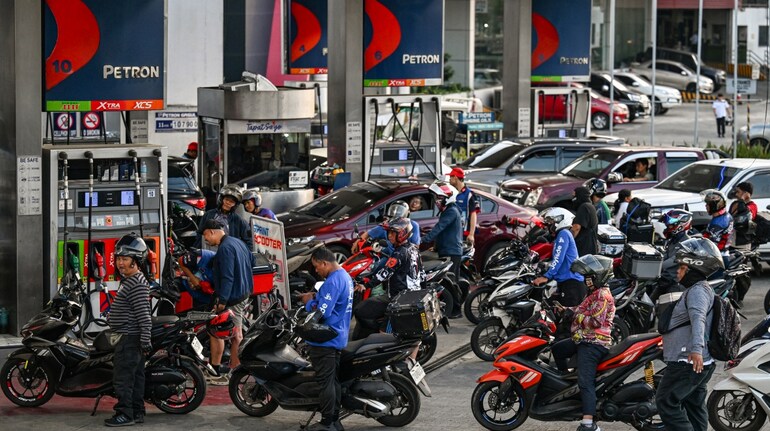
Consumers across multiple regions are already feeling the effects of rising crude prices.
Globally, petrol now averages around $1.35 per litre, while diesel costs about $1.34 per litre.
In the United States, petrol prices have climbed to about $3.58 per gallon from roughly $2.94 previously. Some regions are approaching $3.80 to $4.20 per gallon.
European consumers face even higher prices due to heavy taxation. Petrol in Germany currently costs around $1.92 per litre.
Asian economies have also experienced sharp increases. Vietnam has seen petrol prices jump nearly 50 per cent since late February. Laos recorded a 33 per cent increase while Cambodia saw prices rise about 19 per cent.
According to the energy platform Global Petrol Prices, at least 85 countries have experienced petrol price increases since the conflict began.
India maintains price stability for now
India has managed to shield consumers from the worst of the price surge so far through regulatory controls and fuel pricing policies.
Petrol in Delhi currently costs ₹94.77 per litre, while diesel is priced at ₹87.67 per litre. Prices have remained largely unchanged despite the global oil spike.
However, analysts say Indian oil marketing companies are currently absorbing losses estimated between ₹11 and ₹14 per litre at prevailing crude prices.
In Mumbai, petrol is priced higher at about ₹103.54 per litre due to additional state taxes.
India’s ability to maintain price stability, at least in the short term, reflects both government intervention and diversified supply sourcing.
Asian economies under pressure
Many Asian economies are particularly vulnerable because of their dependence on Gulf energy supplies.
Japan imports about 95 per cent of its oil from Gulf producers. Authorities in Tokyo have instructed storage facilities to prepare for a possible release of strategic reserves.
South Korea, which sources roughly 70 per cent of its oil from the Gulf region, has introduced a temporary price cap on petrol and diesel for the first time in three decades.
South Asian economies are facing even sharper challenges.
Bangladesh has temporarily shut universities as part of energy conservation measures. Pakistan has introduced a four day workweek for government offices and expanded remote work to reduce fuel consumption.
These emergency measures highlight how heavily some economies depend on uninterrupted energy flows through the Persian Gulf.
Natural gas markets also tighten
Natural gas markets have reacted differently across regions depending on domestic production levels.
The US benchmark Henry Hub gas price currently stands at about $3.26 per MMBtu. While this represents a monthly increase of about 13 per cent, the US market remains relatively insulated due to strong domestic production.
Europe and Asia have experienced sharper price increases.
The Dutch Title Transfer Facility benchmark in Europe has climbed to about €49.99 per MMBtu. Asian LNG prices have also surged as buyers scramble to secure cargoes that avoid the Persian Gulf route.
Another disruption has come from the suspension of operations at the Ras Laffan facility in Qatar, the world’s largest LNG export terminal.
Impact on LPG and gas prices in India
Indian households are beginning to see the first signs of the global energy shock.
Oil marketing companies recently raised the price of a 14.2 kg domestic LPG cylinder by ₹60. The retail price now stands at about ₹913 in Delhi and around ₹910.50 in Noida.
Beneficiaries under the Pradhan Mantri Ujjwala Yojana continue to receive a subsidy of ₹300 per cylinder, reducing the effective cost to roughly ₹613.
Commercial LPG cylinders used by restaurants and hotels have also become more expensive. The price of a 19 kg cylinder has increased by ₹114.50.
By contrast, CNG and piped natural gas prices have remained stable so far. CNG costs about ₹77.09 per kilogram in Delhi and ₹85.70 in Noida.
Early signs of consumer impact
In several Indian cities including Delhi, Noida and Lucknow, demand for LPG cylinders has surged as households attempt to secure additional supplies amid fears of shortages.
Some distribution centres have reported delivery delays of three to five days. Booking platforms operated by Indane and Bharat Gas have also faced intermittent technical outages due to heavy demand.
Despite these pressures, India’s regulatory controls, diversified energy sourcing and policy interventions have helped cushion the immediate impact of the global energy shock.
However, economists warn that if the conflict continues and shipping through the Strait of Hormuz remains disrupted, rising fuel costs could gradually push up prices across the broader economy, affecting transportation, food and manufactured goods.
Discover the latest Business News, Sensex, and Nifty updates. Obtain Personal Finance insights, tax queries, and expert opinions on Moneycontrol or download the Moneycontrol App to stay updated!
Find the best of Al News in one place, specially curated for you every weekend.
Stay on top of the latest tech trends and biggest startup news.