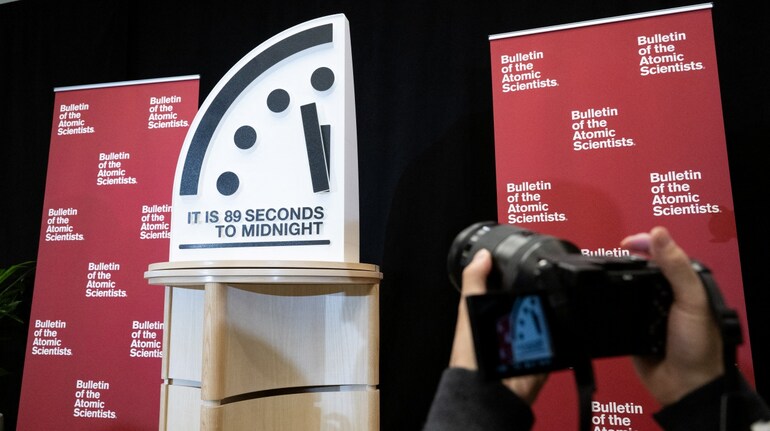

The Doomsday Clock has been moved to 85 seconds to midnight, marking the closest humanity has ever been to self-destruction since the symbol was created nearly 80 years ago. The announcement was made on Tuesday by the Bulletin of the Atomic Scientists.
The clock is a symbolic measure of how near the world is to catastrophe, based on threats such as nuclear war, climate change, emerging technologies and disinformation.
Last year, the clock stood at 89 seconds to midnight. The four-second shift reflects what scientists describe as a worsening global risk environment and a failure by world leaders to reverse dangerous trends.
Why scientists moved the clock
Alexandra Bell, president and chief executive of the Bulletin of the Atomic Scientists, said humanity has failed to act decisively in the face of mounting threats.
“Humanity has not made sufficient progress on the existential risks that endanger us all,” she said.
In a statement accompanying the decision, the Bulletin warned that major powers are becoming increasingly hostile and inward-looking.
Russia, China, the United States and other major countries have “become increasingly aggressive, adversarial and nationalistic,” the statement said.
“Hard-won global understandings are collapsing, accelerating a winner-takes-all great power competition and undermining the international cooperation critical to reducing the risks of nuclear war, climate change, the misuse of biotechnology, the potential threat of artificial intelligence and other apocalyptic dangers.”
Nuclear arms risks in focus
One of the most immediate concerns cited by scientists is the growing risk of a renewed nuclear arms race.
The New START nuclear arms reduction treaty between the United States and Russia is set to expire next week, raising fears that there will be no remaining limits on the world’s two largest nuclear arsenals.
“For the first time in over half a century, there will be nothing preventing a runaway nuclear arms race,” said Daniel Holz, a University of Chicago physicist who chairs the Bulletin’s Science and Security Board.
Holz and other board members also expressed concern over renewed talk of nuclear testing and expanded missile defence systems.
Climate change and political instability
The Bulletin also pointed to record levels of carbon dioxide emissions and weakening global commitment to tackling climate change.
Board members warned that political instability and the erosion of democratic norms further increase the likelihood of conflict.
“History has shown that when governments become unaccountable to their own citizens, conflict and misery follow,” Holz said.
Disinformation as a core threat
Beyond weapons and climate risks, scientists warned that the global information ecosystem itself has become a major danger.
“We are living through an information Armageddon — the crisis beneath all crises — driven by extractive and predatory technology that spreads lies faster than facts and profits from our division,” said Maria Ressa, a Nobel Peace Prize winner and member of the board.
“The men who control the platforms that shape what billions believe have merged with the men who control governments and militaries,” she added.
A brief history of the clock
The Bulletin of the Atomic Scientists was founded in 1945 by figures including Albert Einstein and Robert Oppenheimer. The Doomsday Clock was introduced in 1947, initially set at seven minutes to midnight.
The clock was farthest from danger in 1991, when it stood at 17 minutes to midnight following the end of the Cold War and the signing of a major nuclear arms reduction treaty.
In recent years, however, it has steadily moved closer to midnight. In 2020, it was set at 100 seconds to midnight. It shifted to 90 seconds in 2023 due largely to Russia’s war in Ukraine and remained there in 2024.
Last year, the Bulletin moved the clock forward by one second, citing inaction despite clear warnings.
This year’s move to 85 seconds, scientists say, is a stark signal that the world is edging closer to a point of no return unless urgent corrective action is taken.
Discover the latest Business News, Sensex, and Nifty updates. Obtain Personal Finance insights, tax queries, and expert opinions on Moneycontrol or download the Moneycontrol App to stay updated!
Find the best of Al News in one place, specially curated for you every weekend.
Stay on top of the latest tech trends and biggest startup news.