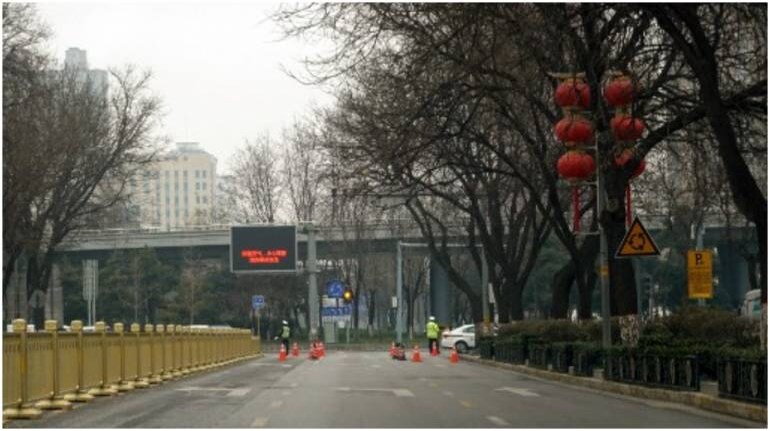
Infectious disease expert Zhang Wenhong has said the current COVID-19 outbreaks across China bring “the most difficult period” for the country since the pandemic first broke out, Global Times reported.
Wenhong, a renowned Shanghai-based expert, made the statement in a Weibo post on March 14.
“This is not the time for China to lie flat and debate over zero-COVID and co-existence; instead, we should take the period as an opportunity to lay out anti-epidemic strategies that are complete, sustainable and with more wisdom,” he stated.
Referring to the rising cases in the Hong Kong Special Administrative Region, Zhang noted that most infections in Hong Kong and the mainland are due to the Omicron BA.2 variant which is “spreading very fast this time”.
Hong Kong is suffering from its fifth yet most deadly wave of the coronavirus pandemic.
Pattern in infectionsNoting the rising pattern, Zhang said his team discovered China kept domestically transmitted cases to below 200 in February, but cases have since risen from 119 to 3,122 between March 1 and 12 (11 days), “despite nationwide active epidemic supervision, prevention and control measures”.
The sporadic rise in cases has caught cities off-guard as many, including Shanghai, battled sporadic outbreaks. Zhang, however, encouraged “pace and confidence” in the prevention and control measures, adding: “Our fights against the virus would last … To clear infections, Shanghai has slowed down. We believe that no matter how fast BA.2 is, we can get it under control as long as we slow down.”
Zhang also noted that the sudden outbreaks have “brought more experiences” and given China an “understanding” of the virus.
He said virologists from the University of Hong Kong “highly agreed” that virulence of COVID-19 has receded and most deaths in Hong Kong are of the elderly or people with chronic conditions.
Vaccines in focus“People with normal immunity and those who have accepted booster shots, no matter what kind of vaccines, will be fine. To not to be afraid is the first step we have to take,” Zhang added.
He also stressed the importance of vaccines, noting that in the Shanghai outbreak over the past six months, only 0.1 percent of the 2,266 infected (94 percent were vaccinated) got serious disease and none was in critical condition or died. He also noted that 90 percent of international travellers to the city are vaccinated and about five percent tested positive.
“This means that vaccination could not prevent breakthrough infections, but has indeed brought the rate of severe illnesses and deaths lower than the flu. Data in Hong Kong also showed that 89.4 percent of patients who died did not receive vaccines or received only one shot. The death rate of people receiving two shots is 0.09 percent while that of those receiving less than two shots is 2.03 percent,” he pointed out.
“It is still not time for China to lie flat. We should have more clearer methods for the future rather than debating over zero-COVID or co-existence. If China reopens quickly at this time, new cases would surge in a short time. The domestic medical system would be overloaded and the society grind to a halt, causing irreparable damages,” Zhang explained.
Preparations important“The recent situation has shown that the Chinese society is not ready to face a large number of cases neither psychologically nor in terms of social resource allocation. Thus, it is very vital for China to continue the zero-COVID strategy to put the Omicron epidemic at a very low level, but it does not mean that we should constantly lock down cities and conduct mass testing,” Zhang added.
He emphasised making preparations for better vaccines, booster shots, drug availability, cheaper kits, home quarantine procedures and medical preparations.
“This time the epidemic came out suddenly, but it is just a cold snap. When we have a clear picture for the future and the upcoming spring, we will have nothing to be afraid of,” Zhang added.
Status quoOn March 13, China placed all 17 million residents of Shenzen under lockdown, as virus cases doubled nationwide to nearly 3,400. All residents were to stay at home as the city struggles to eradicate an Omicron flare-up linked to neighbouring virus-ravaged Hong Kong.
The lockdown and a suspension of public transport will last until March 20, a city government notice said, adding that it would launch three rounds of mass testing. The move extends an earlier lockdown imposed on the city's central business district.
The southern tech hub of Shenzhen reported 66 infections on Sunday — a fraction of the 32,430 confirmed the same day in Hong Kong.
"If prevention and control are not strengthened in a timely and decisive manner, it could easily become large-scale community transmission," Shenzhen health official Lin Hancheng said at a briefing.
The surge in infections across China has also prompted authorities to close schools in Shanghai and lock down multiple north-eastern cities, as 18 provinces battle clusters of the Omicron and Delta variants.
China, where the virus was first detected in late 2019, has maintained a strict zero-COVID policy with swift lockdowns, travel restrictions and mass testing when clusters have emerged. But the latest flare-up, driven by the highly transmissible Omicron variant and a spike in asymptomatic cases, is testing that approach.
Shanghai has so far been spared a citywide order to stay home, but individual housing compounds were being locked down as the megacity ramped up efforts to contain infections and test suspected close contacts.
Jilin — the city at the centre of the outbreak in the northeast — was partially locked down on March 12, while residents of Yanji, an urban area of nearly 700,000 bordering North Korea, were also confined to their homes on March 13.
Discover the latest Business News, Sensex, and Nifty updates. Obtain Personal Finance insights, tax queries, and expert opinions on Moneycontrol or download the Moneycontrol App to stay updated!
Find the best of Al News in one place, specially curated for you every weekend.
Stay on top of the latest tech trends and biggest startup news.