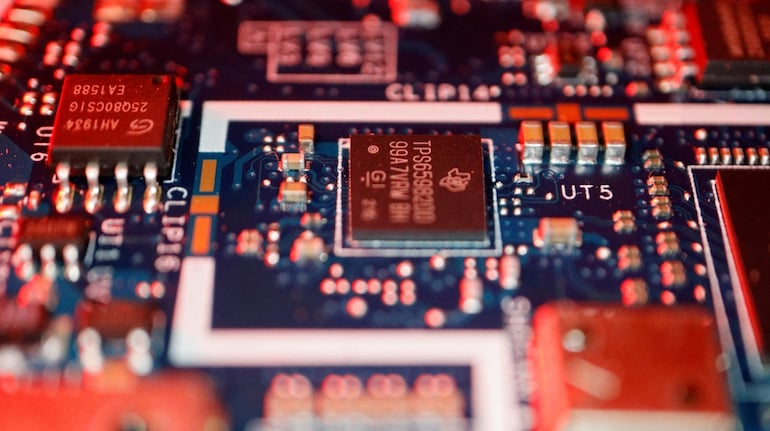
For years, China’s ambition to become self-sufficient in advanced semiconductor manufacturing was treated as a long-term goal with little chance of near-term success. The United States and its allies believed they had locked China out of the most critical technology needed to build cutting-edge chips. That confidence is now under strain.
A Reuters report has revealed that Chinese scientists have built a crude but operational prototype of an extreme ultraviolet lithography machine inside a high-security facility in Shenzhen. The machine has not yet produced working chips, but it is already generating EUV light, a milestone many experts believed China was still a decade away from achieving.
The revelation has surprised analysts and raised uncomfortable questions in Washington and allied capitals about whether the West’s most powerful technology blockade is beginning to crack.
Why EUV machines sit at the heart of global chip power
Extreme ultraviolet lithography machines are essential for making the world’s most advanced semiconductors. They use highly focused beams of EUV light to carve circuits that are only a few nanometres wide onto silicon wafers.
These machines are among the most complex ever built. Each one weighs about 180 tonnes, costs roughly 250 million dollars, and relies on ultra-precise mirrors capable of reflecting EUV light without distortion. Even microscopic flaws can destroy an entire chip.
Until now, only one company has mastered this technology. ASML of the Netherlands spent nearly two decades and billions of euros developing EUV systems before bringing them to market in 2019.
Because of their strategic importance, the United States persuaded the Dutch government to block EUV exports to China from 2018. The restrictions later expanded to older lithography tools, with the goal of keeping China at least one generation behind in chip manufacturing.
As recently as April, ASML chief executive Christophe Fouquet said China would need “many, many years” to develop EUV technology.
What China has built inside Shenzhen
According to Reuters, China’s prototype EUV machine occupies almost an entire factory floor inside a heavily guarded compound in Shenzhen. It is far larger and less refined than ASML’s commercial systems, and it cannot yet produce usable chips.
What makes it significant is that it works.
The machine has successfully generated EUV light, widely regarded as the hardest technical hurdle in EUV engineering. This alone places China closer to EUV capability than most analysts thought possible under current export controls.
Reuters reports that Chinese officials involved in the project have begun calling it China’s own “Manhattan Project”.
Why China compares it to the Manhattan Project
The original Manhattan Project was the United States’ secret wartime effort to build the atomic bomb during the Second World War. It pooled the nation’s top scientific talent, vast funding, and industrial resources under extreme secrecy, and permanently reshaped global power.
The comparison, according to Reuters, is deliberate.
China’s EUV effort is described as a centrally directed national programme involving thousands of scientists and engineers across universities, state laboratories, and major companies including Huawei. Oversight reportedly comes from Ding Xuexiang, a close ally of President Xi Jinping and head of the Central Science and Technology Commission.
Like the Manhattan Project, secrecy is absolute. Engineers reportedly work under aliases, live on site during the week, and operate in isolated teams that do not know the full scope of the project.
For Beijing, the stakes are strategic. Control over advanced chips underpins artificial intelligence, military systems, quantum computing, and economic power. Semiconductor self reliance is framed as an issue of national sovereignty, not just commercial success.
How China bypassed the West’s chokepoint
Reuters outlines several ways China managed to build the prototype despite strict export controls.
Former ASML engineers, many originally from China and recently retired, were recruited with large bonuses and asked to work under false identities. Some reportedly recognised former colleagues inside the facility but were required to use aliases.
China also acquired second hand ASML equipment and components through legal secondary markets and auctions. These parts helped engineers reverse engineer key subsystems.
In parallel, Chinese firms sourced components from ASML suppliers through intermediary companies. Reuters reports that export restricted parts from Japanese manufacturers Nikon and Canon were integrated into the prototype, exposing gaps in global enforcement.
State backed research institutes played a crucial role. The Changchun Institute of Optics, Fine Mechanics and Physics helped integrate EUV light into the system and reportedly offered “uncapped” salaries and exceptionally large research grants to specialists.
Huawei acted as a central coordinator across the effort. Reuters notes that employees sleep on site under tight communication controls, and that chief executive Ren Zhengfei personally briefs senior Chinese leaders on progress.
Why this changes the strategic equation
China’s prototype does not mean it has matched ASML or achieved immediate parity with the West. The system remains crude, oversized, and lacks the ultra precision optics produced by Germany’s Carl Zeiss AG.
But even this limited success carries serious implications.
It sharply compresses China’s timeline. While ASML suggested EUV capability was many years away, Chinese planners are now targeting functional chips by around 2028, although people familiar with the project believe 2030 is more realistic.
It weakens the West’s strongest pressure point. EUV export controls were considered the most effective way to constrain China’s progress in advanced computing and military technology. A domestic alternative reduces that leverage.
It accelerates the global split in technology supply chains. As China builds parallel systems, the world edges closer to two separate semiconductor ecosystems, one led by the West and one by China.
It highlights a growing vulnerability in talent control. Machines can be restricted, but people cannot be embargoed as easily. The recruitment of experienced engineers may prove harder to stop than hardware transfers.
How far China still has to go
Despite the breakthrough, China remains behind ASML in almost every dimension. Commercial EUV systems are far more compact, reliable, and precise. China still lacks access to the highest quality optics and manufacturing tolerances.
But analysts told Reuters that China does not need to invent EUV from scratch. Existing systems provide a roadmap, making the challenge one of engineering refinement rather than conceptual discovery.
The most important shift may be psychological. China has moved from a position where EUV was seen as unreachable to one where it appears achievable with time.
Discover the latest Business News, Sensex, and Nifty updates. Obtain Personal Finance insights, tax queries, and expert opinions on Moneycontrol or download the Moneycontrol App to stay updated!
Find the best of Al News in one place, specially curated for you every weekend.
Stay on top of the latest tech trends and biggest startup news.